

Why We Can't Fix a Broken Life by Changing the Scenery
Why true transformation requires breaking down your old identity instead of just swapping your job, your relationship, or your scenery.


When a strange, hollow feeling creeps in on a Tuesday morning, our default cultural instinct is to look at the external landscape. We assume the problem is the job title, the relationship status, or the city skyline outside the window. So, we change the scenery. We pack up our lives, sign a new contract, sit at a different desk under different fluorescent lights, and wonder why the exact same internal dread shows up three months later.
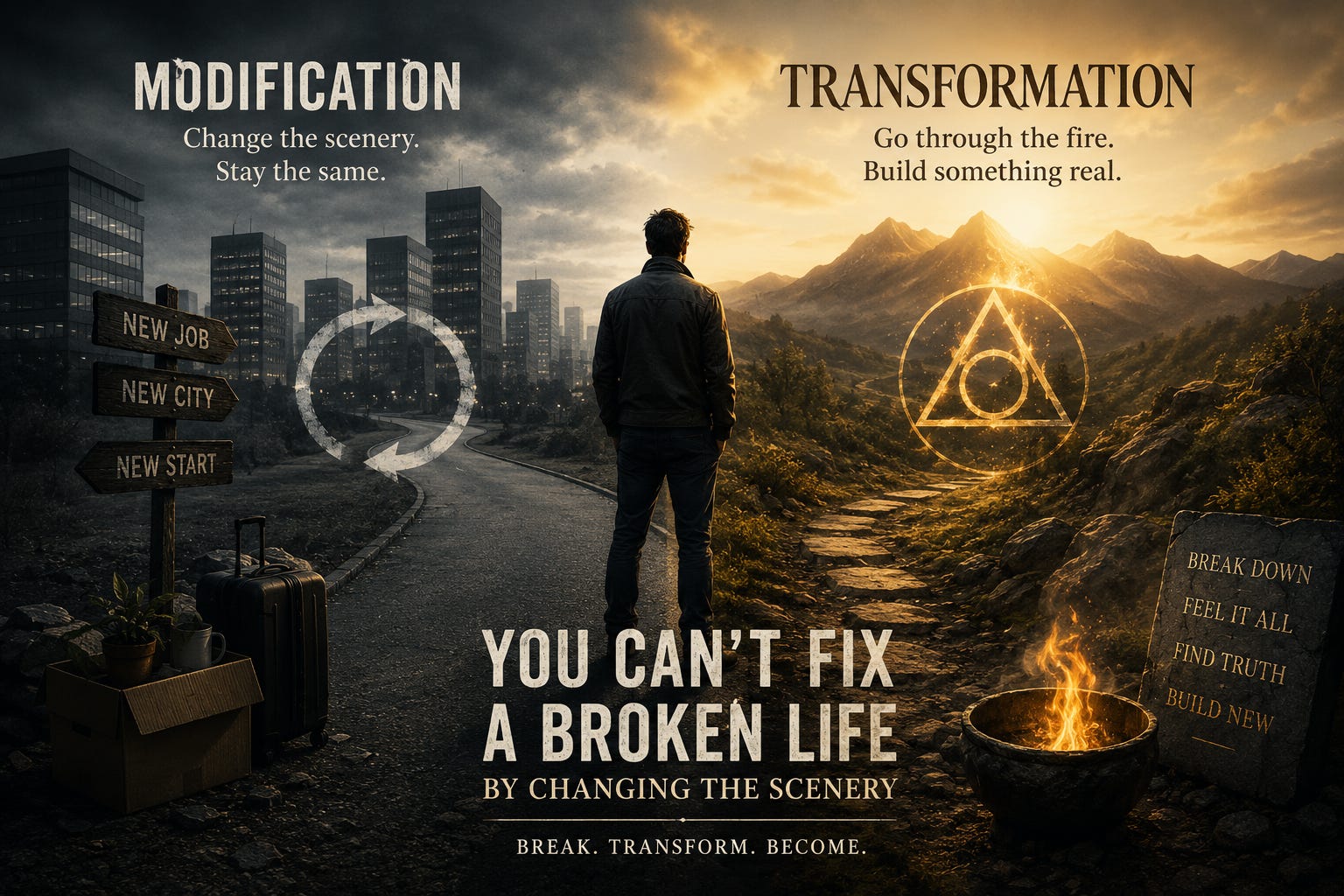
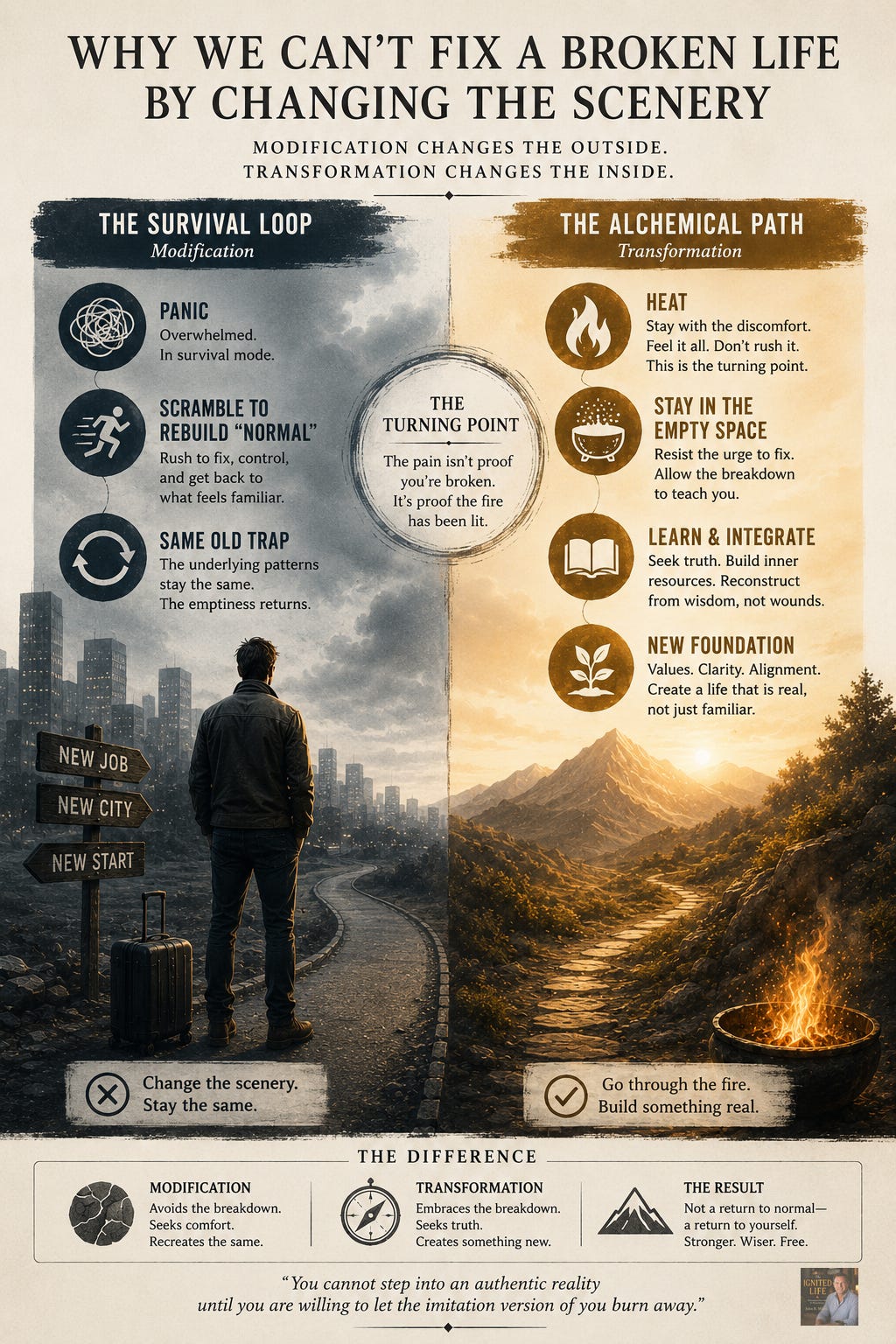
This is modification. It is the exhausting process of altering the external layout of your life while keeping the internal machinery entirely intact.
We live in a culture that treats personal transformation like a linear math equation. We collect productivity metrics, download optimization apps, and treat ourselves like a piece of software that simply needs a quick patch. If we are anxious, we tinker with our morning routine; if we are unfulfilled, we swap one high-stress corporate track for another, carrying our default baggage into a nicer office building.
“The authentic self is not found. It is revealed after the false self burns away.”—John R. Miles
But true human evolution requires a far more radical surrender. The ancient concept of alchemy offers a stark warning to this modern fixation on quick fixes.
The medieval alchemists were not eccentric blacksmiths looking for a shortcut to wealth; the true practitioners understood that alchemy was a profound metaphor for the soul. They recognized that you cannot create gold by simply painting over a block of lead or polishing its surface until it reflects the light. You cannot organize your way out of a foundational crisis.
The raw material has to be broken down entirely. It must be subjected to intense heat, dissolved in the dark, and forced through a painful process of structural collapse until its original form completely surrenders.
The Castles of Our Isolation
Most of us resist this breakdown because it feels indistinguishable from total destruction. When a long-term relationship dissolves, a career falls out from beneath us, or an unexpected loss levels our daily structure, our immediate somatic response is panic.
We treat the empty space as a crime scene rather than a crucible.
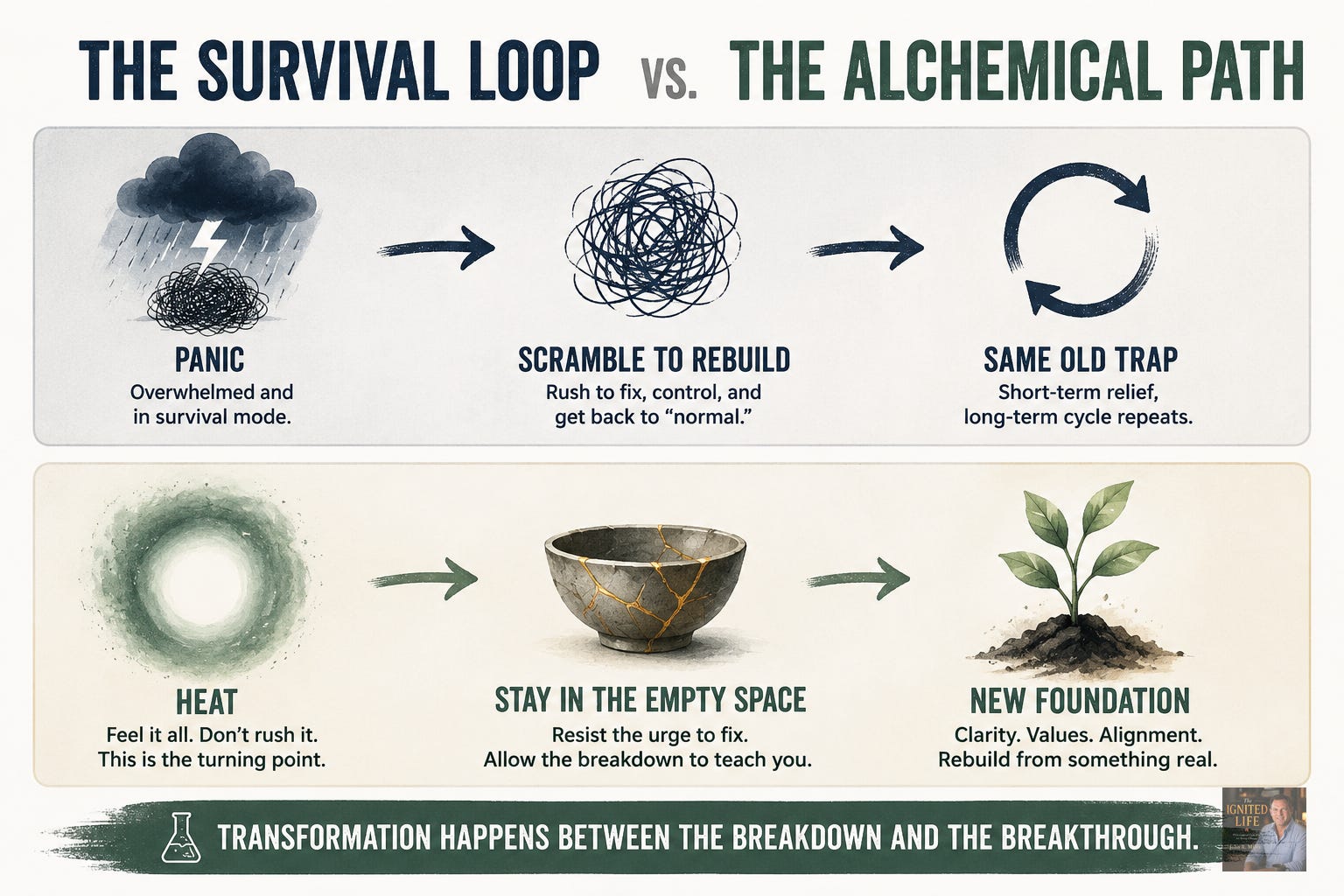
We scramble to gather the scattered pieces and rebuild the old house as quickly as possible, desperate for addition without the agony of subtraction. We ask how to get back to normal, entirely forgetting that “normal” was the precise environment that created our baseline vulnerability in the first place.
The friction you experience during a major life crisis is not proof that your journey has been derailed. It is the sign that the fire has finally been lit. The discomfort is the precise psychological heat required to separate your true self from the social conditioning, the performative expectations, and the survival personas you have spent a lifetime confusing with your actual personality.
You cannot step into an authentic reality until you are willing to let the imitation version of you burn away in the forge.
Chained to the Ghost of a Past Identity
We see this exact psychological battlefield play out with devastating clarity in Alexandre Dumas’s classic masterpiece, The Count of Monte Cristo. When the story begins, Edmond Dantès is a young man of pure, uncomplicated innocence. His future is a straight line of predictable happiness—he is about to become a ship’s captain and marry the woman he loves.
Then, through a conspiracy of jealousy and malice, his life is instantly stripped away. He is thrown into the dungeon of the Château d’If, an isolated stone fortress surrounded by the unforgiving waters of the Mediterranean.
For years, Dantès has lived in absolute darkness. His initial response is completely human: he rails against the stone walls, begs the jailers for a trial, and spends his nights weeping for the life that was stolen from him. He is trying to maintain the identity of the innocent sailor while chained to the floor of a prison cell. He is trapped in the paralyzing illusion that his real life is merely on pause.
True endurance only begins when Dantès finally accepts the brutal finality of his reality.
He meets the Abbé Faria, a brilliant, elderly prisoner who has spent decades digging a tunnel through the hidden spine of the fortress. Faria doesn’t offer Dantès a cheap, superficial message of positivity. Instead, he offers him an education.
Together, in the damp dark, they turn a prison cell into a university. Faria teaches him history, mathematics, philosophy, and languages, helping Dantès map out the hidden mechanics of the world that chewed him up and spat him out.
“Modification is the exhausting process of altering the external layout of your life while keeping the internal machinery entirely intact. You cannot organize your way out of a foundational crisis.”—John R. Miles
This is the internal pivot that happens when we stop treating our profound struggles as an interruption to our real lives. The dungeon changes from a place of passive suffering into an alchemical chamber.
Dantès is no longer the naive boy who entered the prison, but he is not yet the Count. He is standing in the uncomfortable space of dissolution—the quiet void where the old self has thoroughly died, but the new foundation has not yet emerged into the light.

The Trap of Weaponized Suffering
The great danger of any transformative fire is that intense heat can either refine a substance or turn it into useless slag. When Dantès eventually escapes the Château d’If and uncovers the vast treasure of Monte Cristo, he possesses a level of wealth, knowledge, and strategic power that makes him almost godlike.
He steps back into society with a flawless, glittering exterior. He is perfectly composed, highly educated, and capable of manipulating the entire French aristocracy like chess pieces. To the casual observer, he is the ultimate success story.
“The transformation begins the moment you stop treating your struggle as an unexpected interruption to your real life, and start recognizing it as the exact location where your life is being refined.”—John R. Miles
But a closer look reveals a fragile architecture. The Count has built his new identity as a massive, elaborate campaign of retribution. He has transformed his raw pain into an engineered weapon, using his brilliance to methodically dismantle the lives of the men who ruined him.
In his desperate quest to become the instrument of divine justice, he has closed himself off from the capacity to feel joy, tenderness, or genuine human connection.
This is the subtle trap of confusing control with freedom.
Dantès thinks he is entirely free because he is no longer behind the stone walls of the Château d’If, but his entire mind is still organized around the ghost of his injury. He has modified his circumstances from a victim in a cell to a master in a palace, but the internal engine of his life is still fueled by the toxic sediment of his past. He has not transmuted his suffering; he has simply given it a magnificent upgrade.
The true breakthrough of the narrative doesn’t happen when his enemies are ruined. It happens at the very end, when the Count looks at the wreckage of his own making and realizes his obsession with justice has almost cost the lives of the innocent people he actually cares about.
The protective identity collapses. He is forced to confront the raw grief he had been successfully avoiding through his constant, calculated movement.
It is only when he drops the need to dictate the outcome, forgives his past, and steps away from the identity of the avenger that he can finally sail away into an unknown future. The final lines of his famous letter sum up the entire journey of human recalibration: all human wisdom is contained in these two words—wait and hope.
Bending Without Breaking
When we look at the difference between a life that is merely functional and one that is truly generative, we are considering our capacity to tolerate the presence of our history without letting it dictate our future.
Real strength is not the ability to look back at your greatest tragedies and say, “That didn’t affect me.” That is not resilience; that is numbness wearing the costume of discipline.
True transformation means looking directly at the scars, the betrayals, and the seasons spent in your own personal dungeons, and finding a way to integrate those experiences into a deeper capacity for perspective and service.
“We change the scenery, sit at a different desk under different fluorescent lights, and wonder why the exact same internal dread shows up three months later.”—John R. Miles
Consider the physical properties of gold. It is one of the most malleable elements on earth. You can hammer it into sheets so thin they become translucent, or melt it down and reshape it repeatedly. It does not protect itself from the world by becoming rigid; it survives through its capacity to bend without fracturing.
This is the emotional flexibility we are trying to cultivate. When you go through the alchemical fire of adversity, the goal is not to emerge as a hardened, invulnerable version of yourself who can never be hurt again. The goal is to develop the internal space to hold both your pain and your possibility simultaneously.
Standing in the Forge
The truth about your past is that it cannot be rewritten, it cannot be optimized, and it cannot be managed out of existence through sheer force of will. The raw material of what you have lived through—the seasons of isolation, the sudden collapses, and the long nights spent inside your own versions of the Château d’If—is the only substance you have to work with. You cannot trade your life in for a different model.
But you can decide what that material is going to mean.
You can continue to polish the outside of your iron armor, pretending that your rigidity is discipline and your emotional distance is strength. Or you can finally allow the heat of your current transition to melt those old defense mechanisms, freeing up the energy needed to build an internal architecture that is genuinely open, grounded, and alive.
The transformation begins the moment you stop treating your struggle as an unexpected interruption to your real life, and start recognizing it as the exact location where your life is being refined. The fire is not there to destroy you. It is there to show you what survives when everything else is burned away.
[Read the FREE Companion Guide & Digital Workbook for this post.]
What about you?
Have you ever found yourself trying to fix an internal crisis by simply changing your external scenery? How do you recognize the difference between genuinely transforming your life and merely modifying your circumstances?
Drop a comment below. If this perspective resonated, share it with someone who is currently navigating their own long night in the dark—it might just help them see the fire as a forge instead of an end.
Blake Mycoskie and Eric Zimmer are past guests on Passion Struck. Listen to the full episode 771, "Alchemic Transformation," to explore the mechanics of navigating life transitions, breaking default thought patterns, and cultivating deep somatic resilience under pressure.
Thoughts? Let me know below this essay!
Every 🧡, restack, or comment you share here on Substack
is like a signal flare…..
It helps this message find the person who is still walking
their own “schoolyard” alone.
Thank you for being part of this ecosystem.
I love turning these essays into a two-way conversation
So please let me know your thoughts below.
© John R. Miles 2026. All rights reserved.
This is remarkable. Every word. It is what I’m experiencing intensely right now. I appreciate a perspective that will take me beyond survival to a better existence.