

The Person You Were Before the Pain Is Not Coming Back
Why Amy Purdy Believes Resilience Is About Reinvention, Not Recovery


The hardest part of trauma is not always the pain itself. It is the slow realization that the person you were before it happened is gone — not temporarily, but permanently.
For a long time, many of us have understood resilience as the ability to bounce back. We imagine that after the diagnosis, the divorce, the betrayal, the loss, or the collapse, we will eventually return to the version of ourselves that existed before. We treat recovery as a return trip to a familiar place.
But what if that place no longer exists? What if the real task of adversity is not recovery, but reinvention?
This week in Passion Struck EP 769, I spoke with Amy Purdy about exactly that question. Amy’s story is remarkable on the surface. At nineteen, she contracted meningococcal meningitis. She lost both legs below the knee, experienced kidney failure, and was given a two percent chance of survival. Yet the deeper story is not primarily about what her body endured. It is about what happened to her sense of identity.
Trauma not only changes the body. It changes the story we tell ourselves about who we are and what our life is supposed to be. And for many people, that rupture in identity becomes the most difficult part of the experience.
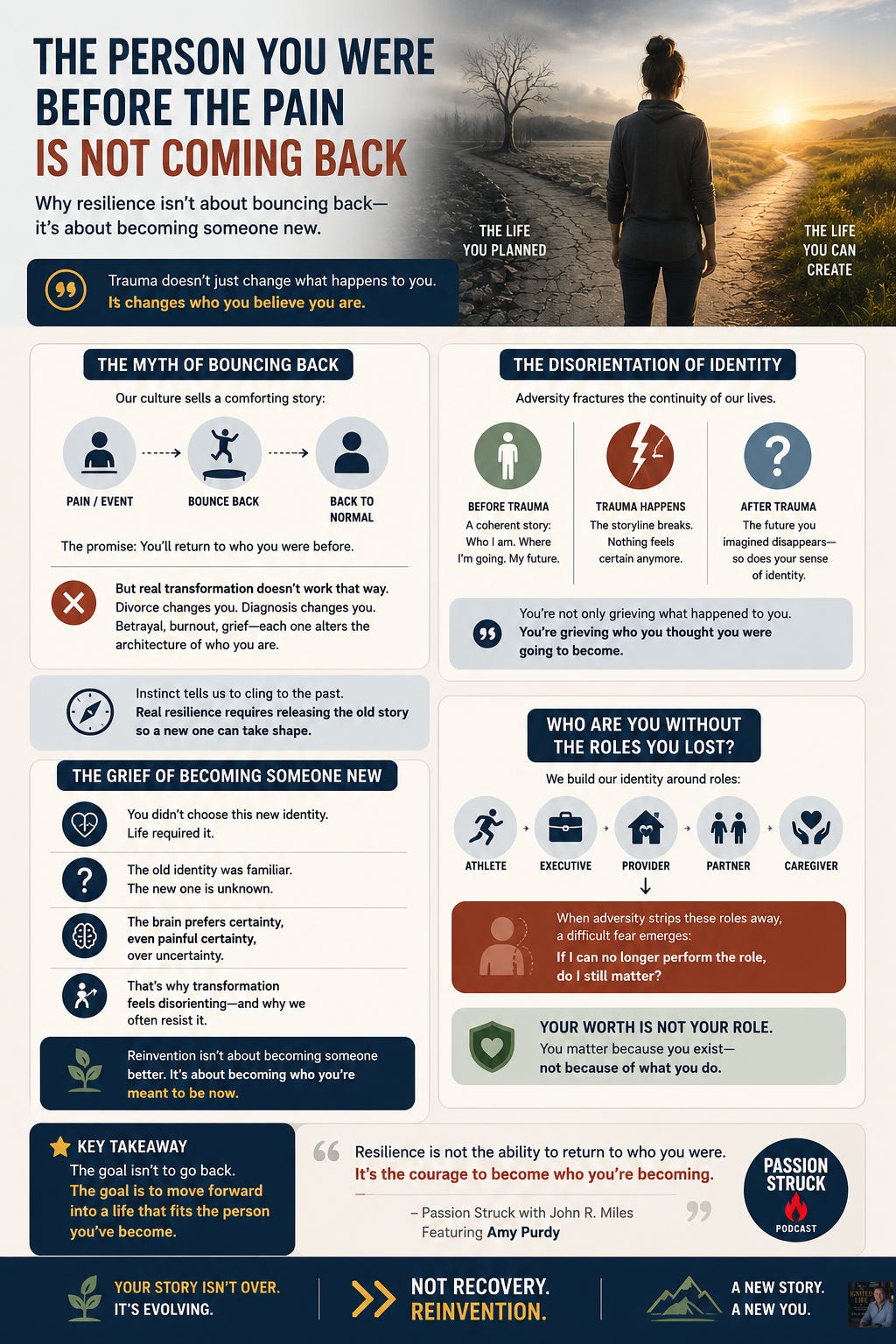
The Myth of Bouncing Back
Our culture celebrates comeback stories because they offer reassurance. They suggest that suffering is temporary and that life can eventually return to normal. The phrase “bounce back” carries an implicit promise: you will regain the life you had before.
But transformation after significant adversity rarely works that way. The divorce changes you. The diagnosis changes you. The betrayal, the burnout, the grief — each one alters the architecture of who you are. Much of the suffering that follows comes not from the event itself, but from the prolonged effort to resurrect an identity that no longer fits the person you have become.
Amy Purdy speaks about “bouncing forward” rather than bouncing back — a philosophy she had to put to the test a second time when a massive vascular crisis in 2019 threatened her mobility all over again. That distinction is important.
Resilience, in her experience, is not about recovering the old self. It is about discovering who you are capable of becoming after the old self is gone.
The Disorientation of Identity After Trauma
One of the most destabilizing aspects of adversity is how it fractures the continuity of our lives. Before the trauma, most people live with a relatively coherent narrative: this is who I am, this is where I am going, this is how my future will unfold. Then something happens that breaks the storyline.
When the future you imagined disappears, your sense of identity often disappears with it. People are not only grieving what happened to them. They are grieving for who they thought they were going to become.
Amy described the period after her illness as one filled with profound uncertainty — not just about survival or physical capability, but about meaning, purpose, and belonging. The question she kept returning to was simple and enormous at the same time: Who are you when the life you planned no longer exists?
That question sits beneath nearly every major life transition. And for many people, the instinctive response is to cling more tightly to the past. Yet real resilience often requires the opposite: the willingness to release the old story so a new one can take shape.
The Grief of Becoming Someone New
There is a form of grief that receives far less attention than it deserves: the grief of becoming someone else, not because you chose to, but because life required it. Reinvention after adversity can sound empowering in hindsight. In the middle of it, it often feels disorienting and frightening.
The old identity, even when it was limiting, was at least familiar. The new one is unknown. And the human brain tends to prefer certainty, even painful certainty, over uncertainty. This tension explains why so many people unconsciously resist the transformation that adversity is asking of them.
Amy’s journey as an adaptive athlete illustrates what becomes possible when someone stops measuring their life against what was lost and begins building meaning around what remains possible. That shift does not eliminate grief or pain. It simply allows suffering to become part of the story rather than the end of it.
Resilience as Adaptation
One of the most insightful parts of our conversation was exploring what Amy calls the Paralympian mindset. Many elite athletes are trained to dominate. Adaptive athletes often learn adaptation first. That process demands emotional flexibility, creativity, humility, persistence, and a different relationship with failure.
Resilience, Amy observed, is rarely a single breakthrough moment. It is a series of small decisions to keep moving forward despite uncertainty, fear, grief, and frustration. Her simple but powerful insight was this: “As long as you’re moving forward, you’re moving forward.” Not perfectly. Not quickly. Just forward.

Who Are You Without the Roles You Lost?
This conversation kept returning me to a larger question at the heart of my own work: What happens to our sense of mattering when the identities we built our lives around are taken away?
Many people derive their deepest sense of significance from roles — athlete, executive, provider, partner, caretaker, high performer. Adversity has a way of stripping those roles away. When that happens, people often confront a difficult fear: If I can no longer perform the role, do I still matter?
Amy’s story offers a clear and important reminder. Your worth cannot depend entirely on the version of you that existed before the pain. Life guarantees change. Capabilities change. Roles change. But mattering must rest on something deeper than utility.
Final Thought
Perhaps we have misunderstood resilience all along. Maybe it is not the ability to return to who you once were. Maybe it is the courage to stop clinging to an expired identity long enough to discover who you are becoming.
The old version of you may not survive every chapter. But that does not mean your life is over. It may simply mean your life is asking for reinvention.
I encourage you to listen to the full conversation with Amy Purdy on Passion Struck and explore her book Bounce Forward.
Read the FREE Companion Guide & Digital Workbook for this post.
Amy’s perspective on identity after trauma, emotional resilience, and the power of moving forward offers something far more useful than inspiration. It offers honest companionship for anyone navigating the difficult terrain between what was and what can still be.
Thoughts? Let me know below this essay!
Every 🧡, restack, or comment you share here on Substack
is like a signal flare…..
It helps this message find the person who is still walking
their own “schoolyard” alone.
Thank you for being part of this ecosystem.
I love turning these essays into a two-way conversation
So please let me know your thoughts below.
© John R. Miles 2026. All rights reserved.
This is my current story exactly. The day I was forced to stop practicing dentistry due to a medical condition, I cried for hours. Not only because I loved the work, but because I suddenly could not separate who I was from what I could no longer do. Almost 1 year later I am rebuilding a new version of myself. This time it is on my own terms, intentional, following what makes me feel alive and not just safe. I still grieve my past identity and my career, but now I am allowing space for art, creativity, slowness, presence and listening to my body for the first time in 20 years since starting that path.
Intriguing and enlightening
On April 30, 2026, I was a multiple. On May 1, 2026 I stopped being a multiple. I became a multiple at 5 months old. Nobody, including me, understood why I was struggling so hard; or why at times I seemed “very normal”, and at other times I was a mystery. Why didn’t I make any sense? Why didn’t my world make any sense?
In the fall of 1989, I was diagnosed with Multiple Personality Disorder (now called Dissociative Identity Disorder). Finally I found someone who understood me! Finally I could heal. For the next 30+ years I worked very hard to heal. It was hard, and scary, and had major unexpected turns in the road. My identity was in being a multiple, and I never imagined I would ever stop being a multiple. Nobody ever expected that total integration was possible!
During the first week of May, I cried out to God, “Has anybody ever been through what I’m experiencing?” My whole self and my entire world shifted into uncharted territory. It was a miracle! And at the same time it was devastating. These were people who walked every step of my life with me. I knew their faces, their voices, their personalities. They helped me raise my children; and I experienced the little ones inside growing up.
Yes, it’s true that they aren’t gone, they are now part of me; but I won’t ever see them again or hear their voices. It’s lonely being just one; and a quiet in my head that I never imagined could exist.
The image of Noah and his family getting off the ark came to mind. The world they had known and experienced their whole lives was gone, and the world they faced was completely foreign and mysterious to them. They didn’t know how they would function, what they would do, or where to begin.
But then I noticed the rainbow. It stretched over them like a canopy, reminding them that God was still with them, watching over them, guiding every step.
A comforting reassurance enveloped me, and a courage to discover how this new world of being “just one” would unfold.
It hasn’t been one month yet, and I’m still discovering the huge impact this is having on my mind and body. I’ve been in the emergency room because my doctor thought I was going into liver failure (which wasn’t the case, but the tests they ran revealed some extremely out of balance values and a UTI). I had migraines every day (thankfully it’s been two days since the last one now). My digestive system almost came to a standstill. My sleep experience was disrupted. I became progressively more fatigued and had increasingly challenging difficulties thinking clearly and organizing my thoughts.
Then I learned that when I was trying to straighten out my days and nights, I was actually causing more stress and exhaustion instead of fixing anything. I learned that I had to prioritize sleep whenever I was able to, and for as long as I needed to. (Thank you for your guidance 😊.) I’ve been doing that for about a week now, and some level of stability is returning. I’ve also added some new foods to my diet to help my body function better, because I learned about the impact of stress on my digestive system.
Who will I be tomorrow? Who am I becoming in the future? I’m acutely aware that there is no previous me to return to. There never was. I think that I’ve been bouncing forward for decades, but nobody gave me a definition for it. Now I’m bouncing into a totally new identity! Amazing!!
I know that whoever I become, it will be good.