

What Comes After the Achievement
Blake Mycoskie on depression, enoughness, and rebuilding identity after donating 100 million shoes

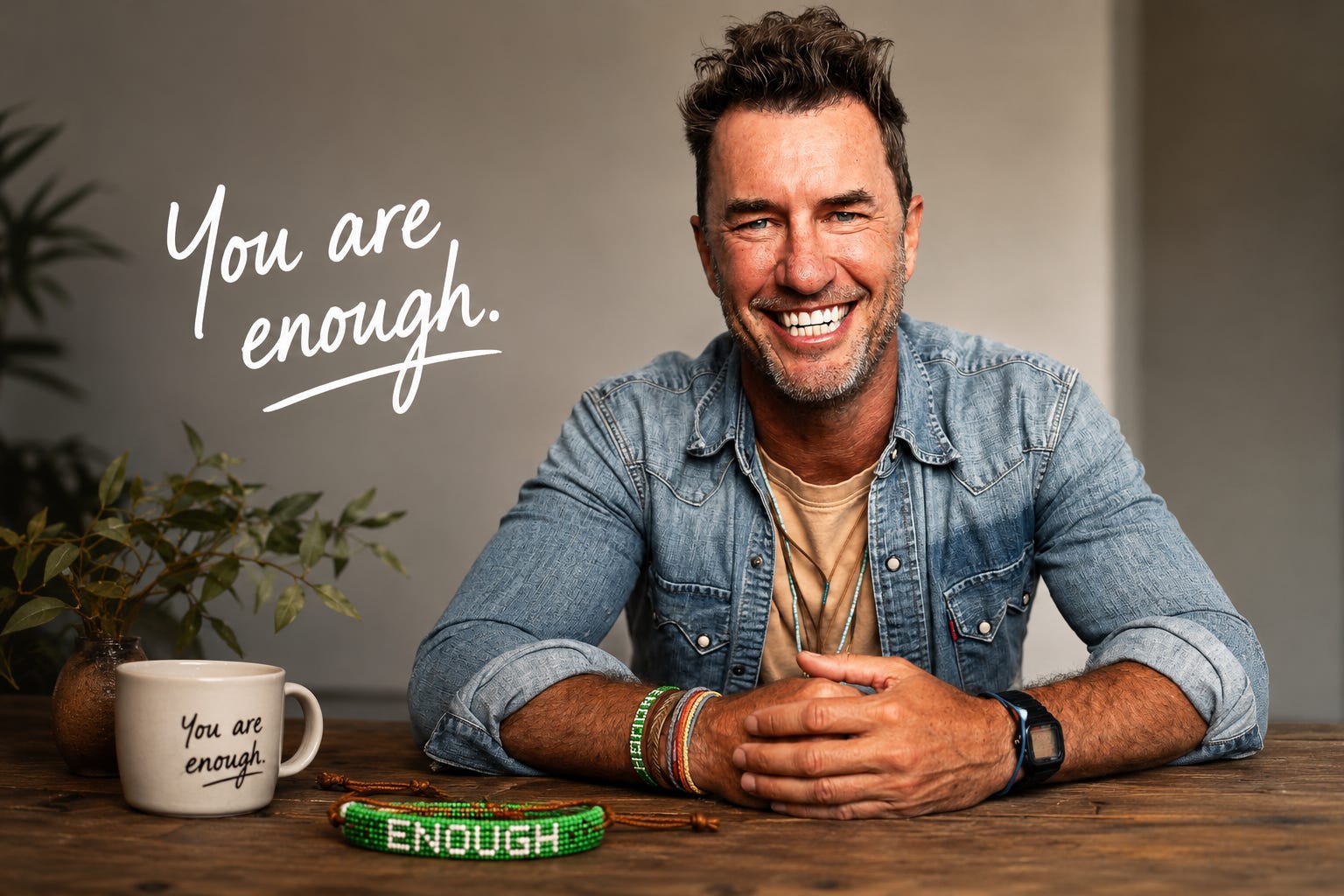
When most people hear Blake Mycoskie’s story, they think of impact, innovation, and success. The young entrepreneur who turned a trip to Argentina into a movement that gave away over 100 million pairs of shoes. Financial freedom. Global recognition. A beautiful family.
From the outside, it looked like the ultimate arrival.
But as Blake revealed on my podcast Passion Struck, the reality was far more painful. After selling TOMS, he was left confronting a truth many high-achievers know too well: massive external success does not heal an internal wound.
The Hidden Trap of a Performance-Driven Scoreboard Identity
Blake traces much of the pattern back to competitive tennis. At fifteen, he moved away from home to train at the John Newcomb Academy in Texas. His days revolved around rankings, repetition, pressure, and performance.
What struck me was that he didn’t describe this as something imposed on him by demanding parents. The pressure came from within. Over time, performance became the structure through which he learned to evaluate himself.
When an Achilles injury ended his realistic shot at becoming a professional player, the underlying dynamic didn’t disappear. It simply migrated into entrepreneurship. The tennis player became the young founder. Wins became company launches, growth, impact, and recognition.
“I had this core wound that I never really addressed… I just never felt that I was enough.”
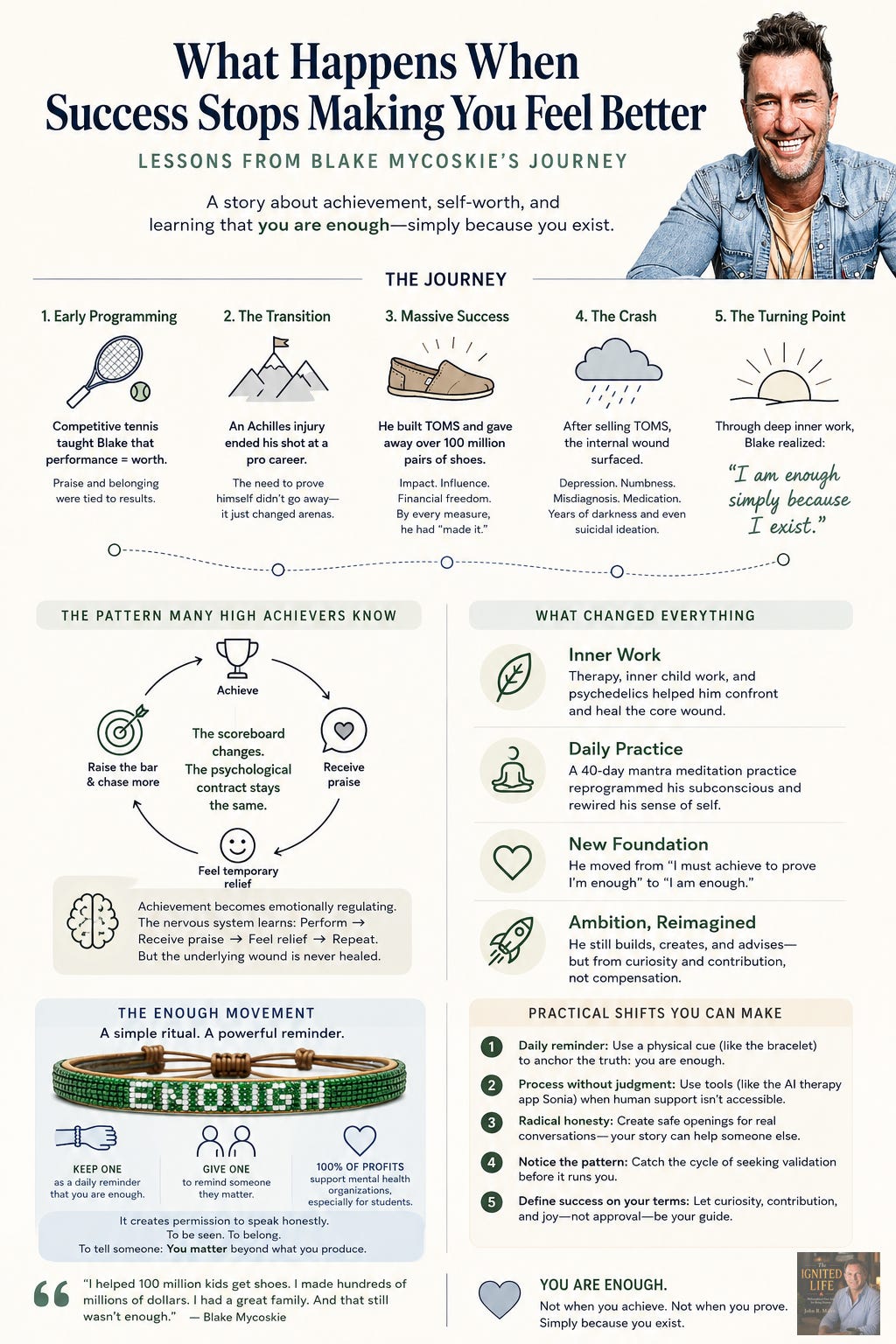
That pattern is more common than many high performers realize. Achievement becomes emotionally regulating. Success briefly quiets insecurity, so the nervous system learns to keep chasing the next milestone, believing peace exists just beyond it.
The nervous system learns early: Perform → Receive praise → Feel temporary relief. The cycle repeats across arenas (sports, business, influence) without ever resolving the underlying deficit.
The scoreboard changes. The psychological contract remains the same.
What Happens When Massive External Success Fails to Heal the Wound
After selling TOMS, Blake had the kind of life many people spend decades pursuing. He had wealth, freedom, influence, and the knowledge that his company had materially impacted millions of lives.
Yet once the momentum slowed, something unsettling surfaced.
“I helped 100 million kids get shoes. I made hundreds of millions of dollars. I had a great family. And that still wasn’t enough.”
This is one of the least discussed aspects of achievement culture. As long as a goal remains unfinished, we can project fulfillment into the future. But once the achievement arrives, the emotional structure underneath it becomes impossible to ignore.
For Blake, that realization triggered years of depression, emotional numbness, a misdiagnosis of bipolar disorder, heavy psychiatric medications, and eventually a terrifying period of active suicidal ideation. He described it with raw honesty — no attempt to turn it into a clean redemption arc. It was a long, painful confrontation with the limits of what external success could actually provide.
The Difference Between Ambition and Self-Worth
What eventually changed for Blake was not the disappearance of ambition. He still launches companies (including Morning Water), advises startups like the AI therapy app Sonia, hosts a podcast, and leads the Enough movement.
What changed was the emotional role achievement played in his life. He no longer needed accomplishments to function as evidence that he deserved worth.
Through therapy, inner child work, psychedelics, and especially a 40-day mantra-based meditation practice, Blake shifted from “I must achieve to prove I’m enough” to a full-body realization: “I am enough simply because I exist.”
That shift didn’t make him passive. It made him lighter. He now starts mornings making eggs for his kids (even if they don’t eat them) and moves through his days without tying his identity to business outcomes or public opinion. The pressure is gone. Curiosity and contribution remain.

Why the Enough Movement Resonates So Deeply
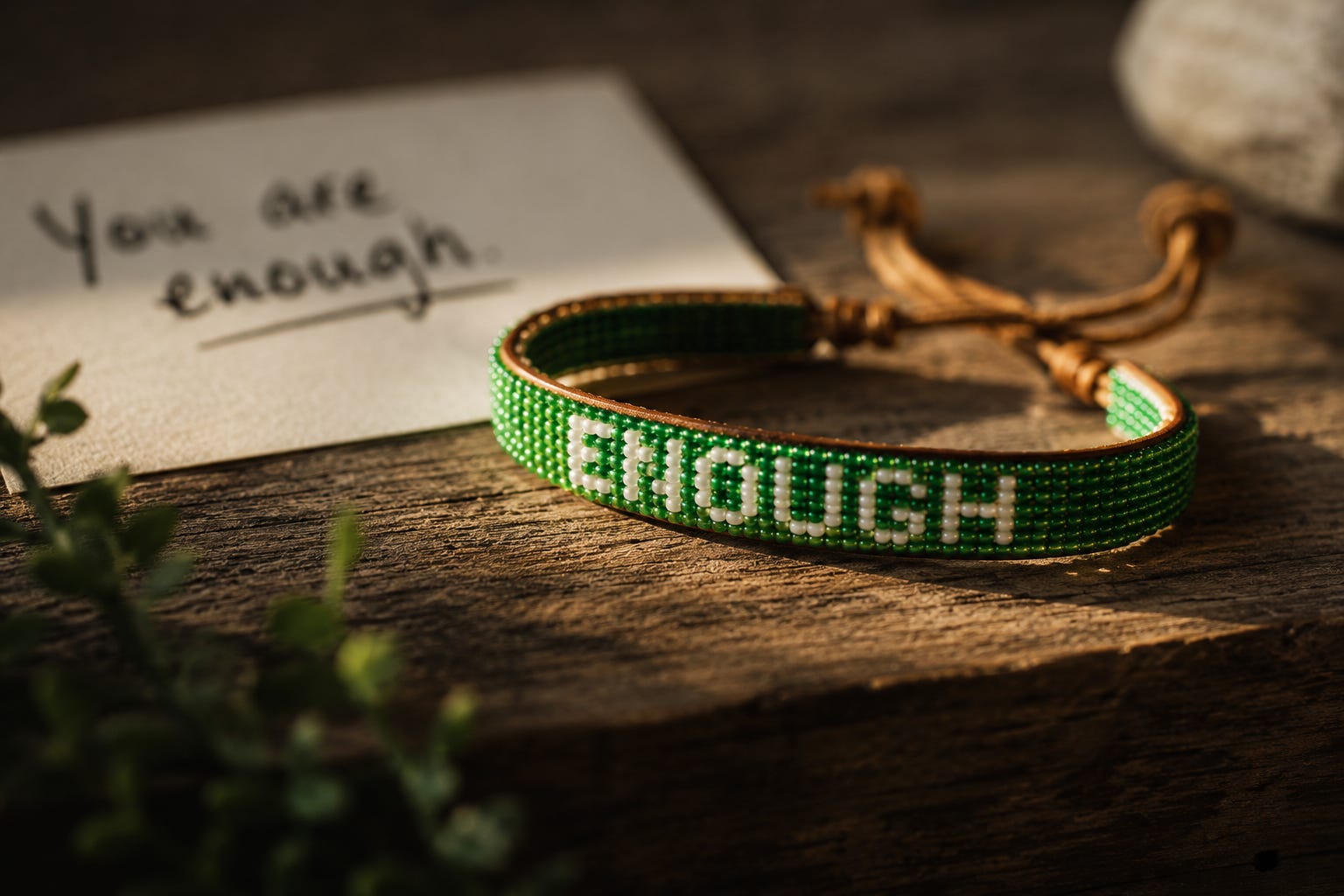
Out of this hard-won clarity came the Enough movement. At its center is a simple but powerful ritual: a set of beautiful beaded bracelets. You keep one as a daily reminder and give the other away. One hundred percent of profits support mental health organizations, especially those serving students.
The bracelets themselves are not magic. What matters is what they create: permission.
Permission to speak honestly. Permission to acknowledge struggle without performing strength. Permission to tell another person they matter beyond what they produce.
Blake shared moving stories — strangers connecting in coffee shops over matching bracelets, and a high school girl who finally opened a conversation with her depressed father by giving him the second bracelet.
In an age where 64% of people don’t feel they belong at work, 74% don’t feel they belong in their communities, and nearly 50% of Americans will face a mental health diagnosis in their lifetime, this matters profoundly. Mattering has become dangerously conditional.
How to Stop Chasing External Validation and Discover Intrinsic Worth
The shift wasn’t about abandoning ambition. Blake continues building and creating. What changed was the source of his drive.
He reprogrammed his subconscious through deep inner work and now operates from a grounded sense of identity rather than emotional repair. Today, he pursues excellence out of curiosity, contribution, and joy rather than compensation.
Practical shifts Blake emphasizes:
Daily reminder practices — like wearing the Enough bracelet as a physical signal that you are enough.
Judgment-free processing tools — such as the CBT-trained AI therapy app Sonia for those 5 a.m. anxiety moments when a human therapist isn’t available.
Radical honesty with others — using visible signals (like the bracelet) to create permission for real conversations about mental health.
Stripping away performance — simplifying life, protecting relationships with kids, and refusing to sacrifice balance on the altar of the next win.
The Relief of No Longer Negotiating Your Worth
The most powerful part of Blake’s story isn’t the success or even the darkness — it’s the relief on the other side.
Relief that you can still create, build, and strive without carrying the crushing weight of “not enough.” Relief that ambition and self-worth don’t have to be fused forever. Relief that you can show up as a parent, leader, or founder without your entire identity on the line every day.
If you’re a high performer who has ever achieved something big only to wonder why it still doesn’t feel like enough, Blake’s message is simple but profound:
You don’t have to earn your worth. You already have it.
Read the FREE Companion Guide & Digital Workbook for this post.
What about you?
Have you ever reached a major milestone only to feel the same emptiness afterward? What helped (or is helping) you separate your achievements from your inherent worth?
Drop a comment below. And if this resonated, share it with someone who needs the reminder — they might just be waiting for permission to stop performing and start healing.
Ready to start your own Enough journey?
Visit WeAreEnough and grab a bracelet for yourself and someone who needs to hear they matter.
Blake Mycoskie was a guest on Passion Struck. Listen to the full conversation for more of his story, including details on mental health tools, parenting from a place of enough, and building the Enough movement.
Thoughts? Let me know below this essay!
Every 🧡, restack, or comment you share here on Substack
is like a signal flare…..
It helps this message find the person who is still walking
their own “schoolyard” alone.
Thank you for being part of this ecosystem.
I love turning these essays into a two-way conversation
So please let me know your thoughts below.
© John R. Miles 2026. All rights reserved.
I read Blake's 'Start Something That Matters' some time ago, and one thing that stayed with me was its emphasis on building from a place deeper than achievement alone.
This conversation felt like a powerful continuation of that idea — especially the honesty around how success, recognition, and accomplishment do not always translate into a lasting sense of enoughness.
In a culture so centered around performance and comparison, this was a meaningful reminder that fulfillment is not just about what we achieve outwardly, but also about the meaning, grounding, and humanity behind what we pursue.
Appreciate the depth and honesty here.