

Do You Own Your Armor, or Does It Own You?
On survival identities and the cost of emotional armor


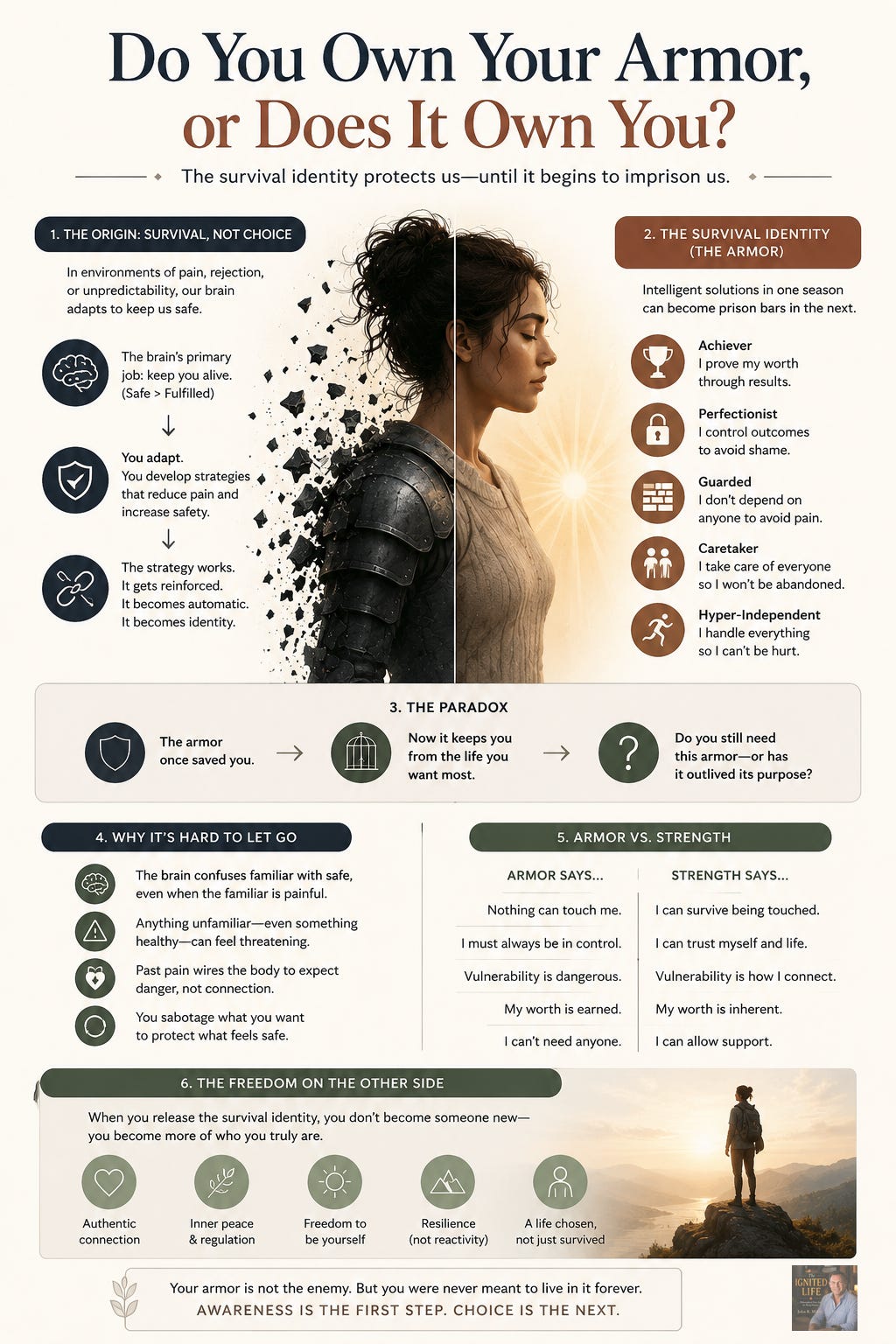
There is a fascinating truth about human beings that psychologists, neuroscientists, and storytellers have all been circling for decades: most of us did not consciously choose the person we became. We adapted into them.
The human brain is extraordinarily good at adaptation, especially in environments that feel unpredictable, rejecting, or painful. Your brain has one primary job above almost everything else: keep you alive.
Not fulfilled. Not authentic. Not connected. Safe.
In our emotionally formative years, the brain becomes efficient at identifying what protects us from pain. This is the origin of the survival identity.
“The strategies that rescue us in one season of life can quietly imprison us in the next.” —John R. Miles
A child grows up in chaos, so they become controlling. Someone grows up emotionally unseen, so they become an achiever. A person experiences betrayal, so they stop depending on anyone. Someone gets praised only when they succeed, so productivity becomes identity.
At first, these adaptations are intelligent. They are solutions. The nervous system learns that certain behaviors reduce pain and increase safety, and once the brain finds a strategy that works, it reinforces it. Neural pathways strengthen, behavior becomes automatic, and identity begins forming around protection.
The Personality Paradox
This is why so many people confuse survival patterns with personality. What they call who I am is often just who I needed to become.
Modern culture rewards these identities constantly. The workaholic gets promoted. The hyper-achiever gets admired. The perfectionist gets results. But underneath many high-performing identities is an exhausted nervous system trying to prevent old pain from happening again. Some of the most celebrated traits in modern life are unresolved survival adaptations in disguise.
We see this most clearly in the character of Tony Stark. When we first meet him, he looks untouchable — brilliant, funny, and powerful. But the humor is deflection. The ego is armor. The constant movement is avoidance. Then he is captured and forced to confront his mortality. He builds the suit to survive. At first, it saves his life. Over time, it becomes the place he hides.
That is the paradox of survival identities: the strategies that rescue us in one season of life can quietly imprison us in the next. The danger passes, but the nervous system keeps acting like the war is still happening. Many people spend decades responding to emotional threats that no longer exist — still proving, still protecting, still defending.
We have to ask: Do I still need this armor? Because you cannot heal a pattern you still mistake for your personality.
When the Armor Becomes the Identity
The dangerous thing about survival patterns is not that we develop them. It is that they work — at least for a while. The achiever gets validation. The perfectionist gains control. The emotionally guarded person avoids disappointment.
Because these strategies produce results, we rarely question them. But there is a profound difference between functioning and healing. A person can appear incredibly successful externally while internally living in a constant state of emotional defense. Over time, the armor fuses to the skin. People stop saying I learned to be this way and start saying this is just who I am.
“You cannot heal a pattern you still mistake for your personality.”—John R. Miles
We see this in Will Hunting. Will is a mathematical genius — sharp, funny, and gifted. But his intelligence is protection. Every joke is deflection. Every argument is distance. He sabotages relationships the moment vulnerability enters the room because he believes that if people truly know him, they will eventually leave. He stays ahead of abandonment by never allowing connection.
This is the tragedy of emotional armor: the behaviors designed to protect us from pain become the reason we cannot experience love, intimacy, or belonging. The avoidant person avoids being hurt, but also avoids being known. The achiever gains admiration but loses themselves chasing validation.
What once felt protective eventually becomes imprisoning.
Why Letting Go Feels Terrifying
If the armor is exhausting and keeps us disconnected, why is it so hard to release?
Because the human nervous system confuses familiar with safe, even when the familiar is painful. The brain is not designed to maximize happiness. It is designed to minimize danger. Anything unfamiliar, even something healthy, can initially feel threatening to a nervous system trained by survival.
This is why we sabotage the very things we say we want. If love once led to abandonment, connection feels risky. If failure once led to shame, rest feels irresponsible. The nervous system would rather keep you trapped in a familiar prison than risk an unfamiliar freedom.
“Some of the most celebrated traits in modern life are unresolved survival adaptations in disguise.”—John R. Miles
This is also why healing is more than an intellectual exercise. You can logically know you are safe while your body is still reacting as though the war is happening. The achiever feels anxious when they stop producing. The caretaker feels guilty when they prioritize themselves. The hyper-independent person feels weak asking for help.
The armor that once protected you from suffering is now preventing you from experiencing the very things that make life meaningful. Love requires vulnerability. Peace requires surrender. Connection requires openness. None of these are fully possible while you are constantly defending yourself from the world.

Armor and Strength Are Not the Same
One of the greatest misconceptions about healing is the fear that letting go of your armor will make you weak. But armor and strength are not the same thing.
Armor says: nothing can touch me. Strength says: I can survive being touched.
Armor avoids vulnerability. Strength tolerates it without collapsing.
In our performance-driven culture, we confuse emotional suppression with resilience and mistake exhaustion for discipline. But you can be highly functional and deeply disconnected at the same time.
That is not freedom. That is survival wearing the costume of success.
The resolution of Will Hunting’s story makes this visible. His breakthrough is not intellectual — it is the collapse of the armor. When Sean repeats it’s not your fault, the power is not in the words. It is in Will, finally stopping long enough to be emotionally seen. Underneath the intellect and the deflection is the grief he spent his life outrunning.

Recognizing Your Armor
The hardest part is that most people do not realize they are wearing it. Protection stops feeling like protection and starts feeling like personality. You stop questioning it and simply call it ambition, discipline, independence, or being fine.
“The armor that once protected you from suffering is now preventing you from experiencing the very things that make life meaningful.”—John R. Miles
The armor reveals itself in recognizable patterns:
The Achiever ties self-worth entirely to performance. Rest feels uncomfortable. Enough is always just out of reach.
The Hyper-Independent carries everything alone, struggling to ask for help while others admire a strength that is, quietly, a profound loneliness.
The Perfectionist turns every mistake into a threat to identity, using control to avoid the possibility of rejection.
The Caretaker becomes emotionally available to everyone except themselves, anticipating others’ needs while quietly abandoning their own.
The Intellectual analyzes emotion instead of feeling it — using insight to avoid the vulnerability of the wound itself.
Life eventually reveals where the armor lives. It appears in the relationship where intimacy feels uncomfortable, in the anxiety that surfaces the moment you stop producing, in the silence that feels threatening rather than restful.
Most people are not afraid of failure. They are afraid of what failure would make them feel about themselves.
Sit with these questions honestly:
What part of my personality was actually built for protection?
What am I still trying to earn?
What do I avoid feeling at all costs?
Who might I become if I no longer needed to protect myself from the past?
Awareness changes everything. The moment the armor becomes visible, you are no longer fully trapped inside it.
Setting the Armor Down
Your armor is not proof that you are broken. It is proof that you survived. At some point, your mind and body made extraordinary adaptations to navigate pain, rejection, or loss. The armor served a purpose. It protected you when you needed it.
Healing does not begin by hating those parts of yourself. It begins by understanding them. The goal is not to shame the survival identity but to recognize when survival has quietly become your permanent way of living.
There is a profound difference between surviving life and participating in it. Perhaps the bravest thing a human being can do is stop organizing their entire identity around what hurt them — not because the pain didn’t matter, but because your life is bigger than the wound.
Freedom begins the moment you stop asking how do I become invulnerable and start asking where is it finally safe for me to be fully human?
The armor may have saved your life once. But you were never meant to live inside it forever.
Check out episode 768 of Passion Struck
Download the FREE Digital Workbook/Companion Guide.
Thoughts? Let me know below this essay!
Every 🧡, restack, or comment you share here on Substack
is like a signal flare…..
It helps this message find the person who is still walking
their own “schoolyard” alone.
Thank you for being part of this ecosystem.
I love turning these essays into a two-way conversation
So please let me know your thoughts below.
© John R. Miles 2026. All rights reserved.
My armor owned me most of my life. I was stuck in survival mode. I have been safe for many years but my nervous system didn't know it was okay to feel so. You described in l me in what I call my old life to a tee.
Most of my childhood was traumatic with witnessing my mother's abuse first, then hands on me later. Abuse of ALL forms.
I was not just one of these examples, I was all of them.
I will be publishing my first book, a hybrid soon. It's part memoir and part tools, tips, self awareness, self help.
Never looked at a moment as self avoidance just adapted to a situation and created a solution. Did i let my Armor define my response , perhaps, but it led to creative thinkig / actions. perhspd letting my armor down translates to positive results.