

You Didn't Disappear. You Were Erased.
My new book on the force quietly taking people apart — and how to build your way back


Most people don’t announce when they start disappearing.
They just quietly stop showing up for their relationships, for their work, for themselves, hiding in plain sight while everything on the outside continues to look fine.
This post is about why that happens. And what to do about it.
The High Cost of Being Invisible
For decades, I lived what looked like a success story but was actually a slow disappearance.
After a traumatic brain injury at age five, I learned a survival strategy that followed me all the way into the C-suite and the Navy: I learned how to take up less space. Invisibility felt safer than being seen and judged. So I became highly valued for what I could do, while remaining fundamentally unseen for who I was.
My usefulness was undeniable.
My humanity was optional.
What I didn’t realize at the time, and what this book finally names, is that my disappearance wasn’t a personal failure. It was systemic. It was the quiet erosion of our sense that we matter, even while we remain visible in the world.
If you’ve ever googled “why do I feel empty despite a good life” or “why do I feel invisible in my own success,” you already know the feeling this book is addressing.
This Is Not a Personal Crisis. It Is a Design Flaw.
We’re living through a quiet epidemic of unmattering, the structural process by which modern systems reward output while slowly erasing our sense of significance.
People still show up in boardrooms, classrooms, hospitals, and family dinners, but they increasingly feel they don’t really matter. Their presence becomes optional. Their absence barely registers. Their contributions feel replaceable.
The numbers are sobering:
Nearly 60% of people don’t feel genuinely valued at work
One in four Americans has no close confidants
The global economic cost exceeds two trillion dollars annually
Chronic disconnection carries health risks comparable to smoking fifteen cigarettes a day
This isn’t just a wellness issue. It’s a human one.
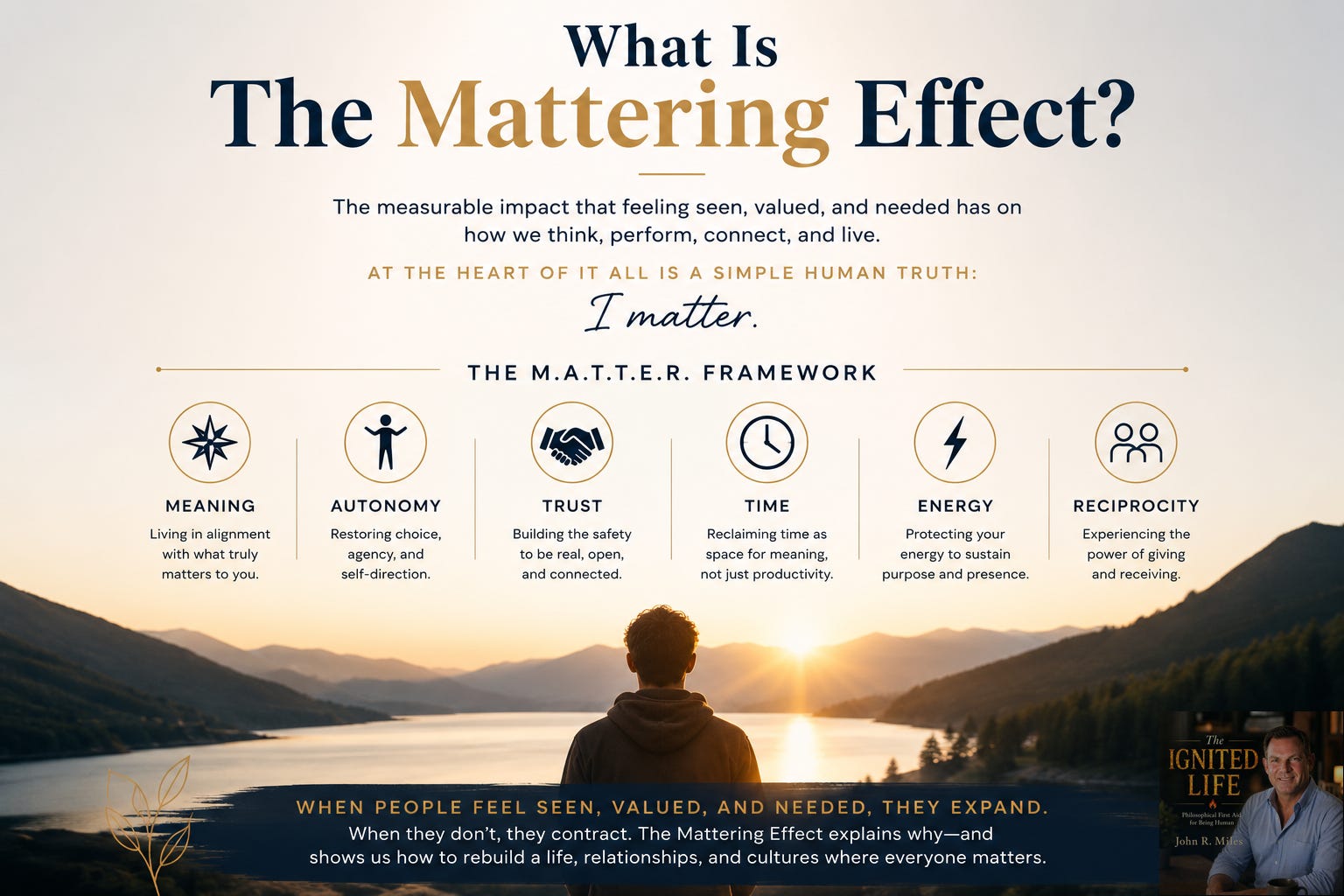
The Mattering Effect: The Framework Most People Have Been Searching For
The Mattering Effect isn’t another self-help book telling you to hustle harder or optimize better. It’s the first clear framework for closing the Mattering Gap, the painful space between the life you’re living and the deep human need to feel seen, valued, and significant.
At its core is the M.A.T.T.E.R. Framework, six essential conditions that determine whether you feel grounded, connected, and fully present in your own life:
Meaning — staying connected to what truly matters
Autonomy — reclaiming the lead role in your own story
Trust — building relationships where you can be fully seen
Time — protecting space for life to actually land
Energy — showing up without burning out
Reciprocity — creating relationships where worth flows both ways
These aren’t fluffy ideals. They’re the conditions that decide whether you feel alive in your own life, or slowly begin to disappear inside it.
After years of research and conversations with psychologists, neuroscientists, leaders, and people who’ve overcome profound adversity, I came to a powerful realization: mattering isn’t something you earn at the end of healing or achievement. It’s something that gets obscured by the environments, relationships, and systems we live in.
You Do Not Have to Disappear to Fit
Seventy-six percent of people die with the regret of never becoming who they truly were.
That does not have to be your story.
The Mattering Effect publishes on October 6, 2026. If any part of this resonated with you, this book was written for you.
Pre-order today and be among the first to reclaim what was never yours to lose.
Barnes & Noble - Target - Amazon - Bookshop.org - Waterstones - Indigo -Orellfuessli - Booktopia - Thalia
What would it feel like to stop hiding from yourself?
© John R. Miles 2026. All rights reserved.
This lands deeply. I think many people are not disappearing because they lack success, talent, contribution, or have severe disability. They are disappearing because they have been valued for function while their humanity has gone unrecognized. Your phrase “systemic unmattering” feels important because it names something larger than personal insecurity. Many modern systems reward usefulness while quietly eroding presence, reciprocity, and genuine human recognition. A person can become highly visible and remain profoundly unseen. This is particularly true for the most wounded of us in our culture. My work with severe trauma might add that mattering is not only something we earn or receive from others. It is also something we remember when the ego is no longer forced to organize life around performance, approval, or survival. The deeper wound is not simply invisibility, but the loss of contact with the part of us that knew we mattered before we became useful. In my experience, healing (of the most severely wounded we can imagine) begins when we/they stop asking for usefulness to prove humanity, and begin reinventing/rebuilding lives where presence, relationship, and genuine recognition can return.
Resignation is not a natural state. Human beings are fundamentally participatory creatures. We are built to engage, to respond, to imagine, to intervene. When that impulse withers, it is usually because something in our understanding of the world has led us to believe that participation is futile. To recover the desire to act, it helps to understand how change actually becomes possible, and how our relationship to reality shapes our willingness to participate in it.