

The Power of the Pit
How Adversity Strips Away Your Old Identity and Reveals Who You Really Are


Imagine a man who once lived by the clock. Not just any clock—the precise, unforgiving rhythm of Federal Express, where every package, every minute, every second mattered. His name was Chuck Noland, and for most of his life, he was the very model of modern competence: efficient, scheduled, successful in all the ways that impress colleagues and strangers. Then one day, his plane crashed into the Pacific, and he washed up on an island with nothing but a volleyball and the sound of waves.
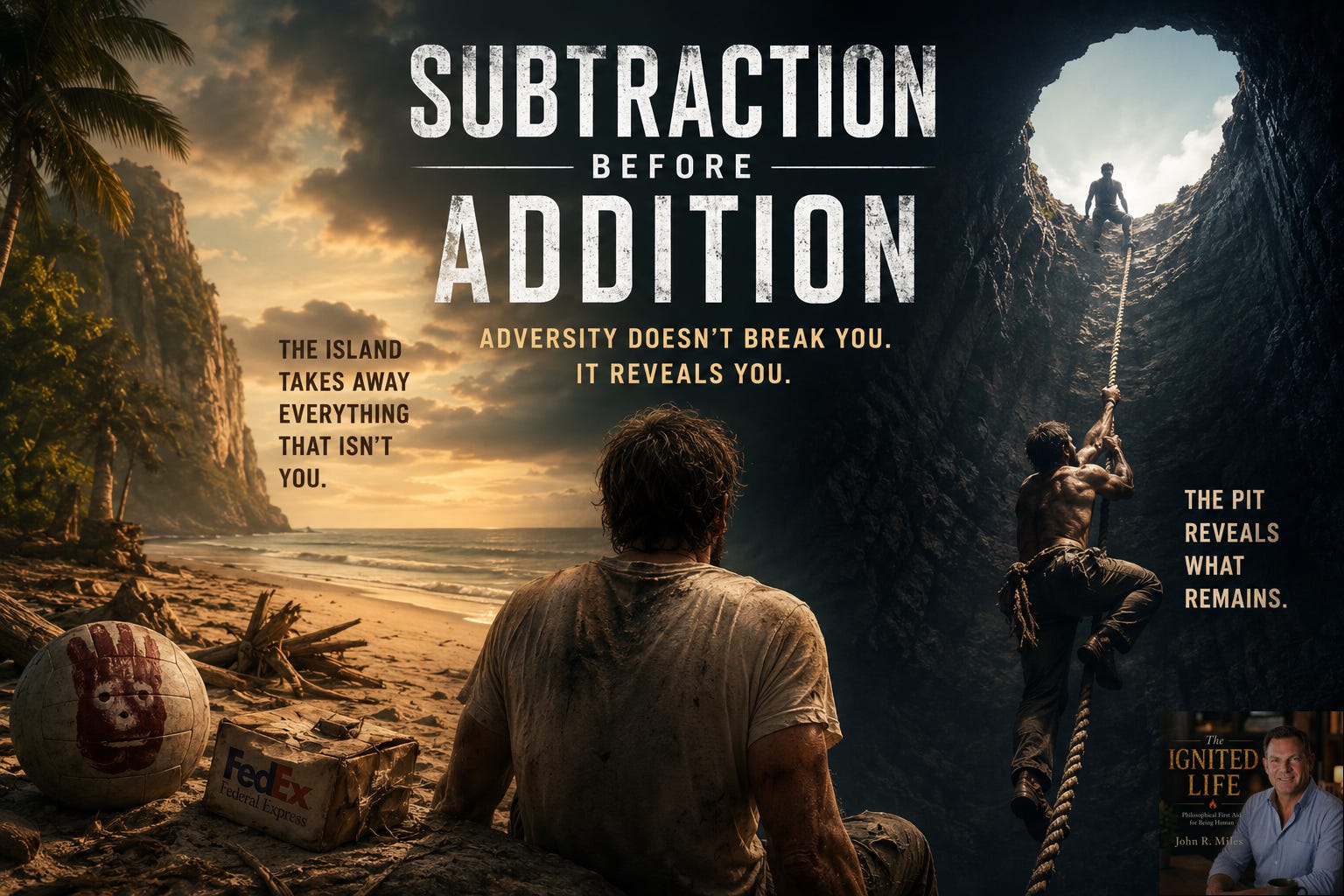
What happened next, as told in Cast Away, is less about survival than about subtraction. The island didn’t build Chuck a new life. It dismantled the old one. The pager, the title, the suit, the urgency—all of it vanished. In their place, he confronted something most of us spend our lives avoiding: who he actually was when there was no audience, no résumé, no performance left to give.
This is the strange pattern we see across stories of transformation. Adversity rarely arrives as a helpful coach shouting encouragement. It shows up like a diagnostic machine—cold, impersonal, ruthlessly accurate. It doesn’t build character so much as strip everything away until only character remains.
Resume Virtues Meet Eulogy Virtues
David Brooks once drew a useful distinction between two kinds of virtues. “Resume virtues” are the ones that get you hired, promoted, and admired: competence, drive, and polish. “Eulogy virtues” are the ones that matter at the end: kindness, integrity, resilience, the quiet stuff that defines who you were when the spotlight is off. Most of us optimize for the first set. We build identities around them. Then something breaks—a divorce, a diagnosis, a layoff, a failure—and suddenly the résumé is underwater.
The fascinating thing is how stubbornly we cling to the old map. Even after the crash, Chuck tried, at first, to live like the FedEx executive he used to be. He kept checking a watch that no longer mattered.
Many of us do the same in our own “islands.” We’re exhausted not just by the hardship itself, but by the extra effort of pretending the old identity still fits the new reality.
The brain, it turns out, hates letting go of a working model. Neuroscientists speak of heightened plasticity in times of crisis—when old neural pathways stop working, the system frantically redraws the map. The discomfort we feel isn’t stagnation. It’s the sound of internal reorganization.

The Rope in the Pit
Consider another story that feels almost engineered for this insight. In The Dark Knight Rises, Bruce Wayne is thrown into an underground prison called the Pit—a sheer vertical shaft with a tiny circle of sky far above. Prisoners try to climb out again and again. Wayne, in peak physical condition, fails twice.
The problem, an older inmate explains, isn’t strength. It’s the rope tied around Wayne’s waist. He thinks the rope gives him courage. In truth, it guarantees that he will never fully commit to the leap. Only when he climbs without it—when failure means death—does he finally succeed.
That rope is everywhere in real life.
It’s the golden parachute you secretly count on. The old reputation you lean on. The backup plan, the ego, the version of yourself that “used to work.” As long as it’s there, you’re playing a game that looks like risk but isn’t. The pit doesn’t test your muscles. It reveals your attachments.
This is why the most profound changes often look, from the outside, like destruction.
Subtraction Before Addition: The Sculptor Principle
Adversity follows the logic of a sculptor. The artist doesn’t add to a block of marble; they remove everything that isn’t the statue. Chips fly. The stone cracks. To the marble, if it could feel, it would seem like annihilation. To the sculptor, it’s the only way the figure inside can emerge. Adversity works the same way: subtraction first, then addition.
You have to let the extra fall away—the performative self, the safety nets, the stories about who you were supposed to be—before the essential self has room to stand.
Your struggle is doing the same thing. It’s chipping away at the performative self, the false securities, and the extra layers you spent decades building. The pain you feel right now is not the sound of you breaking. It’s the sound of the unnecessary falling away so the essential can finally emerge.
The Diagnostic Power of the Bottom
The counterintuitive truth running through these stories is that the bottom of the pit is often the clearest vantage point. When everything external is gone, you finally meet your baseline. Not the curated version. Not the aspirational one. The real one. The person who remains when the titles disappear, and the rope is cut.
When there is nothing left to hide behind — no titles, no money, no reputation — who are you?
Some people never make that leap. They spend years on the island still trying to be the executive who missed his flight. Others drop the rope, accept the terrifying freedom of having nothing left to lose, and climb. They move from endurance to agency—from merely surviving the storm to steering whatever small sail they still control.
The pit doesn’t care about your old metrics of success. It only asks one question, quietly and relentlessly: When there is nothing left to hide behind, who are you? That answer—the one revealed in silence, in failure, in the long nights on the island—is rarely the person you spent decades polishing for the world. But it is almost always the person capable of something truer and more lasting than anything on the résumé.
How to Use the Pit as a Tool for Transformation
Recognize the Island Phase — Accept that your old identity no longer fits. Stop resisting the new reality.
Identify Your Rope — Honestly name the safety nets, ego attachments, or backup plans you’re clinging to.
Allow the Subtraction — Let the chisel do its work. Release what no longer serves you.
Meet Your Baseline — Ask: Who am I when everything external is gone?
Make the Leap — Commit fully without a net. Move from mere endurance to real agency.
Return Transformed — Bring the clarity of the pit back into everyday life. Make decisions with less noise and stronger boundaries.
The Return
Here is the part most people underestimate: the climb out is not the end of the transformation—it is the beginning of a second, quieter test.
You emerge from the pit or wash ashore from the island carrying a different weight. The old résumé virtues feel oddly lightweight now; they no longer define you. The eulogy virtues you discovered in the dark suddenly feel like the only ones worth carrying. Yet the world you return to hasn’t changed. It still speaks the language of titles, metrics, and performance. The temptation is to slip the old costume back on, to pretend the island never happened.
The truly transformed do the opposite. They bring the island's silence and the freedom of the ropeless leap into their daily lives. They make decisions with less noise. They hold boundaries with less guilt. They pursue work, relationships, and goals from the baseline self rather than the performed self. Success still matters, but it no longer owns them.
The final mark of having truly met yourself at the bottom is that you no longer fear returning there. You know the pit is not a place of punishment but a recurring classroom. You learn to visit it by choice—through honesty, stillness, or deliberate subtraction—before life forces you there again.
Drop the rope.
Let the chisel do its work.
The leap — and the life worth living — almost always begins at the bottom.
Check out episode 765 of Passion Struck
Thoughts? Let me know below this essay!
Every 🧡, restack, or comment you share here on Substack
is like a signal flare…..
It helps this message find the person who is still walking
their own “schoolyard” alone.
Thank you for being part of this ecosystem.
I love turning these essays into a two-way conversation
So please let me know your thoughts below.
© John R. Miles 2026. All rights reserved.
I genuinely had a reflective time reading through this piece. Thank you so much for writing and sharing it.
I’ve had seasons in my life when I didn’t have much going on externally and was faced with what I believe is a similar kind of pit to the one talked about here. Looking back now, I’m deeply grateful for the grace to remain connected to the things that truly mattered to me at my core, even when everything else felt uncertain.
I’ve now come to trust that hitting the bottom does not diminish us — it reveals us. And if we allow it to, it can leave us more grounded, more peaceful, and closer to who we truly are.
I'll sure hold on to the lessons shared here ✨️
Thank you for this, v well written. It resonated with me a lot as someone coming out of chronic illness. I related to the two stages - you'd think losing the old identity and getting to know what's underneath was the whole journey, but there's v much a part 2 when you go back into the world and find the old expectations there waiting for you!