

Why Your Brain Rejects Emotional Healing
Dr. Paul Conti on the Generative Drive, self-protection, and rebuilding mental health


The young man was in his mid-20s when the world as he knew it fractured. He had watched his youngest brother battle a serious medical illness, but while the doctors focused on charts, diagnoses, and physical symptoms, something far more dangerous was quietly unfolding underneath the surface.
When his brother eventually took his own life, the grief did more than devastate his family. It exposed a profound blind spot in the way we think about mental health. We have become experts at identifying illness and categorizing dysfunction, yet we remain remarkably unskilled at explaining how a human being loses the connection to themselves in the first place.
That realization eventually shaped the life’s work of psychiatrist and trauma expert Dr. Paul Conti. And honestly, it’s one of the reasons this conversation stayed with me long after it ended. Because I think many people today are walking around internally fragmented—adapting to performance pressure and emotional suppression without the internal architecture needed to process the weight of it all.
This week on Passion Struck, I sat down with Dr. Conti to discuss his new book, What’s Going Right. What emerged was a masterclass in identity, emotional recovery, and the invisible psychological forces shaping how we experience ourselves and the world.
The Difference Between Labeling Yourself and Understanding Yourself
One of the most important ideas Paul shared is that modern psychology often mistakes categorization for understanding. We’ve been conditioned to ask: “What’s wrong with me?” But Paul believes a far more powerful question is:
“What’s happening inside of me?”
That distinction changes everything. When people reduce themselves to labels—depressed, anxious, burned out, broken—they often stop investigating the deeper emotional narratives, protective patterns, and unresolved experiences shaping those states.
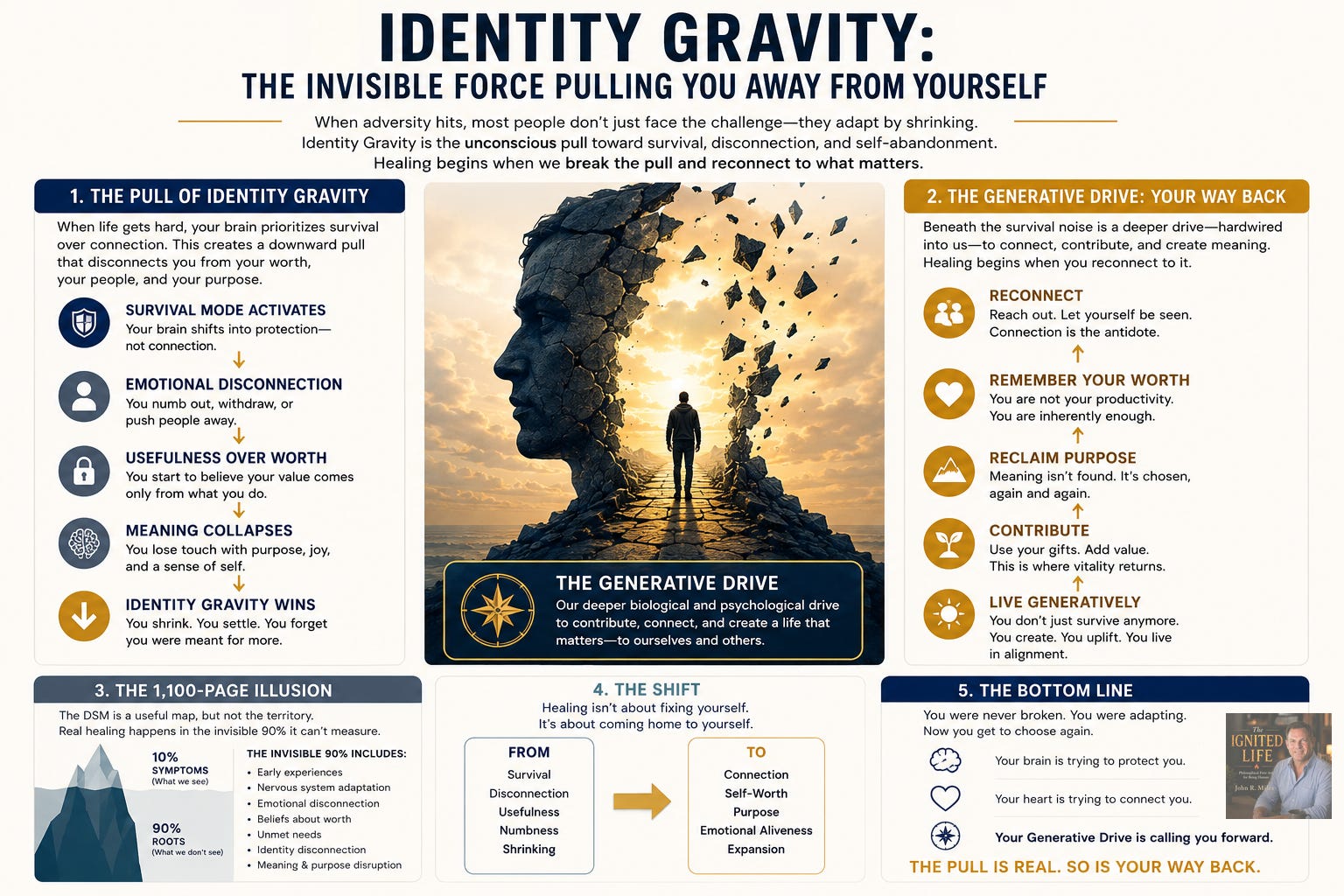
As Paul told me, the DSM (the "Bible" of mental health) is a book of taxonomy. It’s an inventory, an organizational tool, not an explanation for why someone feels emotionally disconnected from themselves or unable to experience meaning, connection, or aliveness.
I think many people today are unknowingly trapped inside what I call Identity Gravity—the psychological pull back toward old emotional patterns, survival identities, and self-protective narratives long after adversity has changed them. The result is a kind of emotional looping: you keep performing, producing, achieving, and functioning externally while remaining disconnected from yourself internally.
The Generative Drive and the Human Need to Matter
One of the most profound parts of our conversation centered around what Dr. Conti calls the Generative Drive. Traditional psychology often frames human beings in terms of two primary motivations: assertion and pleasure. But the deeper argument here is that human beings are driven by something much more meaningful than simply getting what we want or avoiding discomfort.
We are driven by the desire to contribute, to create, to care, to bring goodness into the lives of others, and to feel connected to something larger than ourselves. The Generative Drive is what pulls people toward meaning.
Paul’s 'Generative Drive' is the engine; 'Mattering' is the fuel. You cannot drive toward goodness if you don’t believe your existence carries the weight of significance.
When that drive becomes buried beneath trauma, shame, cynicism, burnout, or emotional suppression, people don’t merely feel unhappy. They begin feeling emotionally invisible, disconnected, and detached from a deeper sense of purpose. Over time, many people stop feeling like they matter at all.
Honestly, this connects deeply to the work I’m doing in The Mattering Effect. I increasingly believe one of the hidden drivers beneath our modern mental health crisis is not simply stress or anxiety. It’s the erosion of significance. People no longer know where they belong, why they matter, or whether their existence carries meaning beyond utility and performance.
When human beings lose connection to meaning, contribution, and emotional connection, suffering compounds quickly.
Emotional Recovery Begins with Compassionate Curiosity
One of the ideas that stayed with me most is that healing doesn’t begin through shame. It begins through curiosity.
Most people respond to emotional pain with self-judgment. They ask themselves why they can’t fix their patterns, why they keep struggling, or why they continue reacting the way they do. But emotional recovery often begins when people stop treating themselves like problems to solve and start understanding themselves as human beings whose emotional systems adapted to survive experiences they may never have fully processed.
That shift from condemnation to compassionate curiosity is incredibly powerful because emotional recovery is not about pretending adversity never affected you. It’s about understanding how it affected you so you can stop unconsciously organizing your entire life around protection, avoidance, self-suppression, or fear.
The Connection Gap
One of the biggest realizations I took from this conversation is how many people today are suffering from what I call The Connection Gap. Externally, they may appear successful, functional, productive, and even admired. Internally, they feel emotionally disconnected from themselves, from other people, from meaning, and sometimes from life itself.
The dangerous thing about emotional disconnection is that it rarely announces itself dramatically. It happens gradually through chronic stress, performance-based worth, burnout, unprocessed grief, emotional suppression, loneliness, and years of believing your value must constantly be earned.
Over time, people stop relating to themselves as human beings and begin relating to themselves as functions. As utility. As output. Eventually, they forget how to simply exist without proving their worth.

Final Reflection
Dr. Conti’s journey—from losing his brother to becoming one of the world’s leading trauma psychiatrists—is ultimately a reminder that healing is not about becoming someone entirely different. It’s about reconnecting with the parts of yourself adversity taught you to abandon.
Mental health is not merely the absence of illness. It’s the presence of self-understanding, emotional connection, agency, meaning, and the capacity to move toward life again.
And maybe the real question is not, “What’s wrong with us?”
Maybe it’s, “What happened inside us that made survival feel safer than connection?”
A Question for You
Where in your life have you confused usefulness with worth?
And what would change if you stopped treating your humanity like something that needed to be earned?
Check out the full conversation with Dr. Paul Conti below.
Download the Companion Reflection Guide here.
Order Dr. Paul Conti’s new book, What’s Going Right, here.
Thoughts? Let me know below this essay!
Every 🧡, restack, or comment you share here on Substack
is like a signal flare…..
It helps this message find the person who is still walking
their own “schoolyard” alone.
Thank you for being part of this ecosystem.
I love turning these essays into a two-way conversation
So please let me know your thoughts below.
© John R. Miles 2026. All rights reserved.
I’m fascinated by what you write. In 1989 I was diagnosed with MPD; and eventually 153 separate personalities were identified. On May 1, 2026 I experienced a total spontaneous integration. Obviously, the story is far more complex than that; but you can see why I’m intrigued by your writing.
What an incredible article. I feel like I can relate with this concept because there’s a part of me that is struggling to let go of emotional attachment and still holding old habits. What a fantastic piece of writing.