

The Gravity of the Old Sun
How to stay in your new life when your old identity gravity tries to pull you back


The door closes behind you. For the first time all day, nothing is asked of you.
You put the phone away. You stand in the quiet hallway, feeling the solid ground under your feet—a simple fact you’d forgotten. You are here. You are not your output.
But the stillness doesn’t last. It curdles.
The unread emails you haven’t sent begin to pulse in your mind. You feel a magnetic pull back to the version of you that manages, produces, and earns your keep. A cold dread whispers: Without your utility, do you even exist?
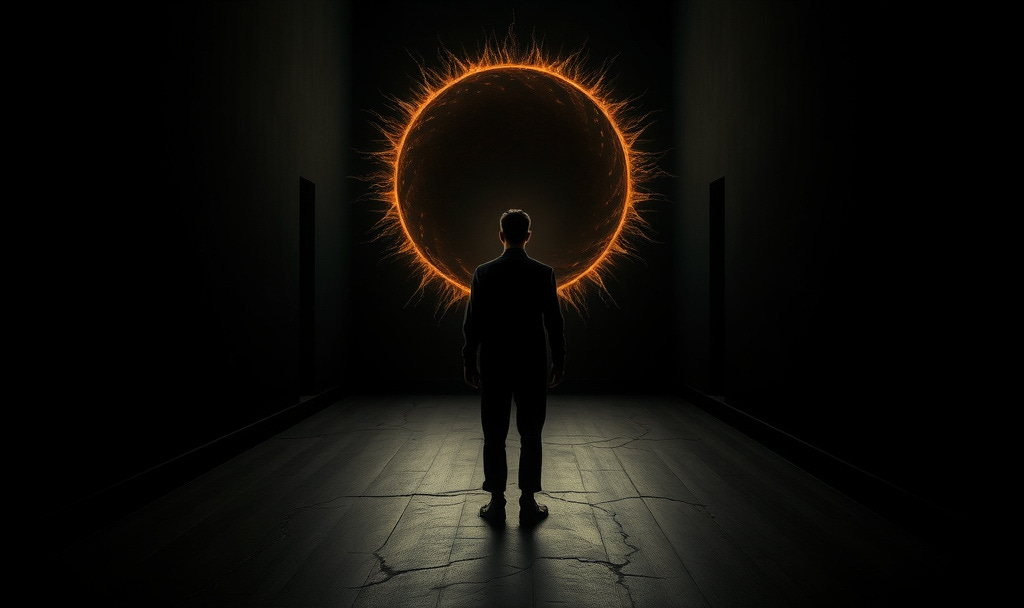
This is the pull of a former sun. This urge has a name: I call it Identity Gravity.
In physics, every object with mass has a gravitational pull. The larger the object, the stronger the pull. For decades, you have built an identity with massive weight. You have been the “Super-Producer,” the “Reliable One,” the “CEO of Everyone’s Crisis.” That version of you is an old sun—massive, dense, and burning with the fuel of external approval.
Even after you decide to move into a new orbit of significance, that old sun is still there. It is the invisible force trying to pull a changing person back into an old, exhausted orbit because your nervous system—and the people around you—are comfortable with the version of you that serves their convenience.
If you are tired of feeling like a rocket that keeps falling back to earth, it’s time to understand the architecture of your interior and how to achieve escape velocity.
The Physics of the Snap-Back: TPN vs. DMN
To stay changed, we have to be honest about why we revert. When you decide to inhabit your life instead of just managing it, you aren’t just making a schedule shift. You are fighting millions of years of evolution.
Your brain sees “stillness” as “vulnerability.” In the modern world, if you stop responding, you feel “replaceable.” This creates a leaden feeling in your gut that tells you that if you aren’t being useful, you aren’t safe. In human performance, we call this the Snap-Back Effect.
To understand why the snap-back is so powerful, we have to look at the neurobiology of the Task-Positive Network (TPN) and the Default Mode Network (DMN).
High-performers are TPN addicts. This is the “Fixer” brain—the part that triages schedules and hits deadlines. Every task completion triggers a dopamine release via the brain’s reward pathways, reinforcing a chronic preference for execution over reflection.
The DMN, by contrast, is your meaning-making network. It is designed for self-reflection, memory consolidation, and asking: “Does this matter?”
For decades, you have trained your brain to prioritize TPN activation over DMN flexibility. Self-reflection slowed you down, so you learned to modulate the DMN’s signal into the background. But here is the neurobiology: The DMN isn’t off—it is just waiting.
When you finally sit still in the driveway, the DMN activates without the TPN’s regulatory counterbalance. That “static” you feel? It’s not your meaning-making brain breathing; it’s dysregulation. Your DMN is firing without boundaries. Because your system is still under the threat of chronic stress and elevated cortisol, that DMN activation becomes rumination and anxiety.
But here is the unlock: The DMN is a mirror.
Under threat, it becomes rumination. In safety, it becomes creativity and meaning. The snap-back isn’t a sign of weakness; it’s a sign your brain is desperately trying to rebalance.
The Anatomy of the Identity Gravity Trap
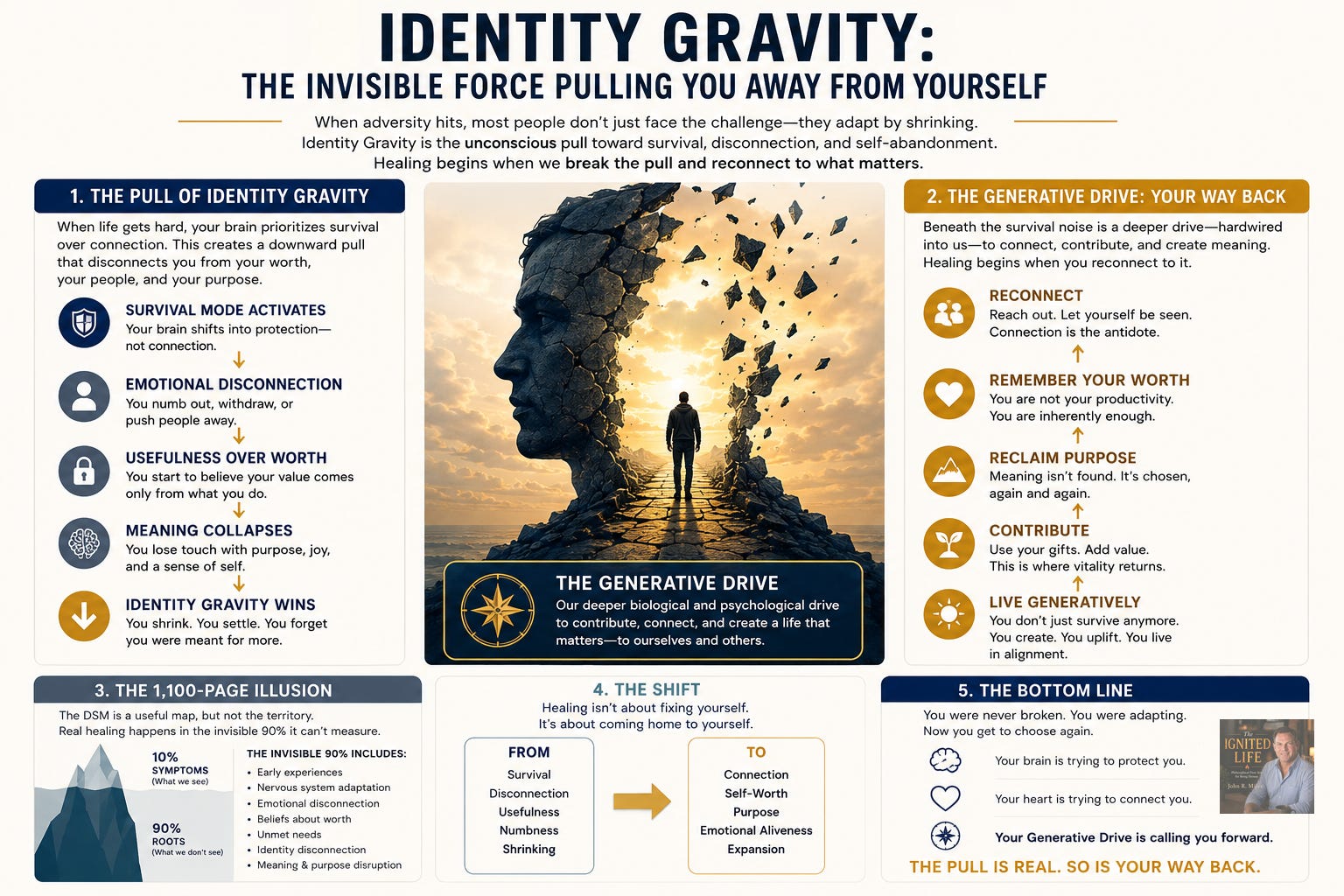
Most high-performers view their habits as choices, but the Identity Gravity Trap reveals that they are actually orbits. When you attempt to change, you aren’t just fighting a “bad habit”; you are fighting the entire ecosystem of your life that was designed to keep you in place.
1. The Identity Vacuum
When you stop being the “Fixer,” you create a sudden silence. To a nervous system that has been “on” for decades, stillness feels like a vacuum. Because you haven’t yet built the “Essential Self” to fill that space, the brain panics.
It views the vacuum as a malfunction and tries to fill it with the only thing it knows: Utility. You snap back not because you want to work, but because you are terrified of the person you might find in the quiet.
2. The Market of You
Identity Gravity isn’t just internal; it’s reinforced by the “Market” around you. As I explored with Nobel Laureate Alvin Roth, markets coordinate behavior. Your family, your boss, and your peers have “purchased” a specific version of you—the one who is responsive, the one who carries the load, the one who never says no.
When you change, you are effectively “de-listing” that version of yourself. The people around you will unconsciously try to pull you back because your Utility is convenient for them, even if it is exhausting for you.
3. The Identity-Utility Feedback Loop This is a self-reinforcing cycle of disappearance:
The Action: You perform a task to prove your worth (Utility).
The Reinforcement: You receive praise or a sense of safety for being “useful.”
The Anchoring: Your identity becomes “The Useful One.”
The Trap: When you try to rest, you feel “useless,” triggering an insecurity response that forces you to return to “Utility” to feel safe again.
The Moral Economics of the Self
Why does it feel so “wrong” to be still?
In my conversation with Roth, we explored Repugnant Transactions—things society could do but finds morally suspect. For the high performer, presence occupies the same moral space.
You have internalized a “Moral Market” where “Being” has zero value and “Doing” is the only currency. When you sit on your porch without a laptop, a voice in your head screams that you are committing a betrayal. You are a “Fixer” who feels morally compromised when you aren’t fixing.
The truth is blunt: The more useful you are as a tool, the more replaceable you are as a human. A hammer is a commodity. If one breaks, you don’t mourn it; you buy another one that performs the same function. If you want to break the gravity of the old sun, you have to stop seeing your aliveness as a waste of time and start seeing it as the only asset you have that cannot be replicated.
Dismantling the Architecture of the Fixer
Breaking identity gravity requires what William James first termed a Noetic Shift—a total shift in how you see. You have to dismantle the three specific traps of Unwise Effort that reinforce your old orbit:
Fixer Avoidance: Using busyness as a shield. If you stay “too busy,” you never have to face the internal questions that require you to be a human instead of a producer.
Fixer Clinging: Gripping the “Commoditized Self” because the “Essential Self” feels like a freefall. You check the project software at 10:00 PM because you’re terrified that if you let go of the machine, no one will be left underneath.
Meaningless Hustle: Filling the vacuum with “busy pebbles” (emails, Slack, chores) so you don’t have to hear the DMN asking: “Who am I when I’m not being useful?”
Achieving Escape Velocity
Escape velocity in physics requires sustained thrust. If the rocket stops firing too early, gravity wins. Your life is no different. To stay in your new orbit, you need architectural rigor:
Pillar 1: The Boundary ADR (Architectural Decision Record)
In software engineering, an ADR is a documented choice that lists trade-offs. Identify the “gravity wells”—the people or apps that pull you back into utility mode. Create a record: “I will offer my ear tomorrow morning, but not my hands tonight.” The trade-off is short-term discomfort for the long-term monopoly of being you.
Pillar 2: Structural Sovereignty
Treat your time as a non-renewable resource. This requires the radical courage to be “unhelpful” to the old system. Move from Provision (providing a service) to Presence (offering yourself).
Pillar 3: The Daily Burn (The 60-Second Floor Protocol)
To stay in orbit, you must fire your engines periodically. Before you cross the threshold of your home, use this somatic anchor:
Feet Planted: Feel the literal weight of your body.
Three Breaths: Signal safety to your nervous system.
DMN Check-in: Ask the question: “Who am I when I’m not being useful?”

The Presence Monopoly
In the architecture of your soul, Labor is a commodity; Presence is a monopoly.
Labor is what can be replaced by AI or a younger “Fixer” within 30 days. Presence is your vitality. It is the unique constellation of your attention that cannot be replicated.
The world doesn’t need more “Fixers.” It needs people who have achieved escape velocity and are finally living in the life they were designed for.
Tonight, when you walk through that door, don’t scan for what needs to be fixed. Just stand still. Feel the floor beneath your feet. Remind yourself: “I am the person who lives here. I am not just the person who maintains the structure.”
Stop trading your monopoly for a commodity. Break the gravity.
Listen to the full exploration on Episode 759 of Passion Struck
Take the Audit: Download the Identity Gravity Audit
Thoughts? Let me know below this essay!
Every 🧡, restack, or comment you share here on Substack
is like a signal flare…..
It helps this message find the person who is still walking
their own “schoolyard” alone.
Thank you for being part of this ecosystem.
I love turning these essays into a two-way conversation
So please let me know your thoughts below.
© John R. Miles 2026. All rights reserved.
Love this! Someone who gets the power of the DMN to help us be and create. Great post
Another wonderful essay, John!
The more I learn about the DMN, the more appreciation I have for it.