

Why Your Brain Rejects "Positive Thinking"
Dr. Deepika Chopra on the Science of Real Optimism and the 7/10 Rule


The woman in the hospital waiting room was a psychologist who specialized in the study of hope. But as she held the manuscript of her book on optimism and listened to a specialist explain her two-year-old son’s rare diagnosis, her expertise felt like a hollow shell.
In that moment, she didn't need inspiration. She needed a way to hold herself together when everything she had built her certainty on had just collapsed.
What she discovered across eighteen months of hospital corridors, sleepless waiting rooms, and small mercies is the core of her work today: real optimism is not a feeling you have. It is a decision about how you explain the world to yourself when the world stops cooperating.
It is a cognitive tool for processing setbacks as temporary and specific, rather than permanent and pervasive. But there is a catch. You cannot simply “choose” to be optimistic if your brain doesn’t believe the story you’re telling it.
This week on Passion Struck, I sat down with Dr. Deepika Chopra, “The Optimism Doctor,” to discuss the mechanics of resilience. We moved past the platitudes of toxic positivity to examine the Believability Threshold—the invisible line where your brain either accepts a new path or shuts down to conserve energy.
The 7/10 Rule: The Logic of Bridge Thoughts
Most of us have tried affirmations. We stand in front of a mirror and say, “I am successful,” or “I am fearless,” even when we feel like we’re drowning.
Deepika explains why this often fails: Your brain has a built-in bullshit detector.
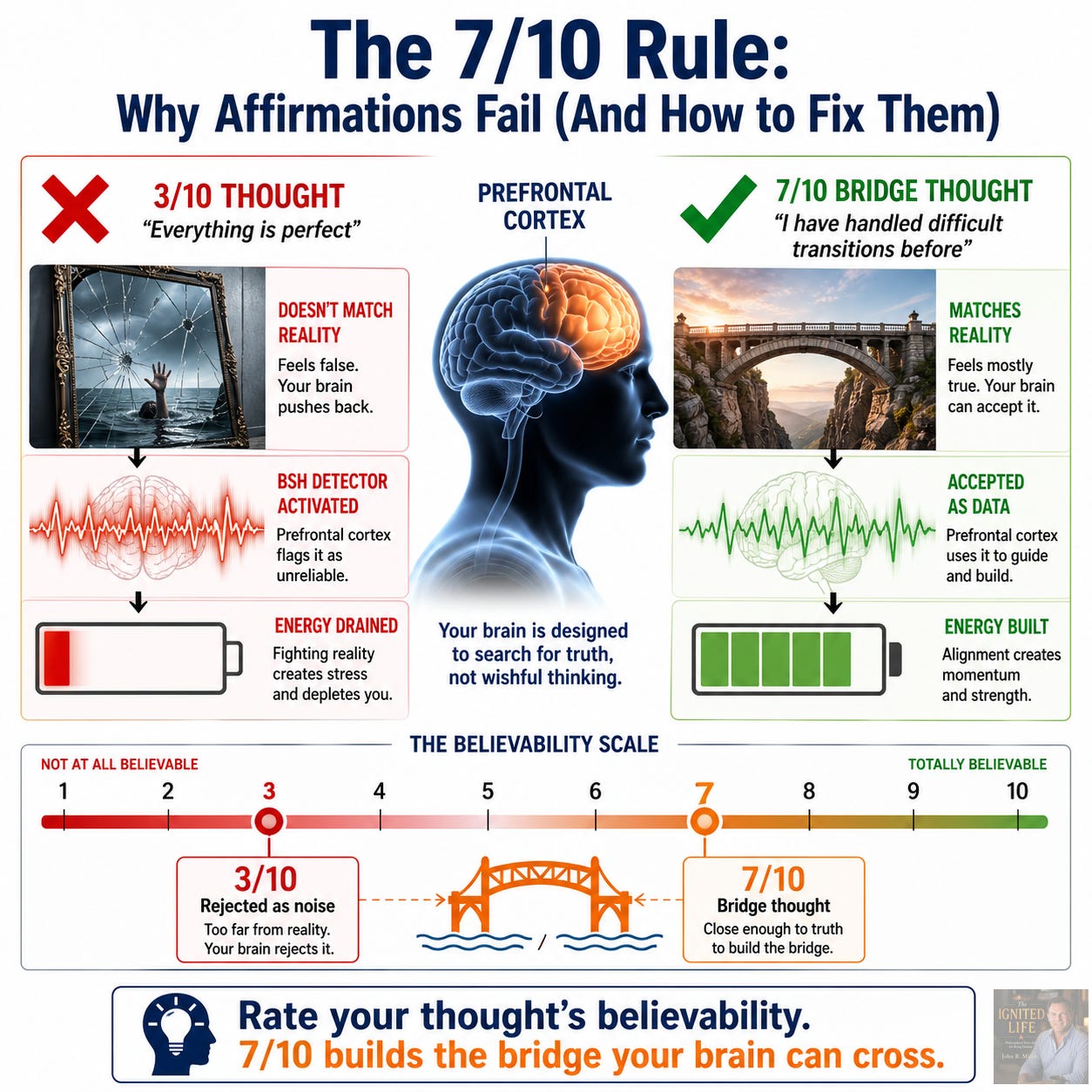
If you offer your mind a thought that feels like a lie, your prefrontal cortex—the part of the brain responsible for planning and goal-directed behavior—rejects it. It sees the gap between your current reality and the affirmation as too wide to cross. Instead of being inspired, you feel more depleted, because you’ve just highlighted the distance between where you are and where you want to be.
The fix is not a better affirmation. It’s a more honest one.
Before you adopt a new narrative, rate its believability on a scale of 1 to 10.
The 3/10 thought: “Everything is perfect.” (Rejected as noise).
The 7/10 bridge: “I have handled difficult transitions before.” (Accepted as data).
When you find a thought that clears the 70% threshold, your brain can actually use it—scanning your environment for evidence that supports it and allocating attention toward variables you can control. This is not manifesting. It is your brain doing its job. Once you give it instructions, it can work with.
Start where the brain can’t argue with you.
Expectancy Is the Engine, Not Desire
We tend to think we are limited by talent or circumstance. Deepika’s research points to something more specific: we are limited by what we expect.
Your brain is an efficiency machine. It doesn’t allocate energy based on what you want; it allocates energy based on what it predicts will happen. If you want a promotion but your internal explanatory style expects rejection, your brain dampens your motivation—not out of sabotage, but out of conservation. Why spend energy on a low-probability outcome?
This is the biology of feeling stuck. It isn’t a willpower failure. It’s a strategic shutdown.
The way out is not to work harder. It is to collect Micro-Evidence—small, believable wins that gradually raise your brain’s expectancy of success. Each 7/10 belief you act on becomes data that effort is worth the investment again.
The Curriculum Warning: Suffering Without the Spin
I often speak about life as a school, but that metaphor requires a warning label. Hardship is not always a lesson sent to teach you something. Sometimes a diagnosis or a loss is simply a brutal fact of being human.
The danger of “Optimism Culture” is that it can slide into victim-blaming: if you’re still suffering, you haven’t learned the lesson yet. Real optimism rejects this entirely. It doesn’t ask “Why did this happen to me?” It asks, “Now that this has happened, what is the most resilient thing I can do next?”
The goal is not to find hidden meaning in the pain. It is to maintain the agency to create meaning despite it.
This is where Moral Beauty becomes practical rather than poetic. When your own life feels like a curriculum of pain, looking outward—witnessing a stranger’s quiet kindness or a friend’s courage under pressure—acts as a neurological reset. It breaks the “pervasive spotlight” of your own suffering. It doesn’t fix the problem, but it reminds your brain that you are part of a larger, functioning human story.

On Mattering
One thread from our conversation that deserves its own moment: the research on loneliness and belonging is not a side note. It is central to the rise in pessimism.
When people feel they don’t matter—to a workplace, a community, a relationship—their explanatory style defaults to a permanent and pervasive one.
The antidote is not a motivational poster. It is a genuine connection, and one of the fastest neurological routes to it is an outward act of kindness. Deepika notes that for people in the grip of depression, prescribing an act of service to someone else can be more immediately effective than prescribing self-care. You cannot think your way into mattering. You act your way there.
Takeaways for the Resilient Architect
Stop affirming, start bridging. Find the 7/10 version of your goal. “I am a success” might be a 2. “I am capable of doing the work required today” might be a 7. Start there.
Audit your explanatory style. When a setback hits, check the label you’re putting on it. Is it Permanent (”this is my life now”) or Temporary (”this is a moment in time”)? The label is a choice.
Validate before you process. Don’t rush to positive vibes. Acknowledge the weight of the moment first. Hope built on denied reality is just a delusion with better branding.
Look for Moral Beauty. When your internal world feels broken, find one external act of virtue. It shifts your focus from your own perceived limits to the vastness of human potential.
Act your way into mattering. If you’re waiting to feel connected before you reach out, you have the sequence backward. Do the small act first. The feeling follows.
Final Reflection
Deepika’s journey from that hospital waiting room to “The Optimism Doctor” shows us that resilience is handmade. It is not a sudden awakening; it is the steady, daily work of choosing a 7/10 belief over a 0/10 lie—and then acting on it before you feel ready.
Where have you been forcing a 10/10 belief that you don’t actually trust? Is it the job title you’re chasing, the relationship you’re trying to fix, or the version of yourself you think you should be by now?
What is the 7/10 Bridge Thought that could actually get you moving today?
Let’s keep this conversation grounded in what works.
Check out the full conversation with Dr. Deepika Chopra Below
Download the FREE Companion Reflection Guide here.
BOOK: https://www.simonandschuster.com/books/The-Power-of-Real-Optimism/Deepika-Chopra/9781668081129
Deepika’s Website: https://www.drdeepikachopra.com/
Thoughts? Let me know below this essay!
Every 🧡, restack, or comment you share here on Substack
is like a signal flare…..
It helps this message find the person who is still walking
their own “schoolyard” alone.
Thank you for being part of this ecosystem.
I love turning these essays into a two-way conversation
So please let me know your thoughts below.
© John R. Miles 2026. All rights reserved.
I would argue that the issue was never affirmations itself, it’s how toxic positivity folks sold it. True affirmation is exactly what the word means, you “affirm” what you intend to be or do, then go act on it. The pivot that hurt people was turning affirmations into a destination rather than a launch pad. The tool was never broken. It was just misused.
This distinction is vital. We’ve all felt the sting of 'Optimism Culture'—that subtle implication that lingering grief or struggle is a failure of perspective. I love how you frame real optimism as a pivot toward agency rather than a search for 'lessons.' It’s the difference between being a victim of your circumstances and being the architect of what comes next. Truly powerful stuff.