

Why You Feel Invisible in a Connected World
The growing mattering gap—and what it reveals about loneliness, belonging, and modern life.


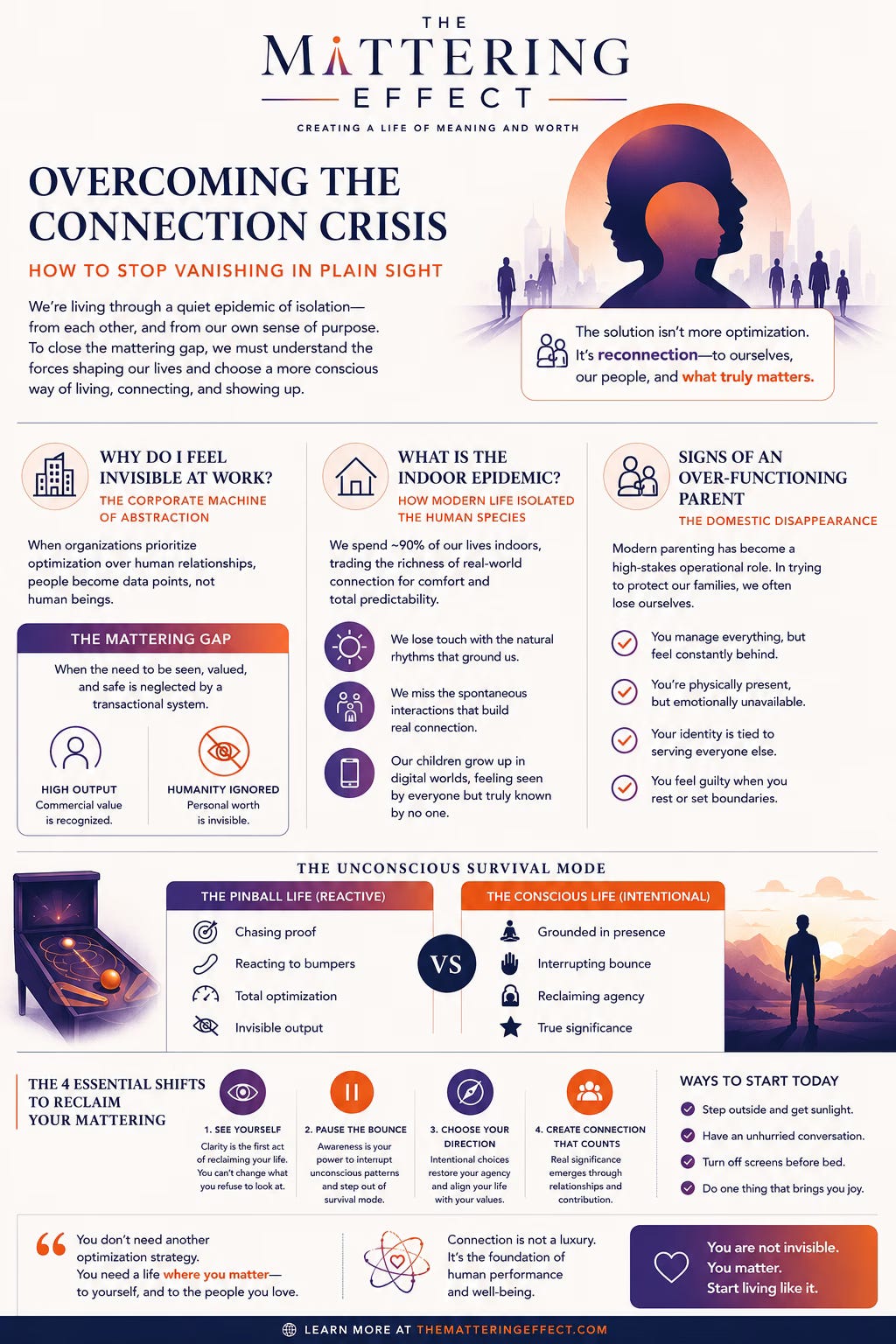
Over the past several years, I have noticed a recurring theme in conversations with people whose lives look very different on the surface. Some were executives leading large organizations. Others were entrepreneurs building successful companies, parents raising families, or students trying to find their place in the world. Their circumstances varied widely, yet many were wrestling with the same question, even if they rarely expressed it directly:
Do I matter?
The question surfaced indirectly. Someone would describe feeling exhausted despite accomplishing goals they had spent years pursuing. Another would admit that although they were surrounded by colleagues, friends, and family, they carried a persistent sense of loneliness. Others spoke about feeling strangely invisible inside organizations that depended on them or within relationships they cared deeply about.
What struck me was that these experiences did not correlate neatly with success, status, income, influence, or even the number of relationships a person maintained. In fact, some of the loneliest people I met were not isolated at all. They were highly connected, deeply involved in their communities, and constantly interacting with others. Yet they still felt disconnected from something they struggled to name.
At first, this appears paradoxical. We tend to assume that loneliness is primarily a problem of insufficient connection. If that were entirely true, modern life should have solved much of it. We can communicate instantly across continents, maintain relationships through digital platforms, and interact with more people in a week than previous generations might have encountered in a month. By almost every measurable standard, we are surrounded by opportunities to connect.
Yet loneliness continues to rise, even as the mechanisms for connection multiply.
The more I reflected on this tension, the more I began to suspect that loneliness is often a symptom rather than the underlying problem. Many people are not simply asking whether they are connected to others. They are asking whether they matter to them. They want to know whether their presence carries weight in the lives of other people, whether they would be missed if they were absent, and whether they are valued for more than the functions they perform.
This distinction may seem subtle, but it changes the conversation entirely. Connection answers the question, “Am I in relationship with others?” Mattering answers the question, “Does my presence have significance within those relationships?” Human beings need both, yet much of modern life has become remarkably effective at providing the first while quietly undermining the second.
The more I explored this distinction, the more I became interested in a growing form of modern invisibility. Many of the people who appear the most connected, accomplished, and engaged are quietly disappearing in plain sight. They are showing up, producing, contributing, and performing, yet increasingly feel unseen within the very systems, organizations, and relationships that depend on them.
That observation became the foundation for my upcoming book, The Mattering Effect. The book explores the hidden forces that cause people to disappear in plain sight and what it takes to reclaim a sense that our presence truly matters in a world that increasingly values performance over presence.
The Cost of Becoming an Abstraction
One of the defining features of modern life is scale.
The organizations we work for are larger than those that existed a generation ago. The institutions shaping our lives operate across countries and continents. Even many of our social interactions now occur through platforms designed to connect millions of people simultaneously.
The benefits of this scale are undeniable. It has expanded access to information, increased economic opportunity, accelerated innovation, and connected people across distances that would once have been insurmountable.
Yet scale introduces a challenge that receives far less attention. Large systems cannot operate through personal familiarity alone. A company with fifty thousand employees cannot function because everyone knows one another’s stories. A healthcare system serving millions of patients cannot rely entirely on intimate relationships. Universities, governments, and digital platforms depend upon categories, metrics, dashboards, and standardized processes because complexity requires simplification.
The result is that large systems inevitably interact with people through abstractions. They see performance indicators, customer segments, demographic categories, productivity measures, and engagement scores. These abstractions are not evidence of bad intentions. They are often the very mechanisms that allow complex organizations to function.
The tension arises because what enables systems to operate efficiently is not always what enables human beings to flourish.
People do not experience themselves as categories or metrics. We come to understand who we are through relationships with individuals who know our stories, recognize our contributions, and acknowledge our unique significance. Recognition is not merely pleasant; it is one of the primary ways human beings construct identity. We learn who we are partly through being seen.
As interactions become increasingly transactional, those experiences become harder to find.
This helps explain a paradox of modern life. Never before have organizations possessed so much information about human performance. Productivity is tracked in real time. Engagement is quantified. Outcomes are measured, analyzed, and compared across increasingly sophisticated systems. Yet many people report feeling less seen than ever before.
The reason is that measurement and recognition serve different functions. Measurement tells us how someone is performing. Recognition affirms that the person performing has value beyond the performance itself.
A performance review can evaluate what you accomplished. It cannot fully capture who you are.
A metric can quantify contribution. It cannot communicate significance.
Over time, people adapt to the environments they inhabit. When systems consistently reward outputs, it becomes natural to invest more of our identity in outputs. Achievement gradually becomes the primary lens through which we evaluate ourselves, and the distinction between what we produce and who we are begins to blur.
This is where the mattering gap begins to emerge. The more people are valued primarily for what they produce, the easier it becomes to lose sight of the person doing the producing. What starts as a structural feature of large systems can slowly become a personal experience of invisibility.

Why Achievement Stops Working
This dynamic helps explain one of the most common paradoxes among high achievers.
Why do so many successful people continue feeling dissatisfied long after reaching goals they once believed would change everything?
The answer is not that achievement lacks value. Achievement can be deeply meaningful. It allows people to develop their talents, contribute to causes they care about, solve difficult problems, and create opportunities for others. Much of human progress depends on people striving toward ambitious goals.
The problem arises when achievement begins carrying a responsibility it was never designed to bear.
Most accomplishments provide a sense of satisfaction because they represent growth, effort, or contribution. Yet they also offer something else: evidence. Evidence that we are capable, valuable, respected, or moving in the right direction. The feeling can be powerful, especially when recognition accompanies success.
Over time, however, it becomes easy to confuse the evidence with the answer.
A promotion may reassure someone that they are valued. Public recognition may create a temporary sense of significance. Professional success may strengthen confidence and self-belief. These experiences matter, and they should not be dismissed.
The difficulty is that their effects are often temporary. The promotion eventually becomes the new baseline. Recognition fades. Success creates new expectations. What once felt like arrival begins to feel ordinary, and the search quietly resumes.
Many people interpret this experience as a sign that they have not achieved enough. They assume the answer lies in the next accomplishment, the next milestone, or the next level of success. Yet the deeper issue is often that they ask achievement to resolve a question it cannot fully answer.
Achievement can demonstrate competence. It can create opportunity. It can expand influence.
What it cannot do is establish enduring significance.
Psychologist Gordon Flett has spent decades studying one of the most overlooked dimensions of human well-being: mattering. His research suggests that many people are not simply searching for achievement, belonging, or self-esteem. They are trying to answer a deeper question: Do I matter to other people, and would my absence be noticed if I were gone?
Significance emerges from a different source. It develops through belonging, contribution, and relationships in which people feel known, valued, and connected to something larger than themselves. Unlike achievement, which depends largely on what we accomplish, significance is rooted in how we are held within the lives of others and the communities we serve.
When those two experiences travel together, life feels integrated. Success becomes an expression of purpose rather than a search for validation. When they become separated, however, achievement can gradually turn into a strategy for securing worth.
This is why some of the most accomplished people continue to feel restless despite extraordinary success. They are not pursuing another goal. They are pursuing reassurance. And no accomplishment, no matter how impressive, can permanently answer a question about human significance.
Success can demonstrate what you can do.
It cannot determine whether you matter.

The Pinball Life
When achievement becomes a source of reassurance rather than an expression of purpose, it begins to change the way people move through the world.
Attention shifts outward. Instead of asking what matters most, people become increasingly preoccupied with what demands attention next. Progress is measured by responsiveness rather than intentionality.
Most of us know what this feels like.
The day begins with a quick glance at a phone. Before we fully enter our own experience, we respond to someone else’s priorities. An email requires attention. A meeting is moved. A notification appears. A deadline changes. A problem emerges. By the end of the day, we may have been active from morning to night while spending surprisingly little time pursuing what we consciously intended.
I think of this as the pinball life.
Inside a pinball machine, the ball is in constant motion. It ricochets from one bumper to another, moving rapidly enough to create the appearance of momentum. Yet the ball is not directing its movement. Its path is determined by the forces acting upon it.
Many people now experience life in much the same way.
Their days are filled with activity, but much of that activity is reactive. Attention is pulled from one demand to the next, one expectation to another, one interruption to the next source of urgency. The pace can feel productive because movement is visible. What often remains invisible is whether that movement is aligned with what matters.
The modern world rewards responsiveness. Organizations value availability. Digital platforms compete for attention. Professional cultures often celebrate those who can absorb the greatest volume of demands while continuing to perform at a high level.
These capabilities have value. The problem arises when responsiveness becomes our default relationship with life.
Responsiveness is not the same thing as agency.
Agency requires authorship. It requires the capacity to decide what deserves our attention, our energy, and our time. It involves acting from intention rather than continually reacting to circumstance.
The greatest danger of the pinball life is not exhaustion, although exhaustion often follows. The deeper cost is that people gradually lose their sense of ownership over their experience. Life begins to feel as though it is happening to them rather than being shaped by them.
When that happens, it becomes increasingly difficult to experience a sense of significance. Mattering requires participation. It requires the sense that our choices shape the direction of our lives and that our presence makes a meaningful difference in the relationships and communities we inhabit.
A pinball may be in motion all day long.
But motion and agency are not the same thing.
What Wall-E Understood About Human Nature
One reason WALL-E continues to resonate years after its release is that it identified a tension that has only become more relevant with time.
The film is often described as a warning about technology. Yet technology is not really the central problem aboard the Axiom. The ship’s passengers are comfortable, entertained, and cared for. Their needs are anticipated before they arise. Decisions are simplified. Friction is removed. Life has been optimized for convenience.
What has disappeared is participation.
The passengers no longer meaningfully shape their own experience. They consume, observe, and react, but they rarely create, contribute, or engage. Their lives are organized around comfort rather than involvement.
This distinction matters because human beings do not derive meaning simply from what they receive. We derive meaning from what we help create.
People become attached to gardens they cultivate, communities they help build, children they raise, causes they serve, and relationships they invest in. The effort involved is not an unfortunate cost attached to meaning. It is often the source of meaning itself.
This is one of the paradoxes of modern life. We work tirelessly to eliminate inconvenience, uncertainty, and discomfort, yet many of the experiences that make life feel significant require all three. Contribution requires effort. Responsibility creates obligation. Deep relationships demand vulnerability. Participation inevitably introduces friction.
Comfort has value. Convenience has value. Few people would choose to abandon the advances that have improved modern life.
The challenge emerges when convenience begins to replace participation rather than supporting it.
Seen through this lens, WALL-E is not primarily a story about technology. It is a story about what happens when people gradually stop authoring their own lives. The film’s deepest insight is that human beings lose something essential when they become spectators to experiences they were meant to help create.
Beyond the Connection Crisis
This is why I believe the challenge facing modern society extends beyond loneliness.
Loneliness matters. But loneliness is often a symptom of something deeper: the feeling that our presence no longer carries weight in the lives of other people.
The desire to matter is one of the deepest organizing forces in human life. People invest in relationships where they feel valued. They commit to communities where they feel needed. They persevere through difficulty when they believe their efforts make a meaningful difference. Mattering does not eliminate hardship, but it changes our willingness to endure it.
When those signals weaken or disappear, motivation often erodes alongside them. People may continue to perform, contribute, and fulfill responsibilities, yet many do so while carrying a persistent sense of invisibility.
The challenge before us, then, is not simply to help people feel more connected. It is to rebuild the conditions under which people can feel seen, valued, and significant again.
Because the opposite of mattering is not loneliness.
It is invisibility.
And few human experiences are more painful than slowly disappearing in plain sight.
Listen to the Full Ad-Free Episode Below:
Download the FREE Companion Guide & Digital Workbook
Thoughts? Let me know below this essay!
Every 🧡, restack, or comment you share here on Substack
is like a signal flare…..
It helps this message find the person who is still walking
their own “schoolyard” alone.
Thank you for being part of this ecosystem.
I love turning these essays into a two-way conversation
So please let me know your thoughts below.
© John R. Miles 2026. All rights reserved.
John, I shared your article with close friends who were athletes.
We were at a book promotion gathering last weekend of former college athletes. Sports have always been a huge part of our life.
One of my husband’s teammates, and our close friend, was one of the panel of speakers. He also is the only pro football player to have summited Mt. Everest. And the 7-summits.
My point: there is much discussion about how detrimental it is for the individual growth and connection of these young athletes in college who some are now being paid millions of dollars at 18 yo, can move through the portal to another university, on a whim for the dollars.
My husband’s football group (who played decades ago) have the unique human experience of strong friendships and connections that have become even more valuable with time.
They feel a page has been turned in college sports that may never be recaptured.
The growth of the individual due to a commitment to teammates.
Endurance as you gut it out to put out your best effort. Learning about yourself as you grow due to challenge. Self-esteem!
The loss that comes for young athletes from thinking being paid millions gives personal value and self-esteem that lasts beyond the limelight. Unfortunately, all too often it doesn’t.
Much of the interpersonal connection, working hard in every play so you don’t let down your teammates, building friendships that last a lifetime is disintegrating.
The kids may not know the quality of their experience is not the same, but former athletes and fans feel regret over dollars replacing value placed on longstanding commitment to overcome right where you are!
I’m on my soapbox over this. Complex topic.
(U of O Ducks are in my city)
Human value and connection is no longer the emphasis.
Wins and TV stats for commercialism success is the name of the game.
Interesting insights — I had never thought about it this way before. I do agree that the opposite of mattering is not loneliness. For me, loneliness is the absence of like-minded people who understand me, share similar world views, and just feel familiar. For me to matter to others, I feel they need to get value from whatever I provide. However, for someone to matter to me, simply liking them is enough — because appreciating someone for who they are is, in itself, a form of value