

Why So Many People Keep Starting Over
Eric Zimmer on sustainable change, self-compassion, and the hidden exhaustion of constantly trying to reinvent ourselves


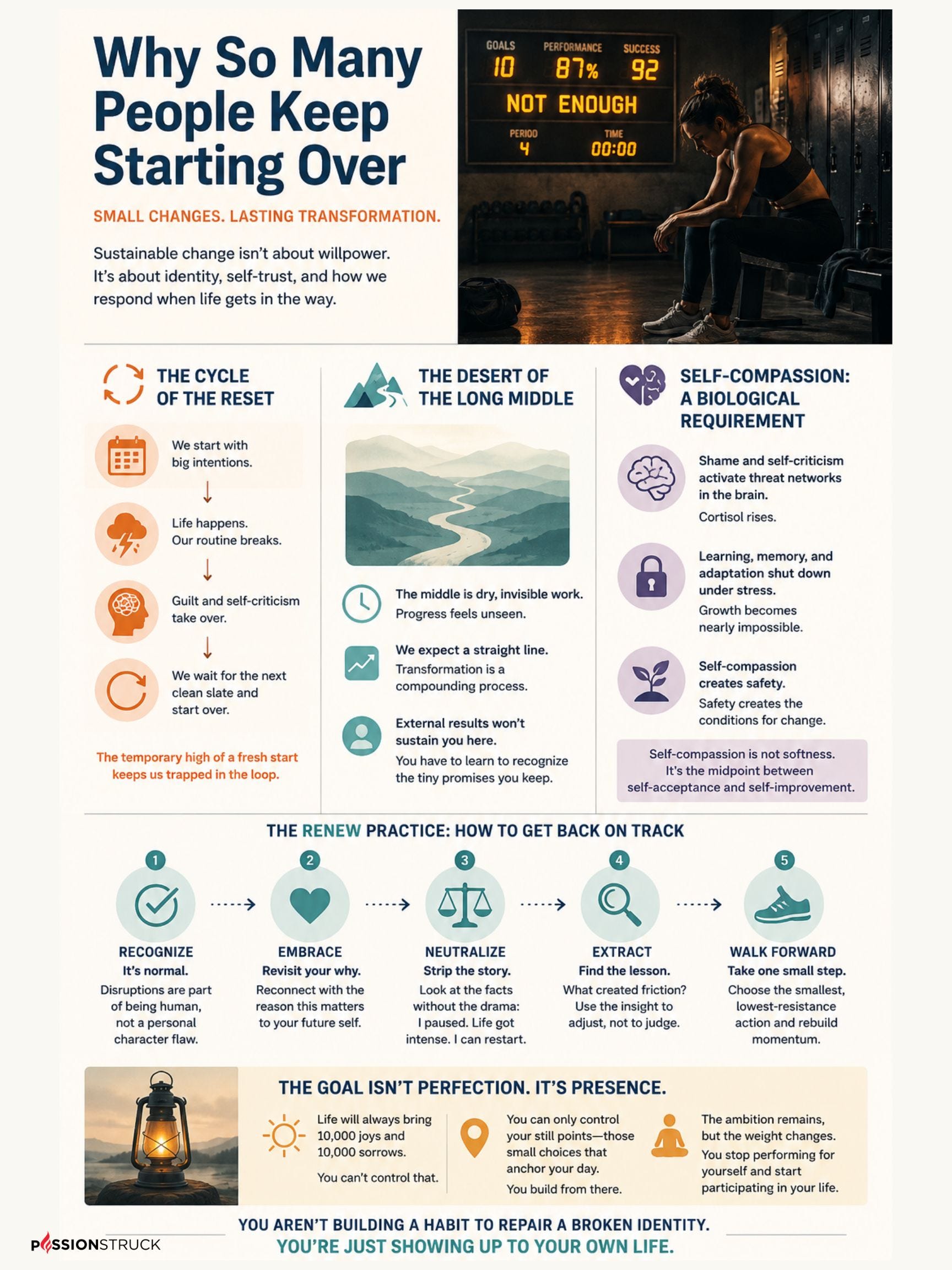
Every Sunday evening, millions of people quietly make a pact with themselves. They decide that tomorrow, everything changes. They resolve to wake up earlier, eat cleaner, work out harder, and finally become the highly optimized version of themselves they have been chasing for years.
By Thursday afternoon, the friction of real life inevitably hits. A sick child, an unexpected work deadline, or pure physical exhaustion derails the plan. The routine shatters. Instead of simply picking up where they left off, they abandon the effort entirely, retreating into a familiar cloud of guilt and self-criticism.
Then comes the wait. We look for the next clean slate—the next Monday, the next month, or the next New Year—to try again.
We have built an entire culture around the exhausting cycle of the perpetual reset. We are deeply addicted to the high of starting over, yet completely unequipped to handle the messy reality of staying the course.
When behavioral coach and host of The One You Feed, Eric Zimmer, re-joined me on the Passion Struck podcast, we pulled back the curtain on this exact phenomenon. What we uncovered is a truth that challenges the entire foundation of modern self-help: our struggle to sustain change has very little to do with a lack of willpower, and everything to do with a profound crisis of identity and self-trust.
The Hidden Exhaustion of Reinventing Yourself
There is a quiet weariness that comes from living in a culture obsessed with constant self-reinvention. We collect habits like software updates. We scroll through complex daily routines, perfectly timed biohacks, and morning schedules, tracking our performance on internal scoreboards.
But the scoreboard sets up a fragile psychological contract.
When your sense of worth is tied to flawless execution, a missed day isn’t just a lapse in behavior—it feels like an identity failure. You don’t just skip a workout; your internal critic steps in to convince you that you are fundamentally broken.
That is why starting over feels so seductive. It offers the temporary high of a clean slate, a brief relief from the weight of our own self-rejection. But if the underlying emotional relationship with yourself remains unchanged, the new routine will eventually collapse under that exact same weight.
The Desert of the Long Middle
Every journey of personal evolution eventually hits a wall. Behavioral scientists call it the long middle.
It is the dry, unglamorous stretch of road that exists between the initial wave of novelty and the ultimate arrival at a goal. In the beginning, you are fueled by the excitement of a fresh start. At the end, you are pulled forward by the finish line.
But in the long middle, the effort feels entirely invisible.
Writing a single paragraph or walking for ten minutes doesn’t change your life by Tuesday morning. The trap of the long middle is that we expect a linear path, but human transformation is a compounding process. If you only validate yourself when you see massive external results, your nervous system will naturally rebel when the experience gets dry.
We have to learn to register success differently. Surviving this space requires recognizing the tiny, quiet micro-promises we keep to ourselves. It is not about checking off a grand outcome; it is about acknowledging the choice right in front of us.

Neutralizing the Emotional Drama of a Setback
The people who manage to sustain change over the long haul don’t have more willpower than anyone else. They just have a different relationship with failure.
Most of us treat a routine disruption like a catastrophic event that ruins the entire journey. But life updates—vacations, emergencies, seasons of deep stress—are statistical certainties. They are a natural part of being human.
When we get off track, our default habit of thought is to layer the event with intense emotional drama. We historicize it.
A missed workout somehow becomes retroactive evidence for every abandoned project, every half-finished book, and every broken promise that came before it.
To break this loop, Eric uses a streamlined process he calls a renew practice. The core of it isn’t a complex checklist; it is an exercise in emotional sobriety.
First, you recognize that dropping the ball is normal. You embrace the foundational why behind your choices. But the true pivot point is learning to neutralize the emotional drama. You strip away the catastrophic stories and look strictly at the facts: I was practicing a behavior. Life got intense, and I stopped. Now I am going to restart.
You don’t need any more story than that.
From there, you extract the objective lesson about what caused the friction, and you walk forward with the smallest, lowest-resistance action available. If you fell off your exercise routine, you don’t stress about a grueling hour-long session; you step out the door for a five-minute walk. You reset the momentum without demanding perfection.

Self-Compassion as a Biological Requirement
This requires an internal shift that runs counter to everything high performers are taught. We are conditioned to believe that a harsh internal critic is our most reliable motivational engine. We fear that if we are kind to ourselves when we fail, we will become soft, lazy, and complacent.
But the brain does not learn well under chronic internal threat.
Shame and self-loathing actively trigger the threat networks of the brain. When your system is flooded with cortisol, the neural centers responsible for learning, memory, and behavioral adaptation shut down. You cannot build a more resilient version of yourself while your nervous system feels like it is constantly under siege from within.
Self-compassion is not an act of soft self-indulgence; it is a biological requirement for growth. It is the essential midpoint between self-acceptance and self-improvement. It is the capacity to look at an imperfect attempt and say, “That effort wasn’t right, but I have the capability to adapt and try again.”
Shifting away from an abusive internal voice takes thousands of silent repetitions. It means catching the inner critic mid-sentence and choosing the supportive tone of an encouraging mentor instead of an executioner.
Finding Still Points in an Uncertain World
Much of our frantic obsession with self-reinvention is actually an attempt to outrun uncertainty. We live in a world of rapid disruption, and we mistake hyper-optimization for safety. We assume that if we can perfectly control our habits, we can insulate ourselves from the unpredictable pain of being human.
But life doesn’t honor our scripts. It arrives as a messy coexistence of the 10,000 joys and 10,000 sorrows.
At any given moment, both are true. You can be in a rewarding season of personal growth while simultaneously navigating a family health crisis or deep professional doubt. When we view our lives strictly as a self-improvement project to be solved, we forfeit our capacity to experience meaning in the present. We check into a beautiful vacation spot and instantly ruin the experience by projecting future anxieties.
The return to the present requires finding what Eric calls still points—brief checkpoints built into the chaos of the day where you anchor yourself back into your physical senses. It doesn’t require a silent retreat. It happens when you pause on a morning walk to notice the quiet dark, or take thirty seconds at your desk to listen to the room.
Your senses are the ultimate portal back to reality.
The Weight of the Scoreboard
Choosing low-resistance actions doesn’t mean the static in your head goes completely silent. The internal critic doesn't vanish; it just loses its teeth. The long middle will still have days that feel entirely pointless.
But you stop treating your worth like a stock price that needs to be defended before the closing bell.
We spend so much of our lives waiting for the version of ourselves that has it all figured out—the one who never slips, never gets tired, and never defaults to old comfort. We keep starting over because we are terrified of letting the current, flawed version of us be seen.
When you focus on the single, tiny choice right in front of you, the architecture shifts. You aren’t building a habit to repair a broken identity; you’re just showing up to your own life. The ambition remains, but the desperation leaves.
You find a strange, quiet kind of peace in realizing that the scoreboard was an illusion all along. You can finally step off the field.
[Read the FREE Companion Guide & Digital Workbook for this post.]
What about you?
Have you ever found yourself trapped in the exhausting cycle of starting over? How do you quiet your harsh internal critic when your routines get thrown off track?
Drop a comment below. And if this resonated, share it with someone who needs the reminder—they might just be waiting for permission to stop performing and start healing.
Listen to Episode 772 with Eric Zimmer for the full conversation on breaking the cycle of self-improvement burnout, mastering the renew framework, and reclaiming self-trust.
Thoughts? Let me know below this essay!
Every 🧡, restack, or comment you share here on Substack
is like a signal flare…..
It helps this message find the person who is still walking
their own “schoolyard” alone.
Thank you for being part of this ecosystem.
I love turning these essays into a two-way conversation
So please let me know your thoughts below.
© John R. Miles 2026. All rights reserved.
This resonated so much. I believe that the importance of relating with ourselves with compassion cannot be emphasized enough.
It may sound simplistic, but living in the moment is key, right now, today. It’s too heavy for any human to drag yesterday’s disappointments or failures. And fears about our performance or role tomorrow, totally destroys living a fulfilling life today.
Self-acceptance and self-compassion eliminate much of the angst we can inflict upon ourselves.