

The Fire of Self-Leadership
The R.E.A.C.T. Method: A 5-step framework for staying grounded when your nervous system wants to do anything but.

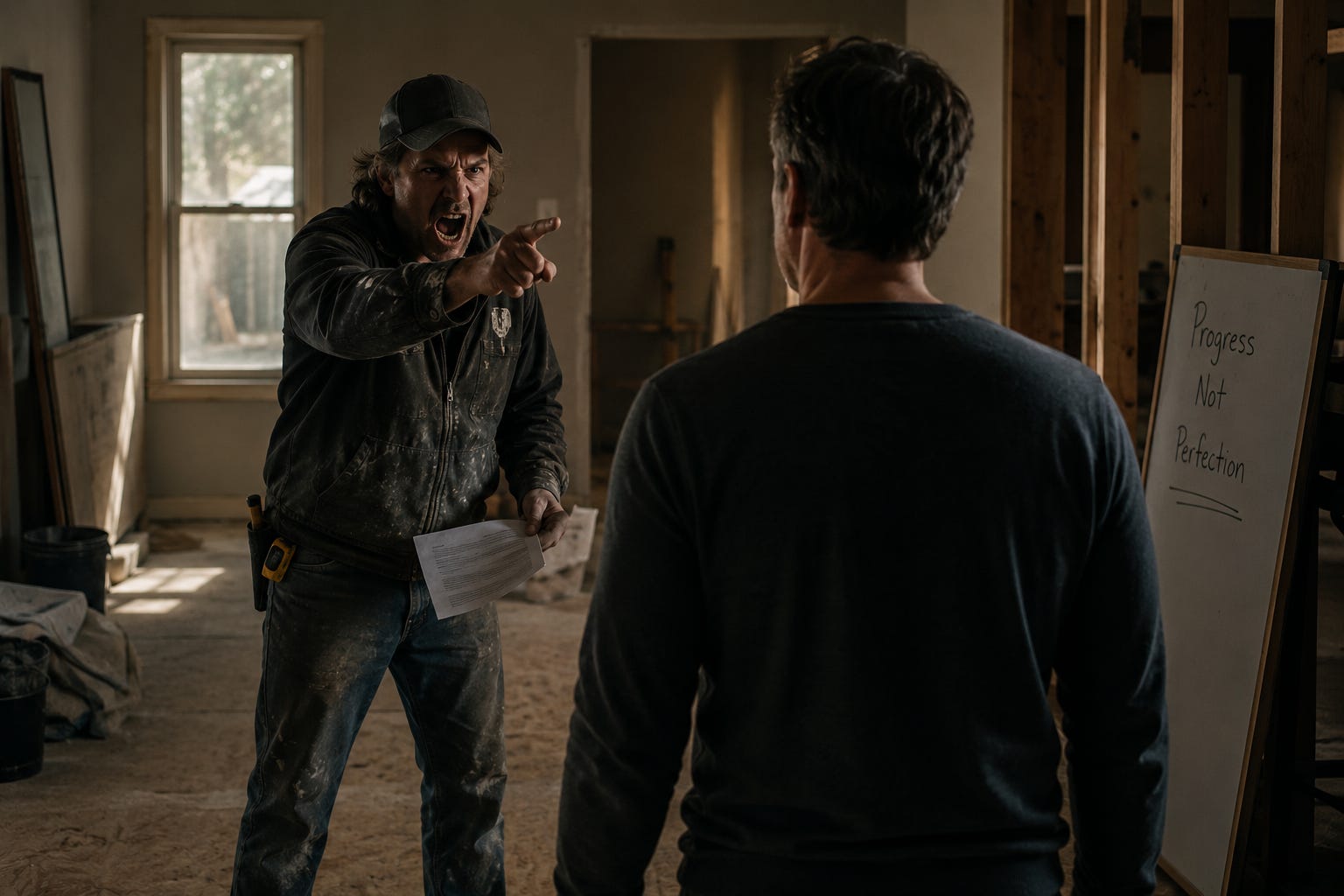
The confrontation didn’t happen in a corporate boardroom or under the polished spotlights of a speaking stage. It happened on the dusty, bare subflooring of my half-finished family room.
I was standing there staring at a patch of grout that was completely different from the color we had chosen, holding a surprise invoice that had suddenly doubled in cost with absolutely no breakdown or warning. Before I could even process the drop in my stomach, the contractor started shouting.
He didn’t offer an explanation or try to clarify the discrepancy. He simply unleashed his anger, questioning my integrity, bringing up God, and threatening to walk off the job entirely—leaving our home in mid-remodel chaos with weeks of work remaining and no resolution in sight.
In that single beat, something inside me fractured.
For the past eight months, my life had been dictated by a grueling version of survival mode. When Hurricane Helene tore through, it literally washed away everything we owned. Every day since had been an exhausting blur of nonstop decisions, constant compromises, and a relentless effort to manufacture some semblance of stability out of complete devastation. I was running on empty, and this broken room was supposed to be a step toward healing.
I tried to remain steady. I pointed out the invoice discrepancy and asked fair questions about the grout, but his volume kept climbing, and my own internal temperature started to rise with it. I could feel my jaw lock, my voice sharpen, and my chest tighten as a massive wave of adrenaline flooded my system.
It was the classic biological trap: fight or flight. In moments like that, the real test of leadership presents itself. It has nothing to do with winning an argument or performing a clean version of professionalism. The true challenge is whether you can access clarity when your entire nervous system is screaming for defense, choosing to respond from the person you want to be rather than the reactivity that feels entirely justified in the heat of the moment.
The Hidden Biology of the Amygdala Hijack
When someone is screaming in your face, your brain completely stops prioritizing strategic leadership and focuses entirely on primal survival.
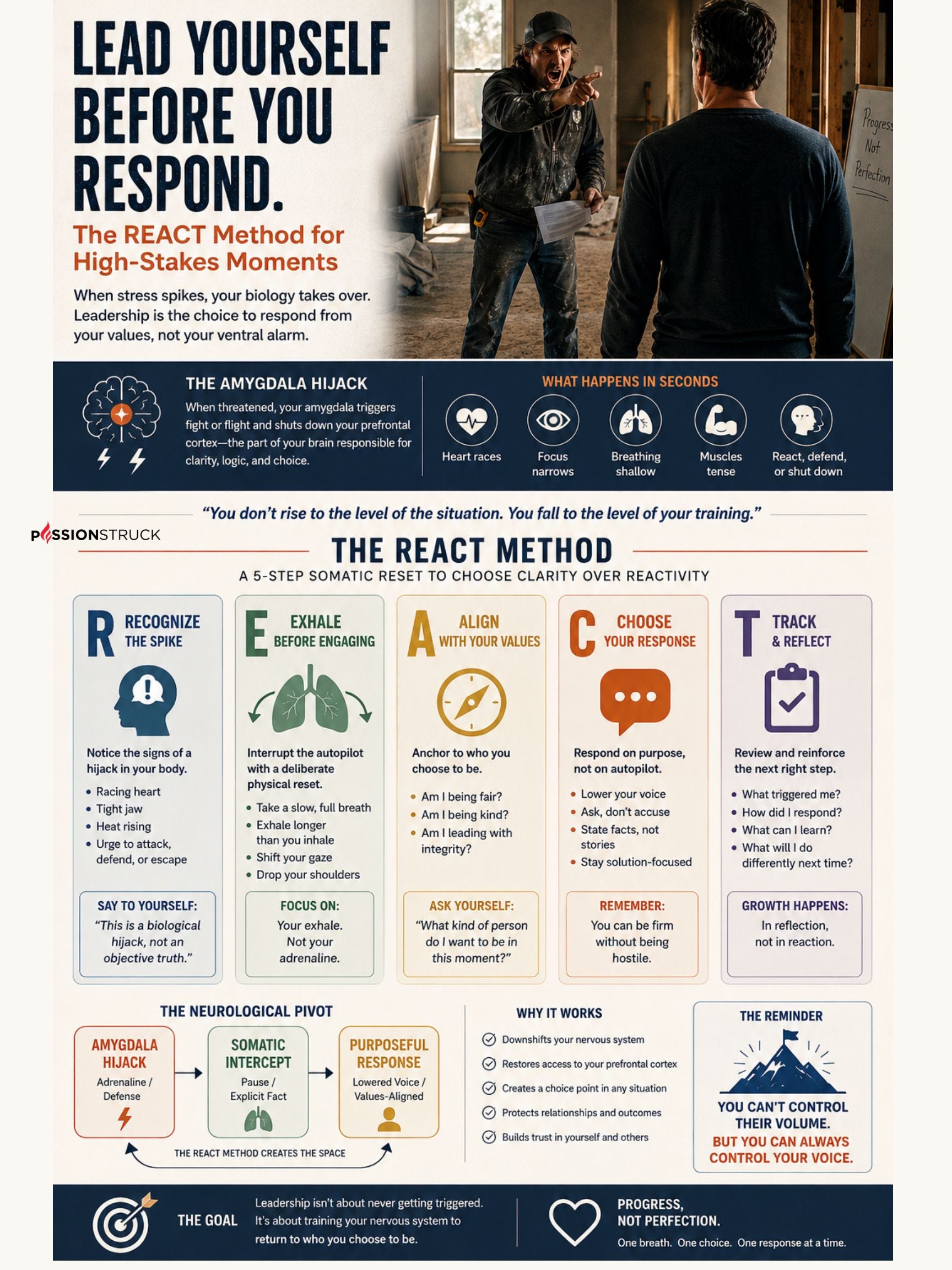
Psychologists refer to this immediate neurological shift as an amygdala hijack. The emotional center of the brain detects an existential threat and effectively cuts off communication to the prefrontal cortex—the rational, logical engine responsible for self-awareness and deliberate choice. Your perception narrows to a pinhole, your breathing shallows, and your muscles prime themselves for a collision.
The real tragedy of this biological response is that it renders your standard mental toolkit temporarily inaccessible. You can read every book on mindfulness and emotional regulation, but when the adrenaline surges, those intellectual concepts feel miles away.
During a recent conversation on my podcast, Johns Hopkins-trained neurologist Dr. Majid Fotuhi noted that high-octane stress can physically damage brain synapses, while author Dr. Anna Lembke pointed out that our modern, overstimulated lives leave our nervous systems perpetually hyper-activated. We live in a culture that has intensified every stimulus, meaning it takes very little friction to tip us over the edge from reflection into raw reaction.
Standing in that unfinished room with a shouting contractor, I wasn’t consciously choosing clarity. I was experiencing a biological defense mechanism.
If you don’t understand the somatic reality of how your body reacts when it feels cornered, you will easily mistake your reactivity for righteousness. You will look at your raised voice and call it “setting a firm boundary,” or view an emotional shutdown as “self-protection.” You might feel completely vindicated in the moment, but you rarely feel proud when the dust settles.
Moving From Autopilot to Awareness: The R.E.A.C.T. Method
Interrupting this automated survival script requires a structured process that can be deployed in the two seconds between a provocation and a response. To navigate these high-stakes moments without losing my character, I rely on a simple behavioral sequence designed to downshift the nervous system under fire: the react method.
The strategy doesn’t require complex intellectual gymnastics; it is a somatic reset that unfolds in real-time.
The Neurological Pivot:
┌─────────────────────────┐      ┌─────────────────────────┐
│   The Amygdala Hijack   │ ───➔ │  The Somatic Intercept  │
│ (Adrenaline / Defense)  │      │ (Pause / Explicit Fact) │
└─────────────────────────┘      └─────────────────────────┘
                                              │
                                              ▼
                                 ┌─────────────────────────┐
                                 │ The Purposeful Response │
                                 │ (Lowered Voice / Value) │
                                 └─────────────────────────┘
The REACT Method begins by recognizing the spike. The moment your heart starts racing, and your internal script demands that you dominate or withdraw, you have to explicitly name the sensation. Saying to yourself, “This is a biological hijack, not an objective truth,” immediately creates a microscopic layer of distance between the emotion and your behavior. You cannot lead yourself through a crisis if you refuse to acknowledge that you are currently melting down.
The second step is to force an intentional physical interruption: exhale before engaging. Your biology wants to speak instantly from a place of panic, but taking a single deliberate breath or shifting your gaze breaks the automated pattern.
From that brief pocket of space, you pivot to aligning with your values. You stop evaluating what is “fair” or what will make you look powerful, and instead ask a single orienting question: What does integrity look like right now? This instantly shifts the focus away from defending a bruised ego and anchors it back to your personal standard of character.
Once anchored, you can explicitly choose your response. You bypass the emotionally explosive option in favor of a clear, sustainable statement of boundaries. Finally, well after the conflict has cleared, you take time to reflect, evaluating where you held your ground and where your architecture slipped so that the experience builds actual resilience for the next encounter.
What It Looks Like to Stay in the Fire
When that contractor threw his hands up and invoked divine judgment over a basic business invoice, the urge to go toe-to-toe with him was overwhelming. Every instinct told me to match his fire with my own.
Instead, I used that tiny two-second window to practice what I preach. I stopped talking entirely. I turned my head, looked out the frame of the window at the Florida landscape, and took a deep, slow breath to ground my feet onto the subfloor.
It wasn’t a performance of zen-like calm; it was a matter of practical self-preservation. I knew that if I spoke from that triggered place, it would be my wounded ego doing the talking, not my best self.
When I turned back, I deliberately lowered the volume of my voice.
“I hear that you feel disrespected,” I told him calmly. “And I need you to hear that I am simply trying to understand this billing discrepancy and the mistake with the grout so we can finish this project with absolute clarity.”
He tried to pull me back into the shouting match, interrupting and pacing the room. But I refused to match his energy. I repeated the statement clearly, remaining anchored to my own physical presence. When it became completely obvious that he was incapable of meeting me in a rational space, I calmly stepped away and ended the conversation for the day—not to punish him, but to protect the peace I had worked so hard to rebuild over the last eight months.
I didn’t handle the situation perfectly, and I certainly didn’t enjoy it. But I stayed inside my own skin. I didn’t abandon my values just because someone else couldn’t manage theirs, and that is where real self-trust is quietly forged.

Rebuilding Identity on Unfinished Flooring
Growth rarely looks glamorous when it is actually happening. It doesn’t look like an inspirational quote or a clean redemption arc.
True emotional maturity looks like standing in a broken, half-rebuilt house with your heart pounding against your ribs, consciously choosing not to scream back at a broken system. It is the invisible work that happens when you want to punish someone, but choose to breathe instead.
Nobody applauds you for the arguments you choose not to have. There is no highlight reel for the moments you maintain your composure in an empty room. But that unglamorous friction is exactly where your character is tested and formed.
The true work of building an intentional life isn’t just about how we navigate our external relationships when things are smooth. It is fundamentally about how we lead ourselves when we are pushed directly to our absolute edge, refusing to let the chaos around us dictate the humanity within us.
[Read the FREE Companion Guide & Digital Workbook for this post.]
What about you?
Where in your life do you feel most reactive right now? When a conflict catches you by surprise, what is the physical signal that tells you your nervous system has been hijacked?
Drop your thoughts in the comments below. Let’s turn this into an honest conversation about the messy reality of staying grounded when the environment around us is still unfinished.
Eric Zimmer and Dr. Anna Lembke are past guests on Passion Struck. Listen to Episode 627 for the complete masterclass on navigating emotional triggers, mastering somatic presence, and utilizing the REACT framework under pressure.
Thoughts? Let me know below this essay!
Every 🧡, restack, or comment you share here on Substack
is like a signal flare…..
It helps this message find the person who is still walking
their own “schoolyard” alone.
Thank you for being part of this ecosystem.
I love turning these essays into a two-way conversation
So please let me know your thoughts below.
© John R. Miles 2026. All rights reserved.
Yes, the amygdala…it can make us want to go into fight or flight.
Even so, we can choose to hold back. We can take breath. We do it for ourself, so we don’t regret.