

How to Rebuild Your Brain in 12 Weeks
Johns Hopkins neurologist Dr. Majid Fotuhi’s science-backed protocol to reverse cognitive decline — plus your free Invincible Brain companion guide


We have been taught to view the human brain as a high-performance machine with a predetermined expiration date. We watch our parents or grandparents struggle with memory, and we assume that a similar flickering out is our inevitable destiny. Every time we forget a name or misplace our keys, a small part of us wonders whether the foundation is starting to crumble.
But after spending hours with Dr. Majid Fotuhi, a Johns Hopkins-trained neurologist who has spent three decades analyzing tens of thousands of MRIs, I’ve realized that our cultural narrative of the fragile brain is fundamentally flawed.
The most important takeaway from our conversation is this:
Reversing cognitive decline is not a medical miracle; it is a biological process. And because it is a process, it can be redirected.
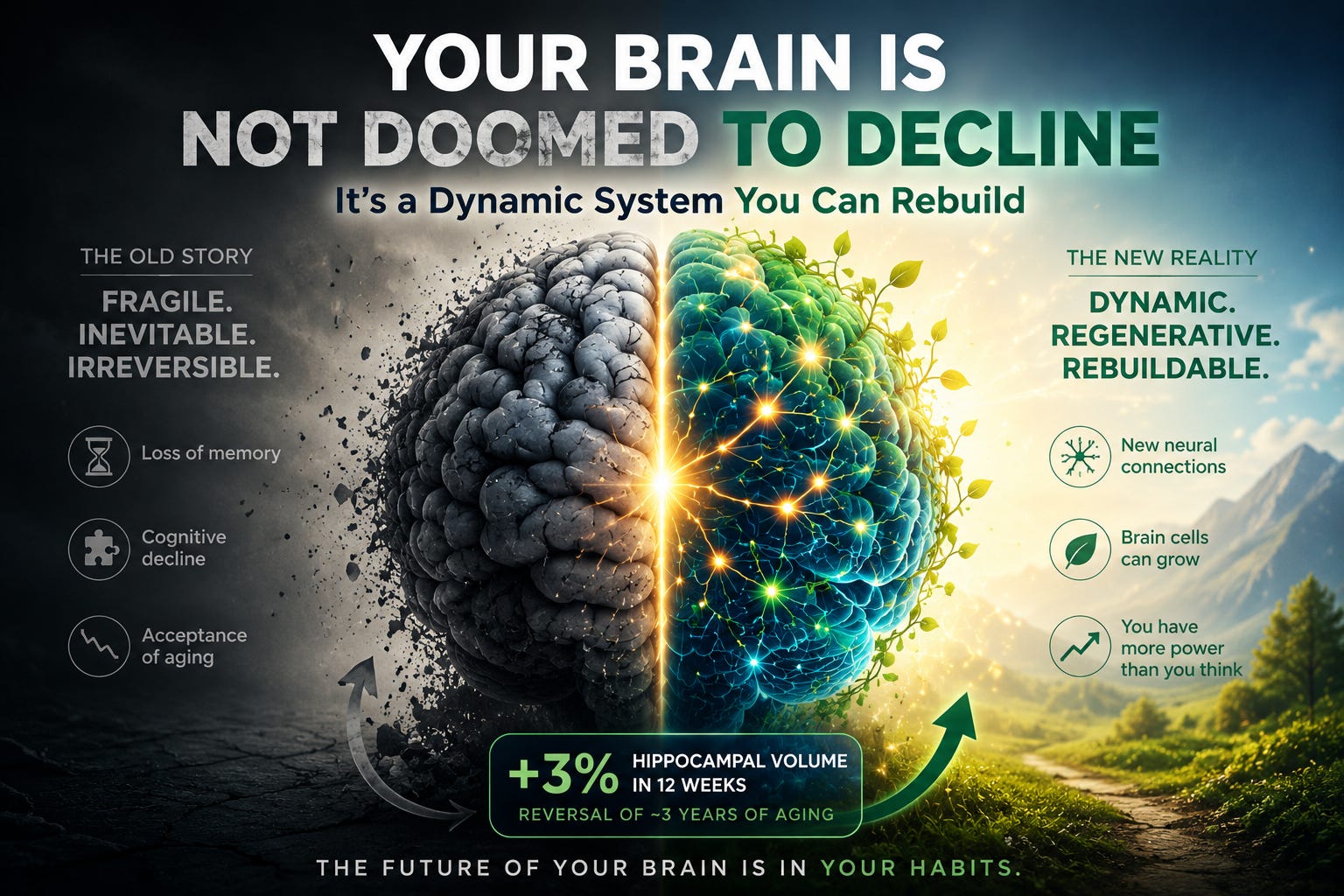
Dr. Fotuhi’s clinical data reveal that the brain is not a static organ waiting to fail. It is a dynamic, adaptive muscle. In his studies, patients with Mild Cognitive Impairment (MCI) didn’t just slow their decline—they physically regrew their brains. In as little as 12 weeks, they saw a 3% increase in their hippocampal volume.
To understand the magnitude of that, the hippocampus (the brain’s center for memory and learning) typically shrinks by 1% per year after middle age.
These patients essentially “clawed back” three years of biological aging in three months.
If you want to move from a state of fear to a state of agency, you have to stop looking for a cure and start looking for a rebuild. Here is the blueprint for reversing cognitive decline through the Invincible Brain protocol.
The Misdiagnosis of Fate: Is it Alzheimer’s or a Soup of Problems?
One of the greatest barriers to reversing cognitive decline is the cloud of fear surrounding the word Alzheimer’s. In the current medical landscape, we often use Dementia and Alzheimer’s interchangeably, but the distinction is where your agency lives.
Dementia is a syndrome—a collection of symptoms—while Alzheimer’s is a specific neurodegenerative disease. Dr. Fotuhi argues that we are currently in an epidemic of misdiagnosis. Many people are labeled with irreversible Alzheimer’s when they are actually suffering from a “soup of problems” that are entirely modifiable.
When a brain appears to be failing, it is often reacting to specific, untreated “ingredients” in that soup:
Vascular Congestion: Small, “silent” mini-strokes that go unnoticed but cumulative.
Sleep Apnea: Starving the brain of oxygen for eight hours every night.
Chronic Cortisol: High-octane stress that physically melts the synapses.
Nutritional Inflammation: A diet that acts as a slow-burning fire in the neural pathways.
When you treat the individual ingredients, you change the soup. By identifying these modifiable factors early, reversing cognitive decline moves from a hope to a clinical reality.
Here’s a clear visual of Dr. Fotuhi’s Invincible Brain System — the five pillars that work together to rebuild brain health:
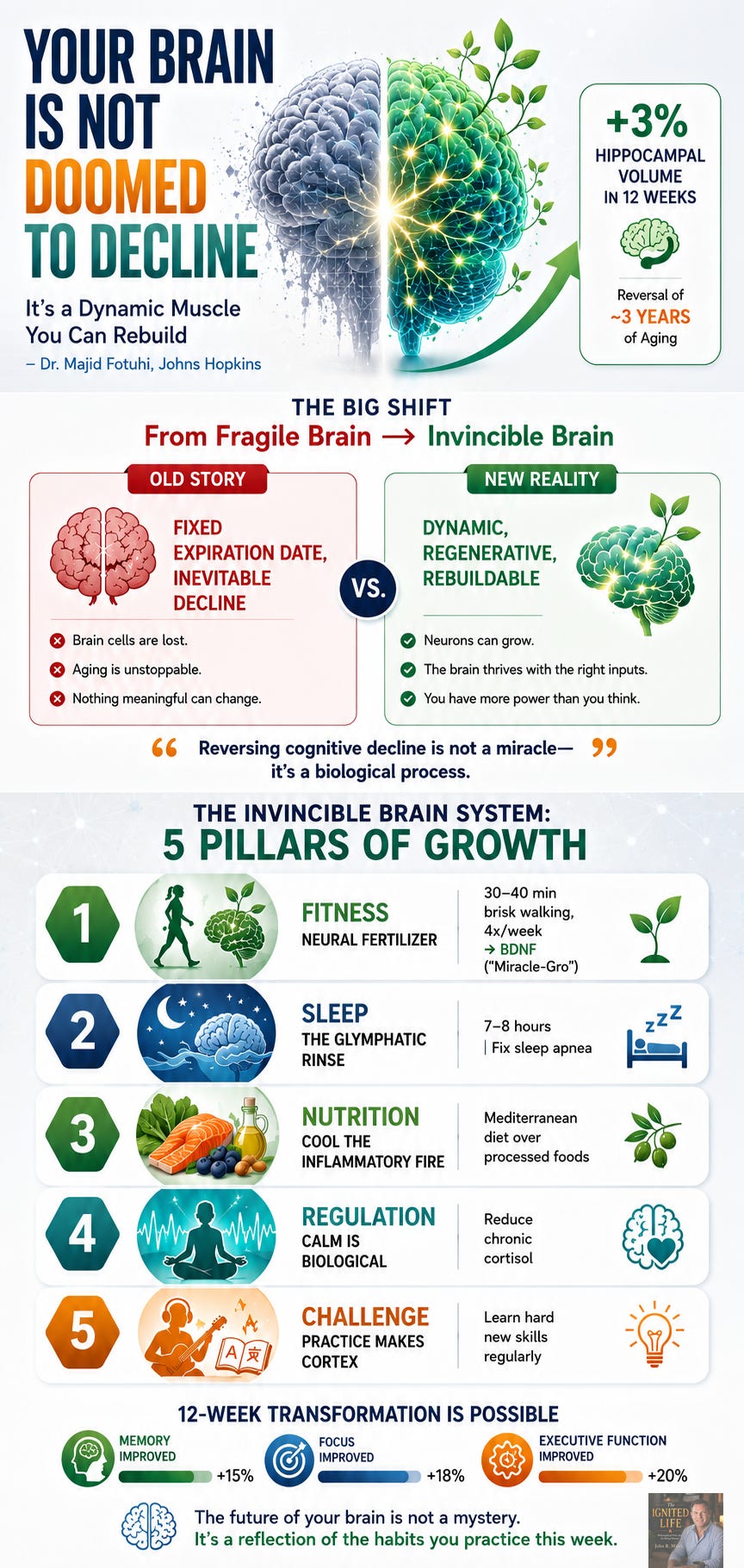
The Invincible Brain System: The Five Pillars of Growth
This protocol isn't a list of wellness tips; it is a synergistic system. If you only focus on one area, the architecture remains brittle. If you engage all five, you create a biological shield capable of reversing cognitive decline.
1. Fitness: The Neural Fertilizer
If there were a pill that could do what aerobic exercise does for the brain, it would be the most expensive drug on earth. When you engage in brisk walking or cycling, your brain produces Brain-Derived Neurotrophic Factor (BDNF). Dr. Fotuhi calls this “Miracle-Gro” for the hippocampus. It is the literal fuel for neurogenesis—the birth of new brain cells.
The Action: 30–40 minutes of brisk walking, four times a week. The goal is to get "out of breath" just enough to trigger the blood flow required for reversing cognitive decline.
2. Sleep: The Glymphatic Rinse
We used to think sleep was a passive state of rest. We now know it is a high-intensity cleaning cycle. During deep sleep, the glymphatic system opens up, allowing cerebrospinal fluid to “rinse” the brain. This process clears out the metabolic waste and amyloid plaques that are the precursor
The Action: Prioritize 7–8 hours of uninterrupted rest. If you snore or wake up tired, get tested for sleep apnea. You cannot rebuild a brain that isn’t being rinsed.
3. Nutrition: Cooling the Inflammatory Fire
The brain is the most metabolically active organ in the body. If you feed it ultra-processed sugars and trans fats, you are essentially pouring gasoline on an inflammatory fire. To reverse cognitive decline, you must provide the brain with the cooling agents it needs: Omega-3 fatty acids, leafy greens, and antioxidants.
The Action: Swap processed “white” foods for Mediterranean-style fats. Think of food as information—every meal is either tel
4. Regulation: Calm is a Biological Requirement
Chronic stress is not just a feeling; it is a neurotoxin. When you live in a state of constant threat, your adrenal glands flood the system with cortisol. While cortisol is useful for escaping a predator, chronic exposure physically shrinks the hippocampus. You cannot grow your memory while your body is convinced it is under attack.
The Action: Use biofeedback or simple two-minute breathing exercises to reset your heart rate variability (HRV). This signals to the brain that it is safe to shift from survival mode to growth mode.
5. Challenge: The “Practice Makes Cortex” Rule
The brain operates on a “use it or lose it” economy. Synaptic bridges only form when the brain is forced to work. Dr. Fotuhi’s mantra is “Practice Makes Cortex.” When you learn a complex new skill—a language, an instrument, or a new professional discipline—the cortex physically thickens to accommodate the new data.
The Action: Pick one skill that forces deep concentration. It should be hard enough to cause mild frustration; that frustration is the biological signal that your brain is building new bridges.
The 12-Week Transformation: Why “Yet” is a Power Word
One of the most striking parts of Dr. Fotuhi’s clinical work is the speed of the results. We often think of reversing cognitive decline as a decades-long project. But the brain is incredibly responsive.
If you feel like your memory isn’t what it used to be, the most dangerous thing you can say is “I’m losing my mind.” The most powerful thing you can say is “I haven’t optimized my brain architecture yet.”
In just 12 weeks of following the Invincible Brain protocol, patients showed measurable improvements in:
Memory Retrieval: The ability to find names and words faster.
Attention Span: The capacity to stay focused in a distracting world.
Executive Function: The “CEO” part of the brain that plans, organizes, and executes.
This 12-week window proves that your brain is not a porcelain vase that is permanently broken once cracked. It is a living forest. Even if some areas have been scorched by stress or neglect, new growth is always possible if the soil is right.
Purpose as a Neurological Shield
There is a final ingredient in the “Invincible Brain” that often gets overlooked in clinical settings: Meaning. Dr. Fotuhi’s research shows that people with a strong sense of purpose—those who feel their lives matter to something larger than themselves—experience significantly slower brain aging. Neurologically, purpose activates the motivation and resilience networks that buffer the brain against the damage of cortisol and inflammation.
When you have a reason to get out of bed, your brain has a reason to keep building synaptic bridges. Reversing cognitive decline is as much about your “Why” as it is about your “How.”
The Present-Moment Audit
If you are worried about the trajectory of your mind—or the mind of someone you love—stop looking at the horizon and start looking at this week. You do not need a miracle drug; you need a system.
Ask yourself these five questions:
Is my brain being “rinsed” nightly? (Sleep)
Is my brain being “fertilized” weekly? (Movement)
Is my brain being “cooled” daily? (Nutrition)
Is my brain being “shielded” from cortisol? (Regulation)
Is my brain being “stretched” regularly? (Challenge)
The future of your mind is not a mystery. It is a reflection of the habits you practice in the present. Reversing cognitive decline is possible, but it requires you to step into the role of the architect.
Which of the five pillars is your weakest link right now? That is where your 12-week rebuild begins.
Let’s talk about the science of staying sharp and the reality of a responsive brain.
Listen to the Full Conversation
Dr. Fotuhi’s Book: The Invincible Brain
The Strategy: [Link to the FREE 12-Week Companion Guide]
Thoughts? Let me know below this essay!
Every 🧡, restack, or comment you share here on Substack
is like a signal flare…..
It helps this message find the person who is still walking
their own “schoolyard” alone.
Thank you for being part of this ecosystem.
I love turning these essays into a two-way conversation
So please let me know your thoughts below.
© John R. Miles 2026. All rights reserved.
I would love to expand on this concept more. I also believe that our homes either support this work or they don't. Are our bedrooms supporting proper rest? Is the lighting in our task areas sufficient to support the work?