

Become the CEO of Your Cure
How to Lead Your Survival in a Broken Medical System — Lessons from Kathy Giusti


She was a high-powered pharmaceutical executive — the kind of woman who spent her career solving complex problems for millions of patients. Then, at 37 years old, with an 18-month-old daughter at home, she heard the words that would change everything: multiple myeloma — a rare, aggressive blood cancer with a prognosis of roughly three years to live.
Her very first goal wasn’t survival in the abstract. It was deeply human: “I wanted to live long enough for my daughter to remember me.”
In that moment, the professional armor she had worn for years cracked open. Being a “good patient” was not going to save her. The system she had worked inside for decades was never designed to move at the speed of one desperate human life.
That executive was Kathy Giusti.
On episode 763 of Passion Struck, I sat down with Kathy — founder of the Multiple Myeloma Research Foundation (MMRF), two-time cancer survivor, advisor to the White House Precision Medicine Initiative, and one of Time magazine’s 100 Most Influential People.
We didn’t talk in survivor platitudes. We talked about the Patient-CEO Mindset — the radical shift from being a passive passenger in your care to becoming the strategic leader of your own survival.
The Business of Beating Cancer
Kathy didn’t just survive her diagnosis. She studied the system like the Harvard Business School executive she was and realized the problem wasn’t a lack of science — it was a catastrophic lack of integration.
Specialists operated in silos. Data didn’t travel. Genomic insights from academic centers rarely reach the community oncologist who makes day-to-day treatment decisions. The burden of connecting everything fell squarely on the patient and their caregiver.
So Kathy did what any great CEO would do: she built her own command center.
The Application:
Treat your medical team like a high-functioning Board of Directors — you are the CEO, they are expert advisors.
Take ownership of integration. Make sure every specialist has the latest scans, genomic sequencing, and notes. Don’t assume the system will do it for you.
The Strategy of “Buying Time”
Through the MMRF, Kathy helped raise over $600 million and fundamentally changed how cancer research gets done. The results speak for themselves: 15+ new FDA-approved drugs and the five-year survival rate for multiple myeloma has doubled from 32% at her diagnosis to 62% today. Average life expectancy has more than tripled.
This is bigger than one disease. It’s a blueprint for anyone facing a serious diagnosis in a fragmented system.
Her core philosophy is powerful in today’s era of precision medicine: Stay alive long enough for the next breakthrough to reach you.
The Application:
Ask your doctors: “What breakthroughs are on the three-to-five-year horizon?”
Align your mindset with the speed of science, not the statistics of the past.
Focus on “buying time” — every extra month of stability increases your odds of accessing the next wave of innovation.
The Urgency Paradox
There is a hidden cost to this level of strategic intensity. The same drive that kept Kathy alive sometimes strained the very relationships she was fighting to stay alive for
One of the most powerful practices Kathy adopted was journaling. She has written in a journal every single day since her diagnosis. While writing Fatal to Fearless, she went back and read 30 years of entries.
What she discovered was both humbling and clarifying: the same strengths that helped her survive — relentless urgency and drive — had also taken a heavy toll on her family and relationships.
“I realized I had been torturing my family with my urgency,” she reflects.
That insight forced one of the most important resets of her life — learning that high-performance survival requires high-performance emotional regulation.
The Application:
Look for moments of human connection — a caregiver’s quiet courage, your child’s laughter, a stranger’s kindness. These are powerful resets that remind you your worth is not defined by your diagnosis, but by your place in the human story.
Takeaways
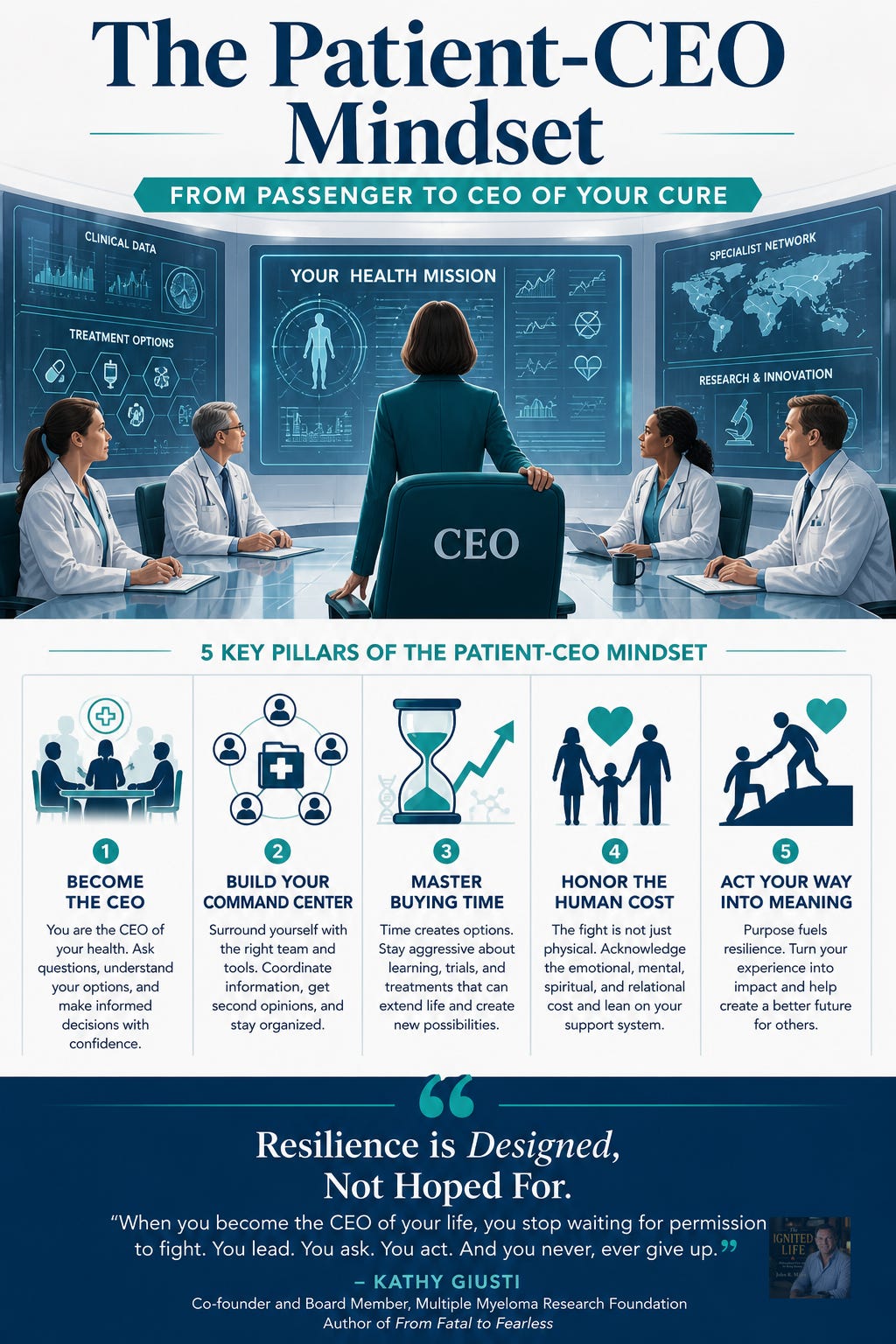
Become the CEO of Your Care. Stop being a passive patient. Take charge like a CEO running a high-stakes company. Build your own command center, demand cross-specialist integration, and lead every decision with urgency and clarity.
Master the Art of Buying Time. Don’t wait for a miracle cure. Focus on staying stable long enough for the next breakthrough to reach you. Actively ask your doctors: “What innovations are coming in the next 3–5 years?” Every extra month of health dramatically raises your odds.
Honor the Hidden Human Cost. The same urgency that can save your life can also damage your most important relationships. Acknowledge the emotional toll. Protect your family and closest connections with the same intensity you apply to your treatment plan.
Lower the Believability Threshold. If “I will be cured” feels impossible, start with a believable truth: “I am building the absolute best team and buying every possible month.” Progress begins with a belief you can actually sustain.
Act Your Way Into Meaning. When the system makes you feel like just another number, reclaim your humanity through action. Do one outward act of service or connection each week. You cannot think your way into mattering — you must act your way there.
Final Reflection
Kathy Giusti’s journey from a three-year prognosis to three decades of impact proves that resilience is not something you hope for — it is something you design.
In a medical system that often treats patients as passengers, the most powerful move is to pick up the pen and become the author of your own survival story.
Where have you been playing the passenger in your health, your career, or your life?
What is the one strategic micro-choice you can make today to reclaim agency?
Leave a comment below. Let’s keep the conversation grounded in what actually works.
Listen to the full episode with Kathy Giusti
Download the FREE Companion Reflection Guide here.
Book: Fatal to Fearless: 12 Steps to Beating Cancer in a Broken Medical System
Learn more: Multiple Myeloma Research Foundation
Thoughts? Let me know below this essay!
Every 🧡, restack, or comment you share here on Substack
is like a signal flare…..
It helps this message find the person who is still walking
their own “schoolyard” alone.
Thank you for being part of this ecosystem.
I love turning these essays into a two-way conversation
So please let me know your thoughts below.
© John R. Miles 2026. All rights reserved.
As a cancer survivor, I absolutely agree that you need to manage your health journey! Most people don't know how to do that. It is an important mission to teach people!