

Why We Ban What We Fear
Nobel Laureate Alvin Roth on Market Design, "The Churn," and Human Survival

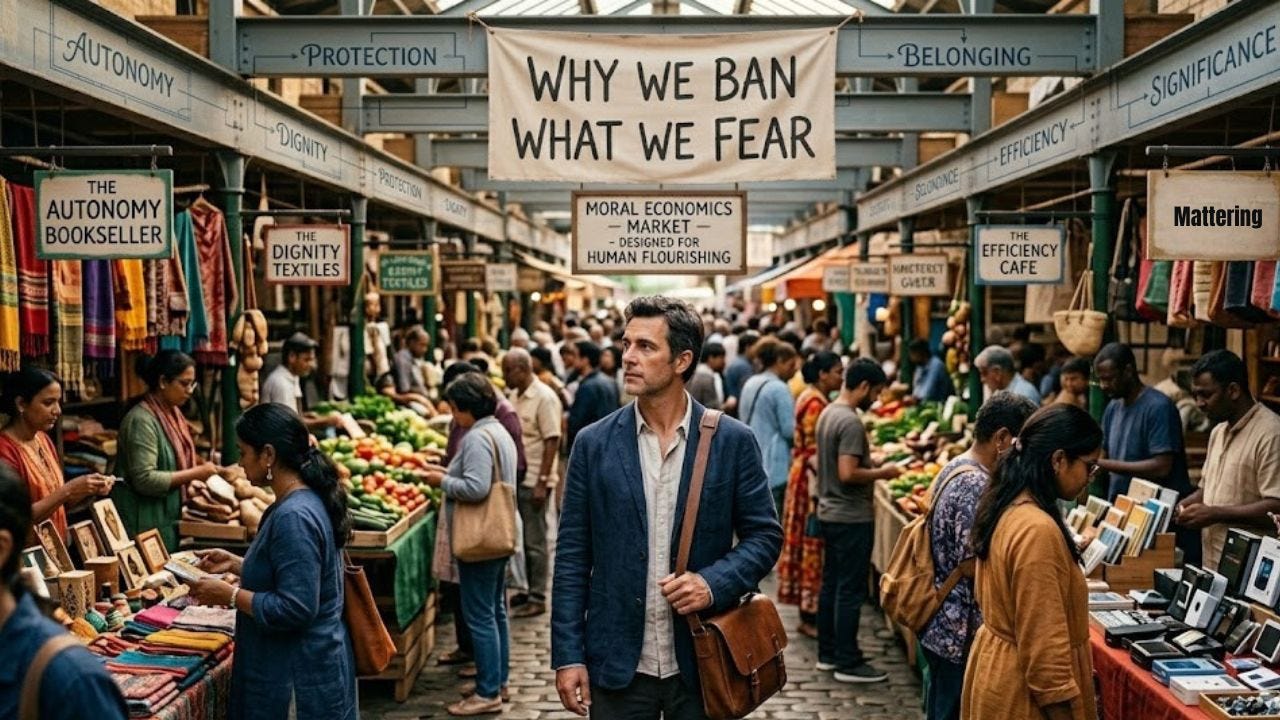
There is a quiet negotiation that happens every time you pull out your wallet, sign a contract, or even decide how to care for a dying loved one.
You think you are making a choice. You weigh the pros and cons. You consult your values. But beneath the surface of your “free will” lies a hidden architecture that has already narrowed your options before you even begin to think.
Most of us treat the systems of our lives—our jobs, our healthcare, our schools—as if they are natural laws, like gravity. We assume they are fixed, neutral, and inevitable.
But they aren’t. They are designed.
In episode 757 of Passion Struck, I sat down with Nobel Prize-winning economist Alvin Roth, one of the world’s leading pioneers in market design. His work doesn’t just deal with money; it deals with the “hidden math” of human survival. In his new book, Moral Economics: From Prostitution to Organ Sales, What Controversial Transactions Reveal About How Markets Work, Roth explores a concept that most of us are too uncomfortable to name:
Markets aren’t just about supply and demand. They are our most powerful moral filters.
The Repugnancy Constraint
Alvin Roth is famous for studying what he calls repugnant transactions. These are exchanges that willing participants want to engage in, but society believes should be banned—think organ sales, commercial surrogacy, or medical aid in dying.
We often think of these bans as “moral victories.” But Roth’s research reveals a dangerous design flaw in our moral certainty. When we ban a transaction because it feels “gross” or morally unacceptable, we don’t eliminate the need. We simply push it into the shadows.
As Roth explained during our conversation:
"Because when they’re banned, and when people want them enough, black markets develop... And those black markets are very dark indeed. They’re run by criminals, they’re outside of the traditional hospital system, they’re dangerous for the patients, they’re dangerous for the donors."
The Lesson: Banning a market is a design choice that carries a “hidden tax.” By pushing transactions into the darkness, we often destroy the accountability intended to protect the vulnerable.
The Mattering Economy
In my work on the Science of Mattering, this is where the real cost emerges. Systems don’t just allocate resources; they signal who is seen and who is overlooked.
Whether it’s how we design school choice or how we manage privacy in an age of facial recognition, these “market designs” are quietly answering the question: Who gets to matter here?
Many of us are living in “churn”—that psychological tension where we feel the weight of the system pushing us toward a version of ourselves that is “useful” but not “essential.” We have become commodities in a market we didn’t design.
The Churn of Anonymity
One of the most provocative moments in my conversation with Roth was his warning about the disappearing right to be anonymous. Traditionally, privacy was a default setting—if you walked down a busy street, no one knew who you were.
But technology has redesigned that market without our consent.
As Roth noted:
“When you’re out in public, you can be pretty anonymous if no one knows what you look like. But if cameras that can recognize you by your face are looking at you, then you’re not so private anymore... Technology is changing those things. But I bet that we’re going to have to think about, among our other civil rights, we’re going to have to think about what are our rights of privacy.”
The Mattering Connection: When we lose the right to be anonymous, we enter a new kind of “Churn.” We are no longer individuals with agency; we are data sets being optimized for someone else’s algorithm. This is the ultimate design challenge for the next generation:
How do we design a digital market that respects human dignity while technology relentlessly moves toward total transparency?

Redesigning the Architecture
Roth’s big takeaway is liberating: We don’t just live inside systems. We can redesign them.
On the hidden design of “Moral” bans, Roth noted:
“When we think about these repugnant transactions, we often think about them in terms of morality... but when you look at how they work, you see that we’re also making choices about how these markets are designed, even when we think we’re just banning them.”
If your life feels “functional but empty,” it’s likely because you’re optimizing for a market that doesn’t value your aliveness. Growth becomes less about “winning” the existing game and more about redesigning the rules.
How to start redesigning your systems today:
Identify the “Invisible Rule”: Look at a choice you’re struggling with. Ask: “Is this a physical limit, or is this a rule of the market I’m currently in?”
Name the Repugnancy: What is a choice you are avoiding because you’re afraid of how it will be perceived? (This is your “Churn”).
Initiate an Asymmetric Signal: If you are a leader, don’t wait for the system to change. Change your team's “market” by signaling that their presence matters more than their productivity.
Which invisible system is shaping your choices right now?
If you could redesign one “rule” of your industry or your home, what would it be?
Your insight might just be the spark someone else needs to stop circling and start designing.
Listen to the full conversation with Alvin Roth on Episode 757 of Passion Struck:
Reflect: Download the Purpose by Design Companion Guide HERE for FREE.
Read: Get Alvin Roth’s new book, Moral Economics.
Thoughts? Let me know below this essay!
Every 🧡, restack, or comment you share here on Substack
is like a signal flare…..
It helps this message find the person who is still walking
their own “schoolyard” alone.
Thank you for being part of this ecosystem.
I love turning these essays into a two-way conversation
So please let me know your thoughts below.
Every ❤️, restack, or forward helps more people feel like they truly matter.