

The Bird and the Big Picture Window
Why Flying Harder Isn’t the Way Forward

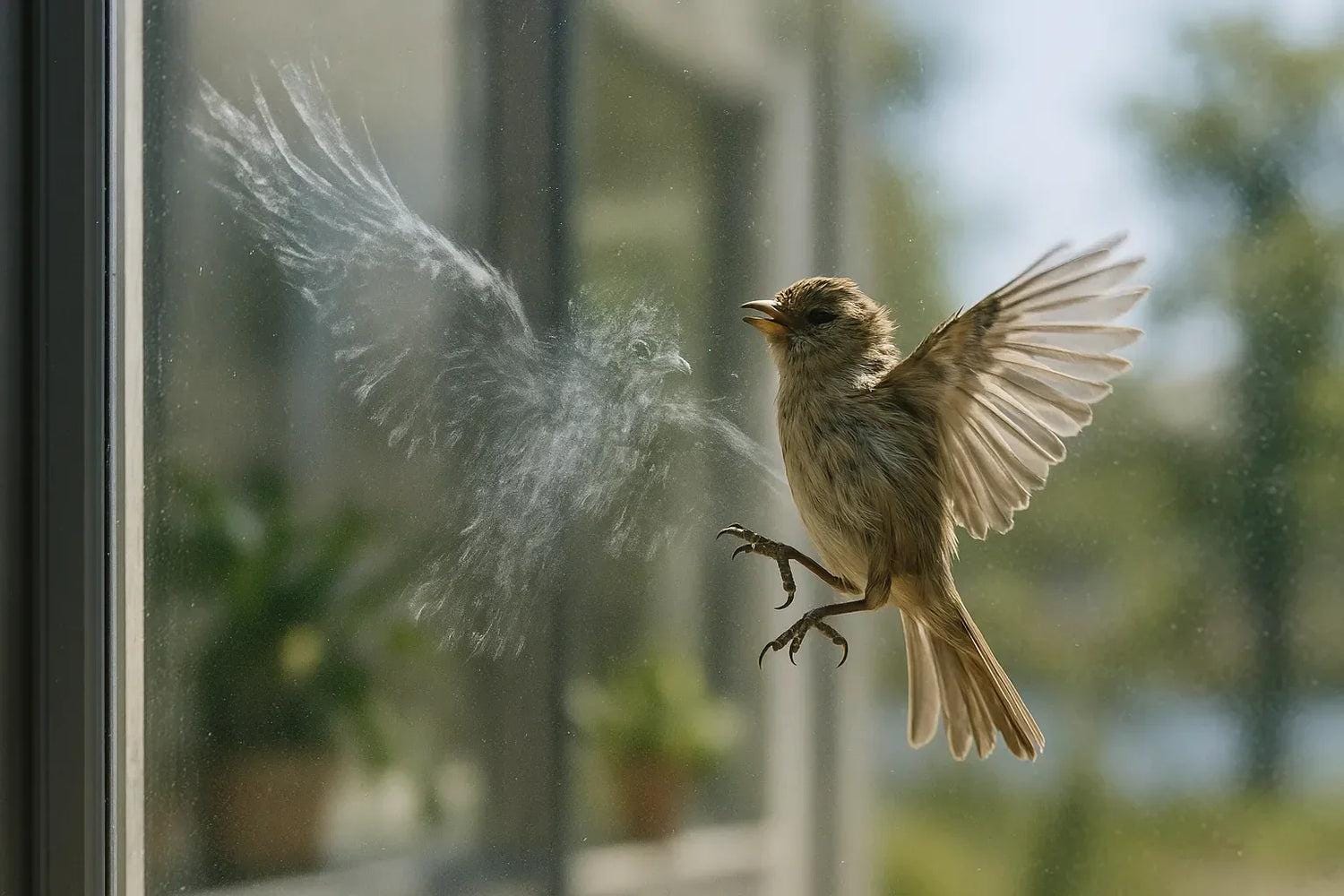
Most of us have been that bird.
You know the one—it flies into your kitchen, sees the expansive view through the picture window, and decides the only way to reach that light is to fly through the glass. It thrashes. It hits its head. It falls to the sill, stunned, and then—because it was evolutionarily designed to escape by flying “up and out”—it does it again.
The bird doesn’t realize the window isn’t an exit; it’s a barrier. And the harder it tries, the more it destroys itself.
In our culture, we call this “crushing it.” We call it “ambition.” There is a unique kind of psychological violence in the phrase “just work harder.”
But clinical psychologist, Dr. Diana Hill, author of the groundbreaking book Wise Effort: How to Focus Your Genius Energy on What Matters Most, identifies this as a dangerous pattern of Unwise Effort. It is the practice of flying harder at a problem that cannot be solved through sheer force.
I recently sat down with Hill for episode 758 of Passion Struck to discuss a truth that hits like a gut-punch for high achievers:
Burnout isn’t usually about doing too much; it’s about misdirecting your “Genius Energy.”
The Mirror in the Rearview
Hill’s journey into this work didn’t start in a textbook; it started in a rearview mirror.
In graduate school, she was the quintessential high achiever—the top 1% of her clinical psychology program. She was running randomized controlled trials on bulimia while secretly battling an eating disorder herself.
One afternoon, driving home from the lab, she caught her reflection. She saw the exhaustion and the physical toll in her own eyes—the same symptoms she was treating in her patients.
“I saw my own client, except it was me,” she told me.
This was a noetic experience—what William James coined as a sudden, profound shift in perspective. It’s what astronauts call the “Overview Effect,” where the micro-crises of daily life vanish against the vastness of the truth. Hill realized she couldn’t fly any harder in her career if she was disintegrating from the inside. She had the genius—the drive, the intelligence, the sensitivity—but it was being used as a weapon against herself.

The Three Ways We Drown (The “Thrash”)
When we feel entangled—inside a toxic workplace, a stagnant marriage, an addiction, or the relentless voice of an inner critic—we often respond in ways that intensify the very suffering we’re trying to escape.
Diana Hill calls these three forms of unwise effort—patterns that keep us thrashing instead of freeing ourselves.
1. We Get Stuck in a Story:
The mind starts narrating catastrophe.
I’ll never get out of this.
This is just who I am.
My worth is what I produce.
What feels like truth is often just a story repeated often enough to sound like fate. As Hill puts it, these stories aren’t facts—they’re anchors.
And the more tightly we grip them, the deeper we sink.
2. We Fight Discomfort and Start Thrashing
When a surfer gets tumbled by a wave, panic says fight harder.
Wisdom says surrender long enough for the water to carry you back up.
But most of us do the opposite with emotional pain.
We resist grief.
We outrun uncertainty.
We numb fear.
We thrash against what hurts.
And in doing so, we often create secondary suffering—burnout, reactivity, avoidance—that wounds us more than the original pain.
The struggle becomes the drowning.
3. We Hold On Long After Something Has Become Harmful
Hill connects this to what behavioral scientists call the escalation of commitment, continuing to invest in something broken simply because we’ve already invested so much.
A role.
A relationship.
An identity.
The Reliable One.
The Fixer.
The Winner.
We keep flying at the same glass because turning toward another door feels terrifying. We stay in the Known Hell because the Unknown Heaven feels too risky. And sometimes the hardest act of wisdom isn’t pushing harder—it’s loosening your grip.
Managing Energy, Not Time
The most revolutionary shift Hill offers is moving from time management to Energy Management.
If you want to escape the “Known Hell,” you have to stop managing the clock and start managing the Psychological Flexibility of your effort.
Hill defines “Genius Energy” not as an IQ score, but as your unique life force—your talents, character strengths, and emotional intelligence.
When you misdirect this energy, your greatest strengths become your biggest traps. The “Super-Helper” becomes a martyr. The “Problem-Solver” becomes a micromanager. The “Achiever” becomes a hollow shell.

The “One Minute to Live” Shift
The most insidious part of the modern grind is the Urgency Effect. When we feel rushed, Hill explains that we don’t do more; we do things that feel important but aren’t meaningful. We check the inbox instead of looking at the trees.
Hill uses a powerful contraction exercise to break this:
What would you do if you had a year to live?
A month?
A day?
Now, what if you only had one minute?
In that final minute, no one optimizes a spreadsheet. They breathe. They say, “I love you.” They finally inhabit their own skin. This is the shift from utility to aliveness.

The Open Door Behind You
If you feel like the bird hitting the glass, you do not have to give up flying. Hill suggests you just have to change your orientation.
How to start practicing Wise Effort today:
Get Curious: Name the “Known Hell” you’re in. Is it a job, or a story you’re telling yourself about the job?
Open Up: Stop thrashing. Hill invites you to allow yourself to feel the discomfort of the “threshold” without trying to fix it immediately.
Refocus: Identify one “asymmetric signal”—a small action aligned with your values, not your to-do list—and take it.
Stop flying at the glass. The door is 180 degrees behind you, but you have to stop thrashing to see it.
Listen to the full conversation with Dr. Diana Hill on Episode 758 of Passion
Reflect: Download the Purpose by Design Companion Guide [HERE].
Sign up for Hill’s new coaching Business of Therapy and Coaching program. This 8-week, small-group program is for therapists and coaches who are tired of the old, outdated way of doing business and yearning for something bigger for their therapy and coaching business.
Thoughts? Let me know below this essay!
Every 🧡, restack, or comment you share here on Substack
is like a signal flare…..
It helps this message find the person who is still walking
their own “schoolyard” alone.
Thank you for being part of this ecosystem.
I love turning these essays into a two-way conversation
So please let me know your thoughts below.
© John R. Miles 2026. All rights reserved.
The bird metaphor is precise — and the arrival at energy management is the right destination. What's still missing is the mechanism. How do you actually know where your energy is going and why? The answer is personal — not a generic framework but a simple diagnostic: what in your life is working, and what isn't. What's working conserves or adds energy. What's not working depletes it. The bird hits the glass because it can't distinguish between the two. That distinction — applied honestly to your own life — is where the door behind you becomes visible.
AwareLife, you’ve hit on the exact friction point that keeps high-performers stuck: we lack a sensory diagnostic for our own energy. We treat effort as a volume knob—if it’s not working, we just turn it up.
You’re absolutely right that the bird hits the glass because it can’t distinguish between the view (the goal) and the barrier (the method).
To your point about the mechanism, I use a binary check to help people distinguish between Utility and Significance:
The Aliveness Check (Wise Effort): Does this effort leave you feeling inhabited? Even if the work is grueling, is there a sense of expansion or connection at the end of it? This is energy that conserves your genius.
The Utility Check (Unwise Effort): Does this effort leave you feeling like a commodity? Are you doing it primarily because you’re terrified of the silence that happens if you stop? This is energy that depletes your soul.
The door behind you only becomes visible the moment you stop asking "How do I do more?" and start asking "How is this effort doing me?"