

The Blueprint in the Background
The hidden childhood stories behind burnout, people-pleasing, and the search for significance


My father grew up in Detroit, learning early on the raw grit and determination it took to build a life from scratch. He carried that resilience with him throughout his life—the kind of work ethic that means doing whatever it takes to build a secure foundation for the people you love. Out of a deep devotion to our family, he poured himself into his career, traveling extensively throughout my childhood to ensure my siblings and I had the opportunities he never had.
He was doing exactly what a responsible father does: sacrificing his own comfort to provide for his kids.
But a young child’s mind doesn’t comprehend the macroeconomics of a career or the noble sacrifices of business travel; it simply counts the days. Somewhere along the way, I began to believe that achievement was how I could make him proud. Decades later, long after I had left home, I found myself following that same high-performance script as a global executive at Dell. I was traveling across five continents, working grueling weeks, and running myself directly into physical exhaustion and isolation.
I kept believing that the next promotion, the next assignment, or the next milestone would finally give me the sense of security I had spent years pursuing. Instead, I discovered that achievement and significance are not the same thing. From the outside, my career appeared increasingly successful. Internally, I felt progressively more disconnected from myself.
During our conversation, therapist and author Kati Morton and I kept returning to one idea: our most destructive adult behaviors are rarely accidental errors. More often, they’re the continuation of adaptations we developed in childhood that once helped us feel safe.
The Stories Children Tell Themselves
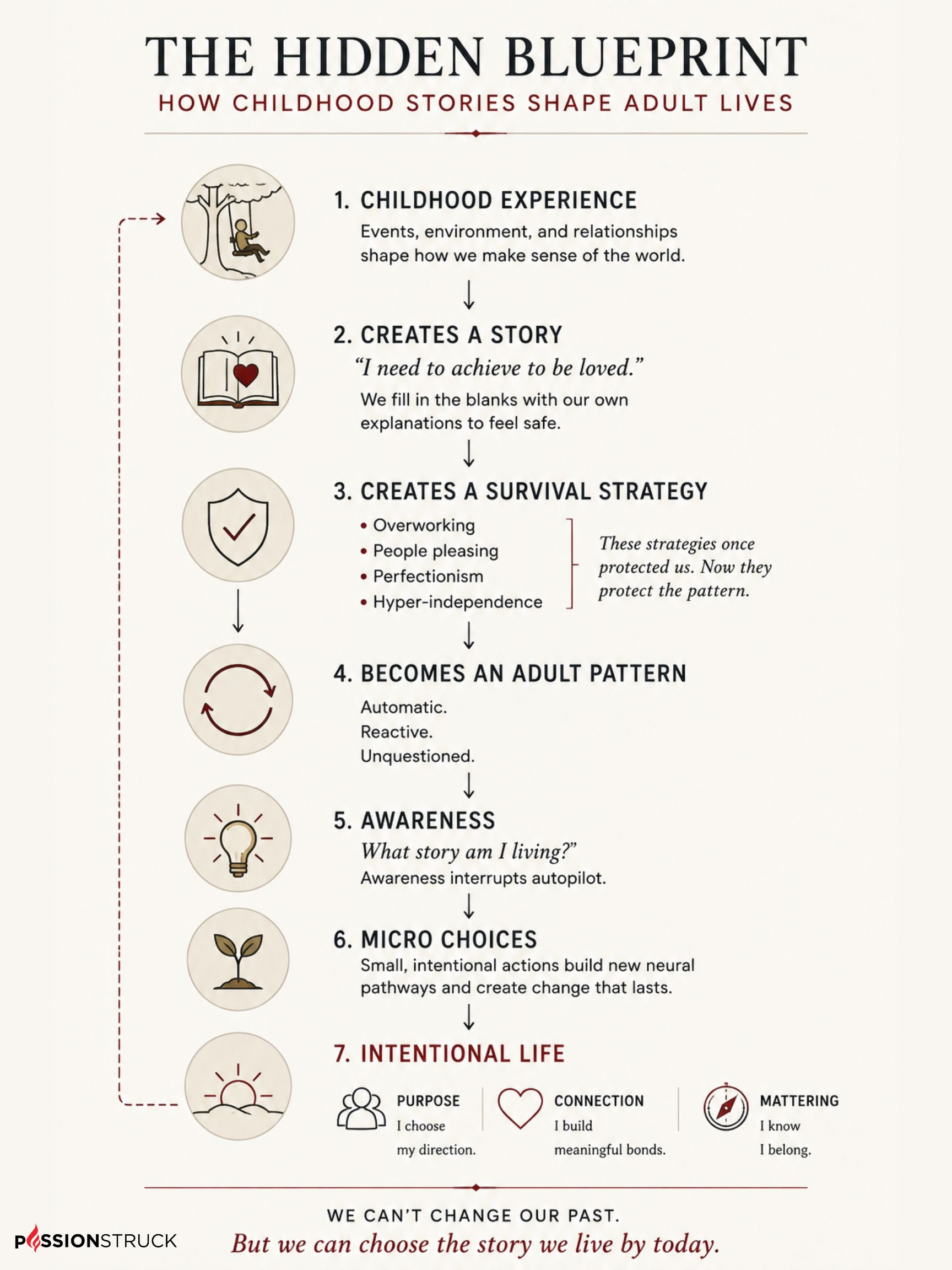
As children, we enter the world with no baseline understanding of complex relational concepts such as emotional boundaries or the balance between work and life. Because we cannot process the external pressures our parents are managing, we look at the climate around us and create our own stories to fill in the blanks.
As a child, Kati created a hidden script based on her own father’s long hours away from home. Her father also came from a background of poverty and worked to ensure his family wanted for nothing. But a young child doesn’t understand financial logistics; she only knows her hero is away. To find a sense of agency, her younger self decided: If I do everything perfectly, if I excel in sports and get the lead in the play, I can match his excellence and bring him closer.
No parent writes a perfect blueprint for their children, even when acting out of love. The challenge is that we often carry these unexamined stories into adulthood without realizing they’re still shaping our decisions. We trim the branches while leaving the roots intact. The behavior changes briefly, but the underlying story continues to grow. We wonder why we keep burning ourselves out at work, failing to realize we are running a race based on an old rulebook.
The Cost of Chronic Compliance
When a child grows up in an environment where attention feels inconsistent, they realize early on that fight-or-flight will not protect them. They cannot fight an adult, and they cannot run away. So, they default to a lesser-known survival strategy: the fawning response.
Fawning is a trauma response in which people sacrifice their own needs and boundaries in an effort to keep those around them emotionally regulated. Kati explores this through the story of a patient named Yvette. Yvette took pride in being the “strong one” in her circles—the reliable woman who never asked for assistance and always put herself last to keep the peace.
She had become so practiced at managing everyone else’s emotional needs that she no longer recognized where her own began. Over time, compliance became the strategy she relied on to feel safe. She had become trapped in what I call the pinball life, reacting to external demands instead of authoring her own direction.
Why the Nervous System Resists Change
When we finally realize we are stuck, our natural instinct is to attempt a complete life overhaul. We set intense, sweeping goals to transform our habits overnight. Yet, by the first week of February, nearly all of these resolutions fail.
This failure isn’t due to a lack of willpower; it’s a structural defense mechanism. Your brain is constantly scanning your environment for threats. When you attempt a massive, sudden disruption to your routine, your nervous system registers that unfamiliarity as a threat.
Real change happens when we make changes small enough that our nervous system doesn’t interpret them as danger. We bypass the threat detectors by utilizing the compounding power of micro-choices.

Why Awareness Changes Everything
The encouraging news is that these childhood scripts are not permanent identities. They are explanations of how we learned to navigate the world, not prescriptions for how we must continue to live.
Awareness rarely changes us overnight. What it does is interrupt autopilot. Once we recognize the story we’ve been living inside, we gain something we didn’t have before: the ability to decide whether it’s still the story we want to keep telling. Awareness doesn’t erase decades of conditioning, but it creates something equally important: choice.
Four Ways to Rewrite an Old Script
To begin reclaiming your agency, consider these practical shifts:
Choose curiosity over judgment. Self-criticism rarely interrupts an automatic habit; curiosity often does. The next time you catch yourself overworking or people-pleasing, resist the urge to shame yourself. Instead, ask: What am I afraid might happen if I don’t do this? Pinpointing the underlying fear—whether of scarcity or loss of connection—strips the habit of its power.
Identify your “admission ticket.” Notice when you are using achievement as an admission ticket to belonging. In your next meeting, catch the urge to over-verify your worth through your output. Practice reminding yourself that your presence has value independent of your achievements.
Open a dialogue through journaling. You do not need to produce perfect prose to connect with yourself. Writing creates enough distance from the noise around us to hear our own voice again.
Test the water with small boundaries. Do not try to leap from one lifestyle extreme to the other. Instead of cutting off a commitment, run a small experiment. Dedicate the first thirty minutes of your morning to reflection before checking digital notifications. It is a simple step that builds momentum without shocking your system.
The Reality of Mattering
This is why changing habits is rarely just about changing habits. The behaviors that frustrate us most are often attempts to solve problems that no longer exist. They were strategies developed years ago to earn love, approval, safety, or belonging. Until we understand what those strategies were trying to accomplish, we’ll keep replacing one habit with another while leaving the underlying story untouched.
Breaking free from these patterns ultimately brings us to a deeper question than habit change alone. It asks whether achievement has become a substitute for significance.
High achievers often discover that visibility and significance are not the same experience. The world may know your accomplishments while you remain uncertain about your own worth. External recognition can affirm what you’ve done, but it cannot answer the deeper question every human being eventually asks: Do I matter?
We cannot resolve an internal crisis of invisibility by putting more effort into a system that treats us as an interchangeable input. Your defense mechanisms were not design flaws; they were protective plates of armor that kept you safe when you were small. But the work of adulthood isn’t about fixing yourself—it’s about learning how to feel safe enough to drop that armor.
We cannot rewrite the experiences that shaped us. But we can decide whether they continue writing the chapters that follow.
Joining the conversation
What did your childhood blueprint teach you about what you had to do to earn attention or love?
Where in your life right now are you mistakenly treating survival mode as a genuine ambition?
What is one tiny, low-lift micro choice you can make today to choose curiosity over judgment?
Listen to the full episode with Kati Morton
Download the Companion Workbook: Access our free weekly reflections and actionable habit exercises for this episode.
Every 🧡, restack, or comment you share here on Substack helps this message reach someone who is still running an outdated schoolyard race. Thank you for being a vital part of this community.
© John R. Miles 2026. All rights reserved.