

The Schoolyard Tables We Never Truly Leave
The High-Definition Remake of Our Thirteen-Year-Old Selves


Over the years, I’ve met more than a few high-achieving executives who have described some version of the exact same moment to me. One conversation in particular always stays close to the surface.
A prominent leader sat alone in his corner office late into the evening on the night of his biggest professional promotion. He had spent more than two decades working eighty-hour weeks, sacrificing his physical health and his primary relationships to climb the corporate ladder. By every external metric, he had won. His phone was vibrating constantly with congratulatory notifications and praise from global stakeholders.
Yet, as the office emptied and the city lights flickered below, a deep sense of loneliness settled into the room. He realized that while hundreds of people knew his name and his title, virtually no one understood what he was actually carrying inside. He was highly visible, but completely unknown.
In the quiet of that evening, his mind drifted back to a place he hadn’t thought about in decades: his middle school cafeteria. He could vividly remember the raw anxiety of holding a lunch tray, scanning a crowded room of distinct social groups, and wondering if there was a single table where his presence would be welcomed.
Sitting in his office, he realized the truth was undeniable: He hadn’t left that middle school cafeteria behind; he had simply exchanged the schoolyard table for the executive boardroom.
The Architecture of the Escape
There is a specific kind of vertigo that happens when you realize your professional life is just a high-definition remake of your thirteen-year-old self.
We like to think of our career paths as a series of logical, adult progressions, but for many of us, they are actually sophisticated escape routes. We are still running away from the ghosts of the middle school cafeteria. We spend decades building performance armor: titles, accolades, and specialized expertise; specifically so we never have to feel that raw, tray-in-hand vulnerability again.
We cross our fingers in our twenties and tell ourselves that these exhausting social dynamics are a temporary fever dream of adolescence. We believe that once we walk across the stage at graduation, we will enter a world that is fluid, meritocratic, and open.
But the circles didn’t disappear; they just rebranded.
The high school clique didn’t die; it evolved into the “influence network.” The lunch table didn’t vanish; it became the executive boardroom. The schoolyard boundary became the corporate hierarchy.
"We haven’t left the middle school cafeteria; we’ve simply rebranded the cliques."—John R. Miles
When you walk into a new office, a high-stakes industry conference, or a strategy meeting, you aren’t just a professional with a resume. Your brain—driven by that same ancient, adolescent scanning mechanism that immediately begins to “map the room.” Within seconds, you are unconsciously calculating who bears the weight, who is protected by the inner circle, and who is still standing on the periphery, wondering whether their presence is actually welcome.
The “interconnected era” hasn’t solved our isolation; it has just given us more places to hide our true selves behind a digital coat of arms. We have successfully engineered a world where you can be processed by a thousand people a day, yet witnessed by no one.
The Admission Ticket Problem
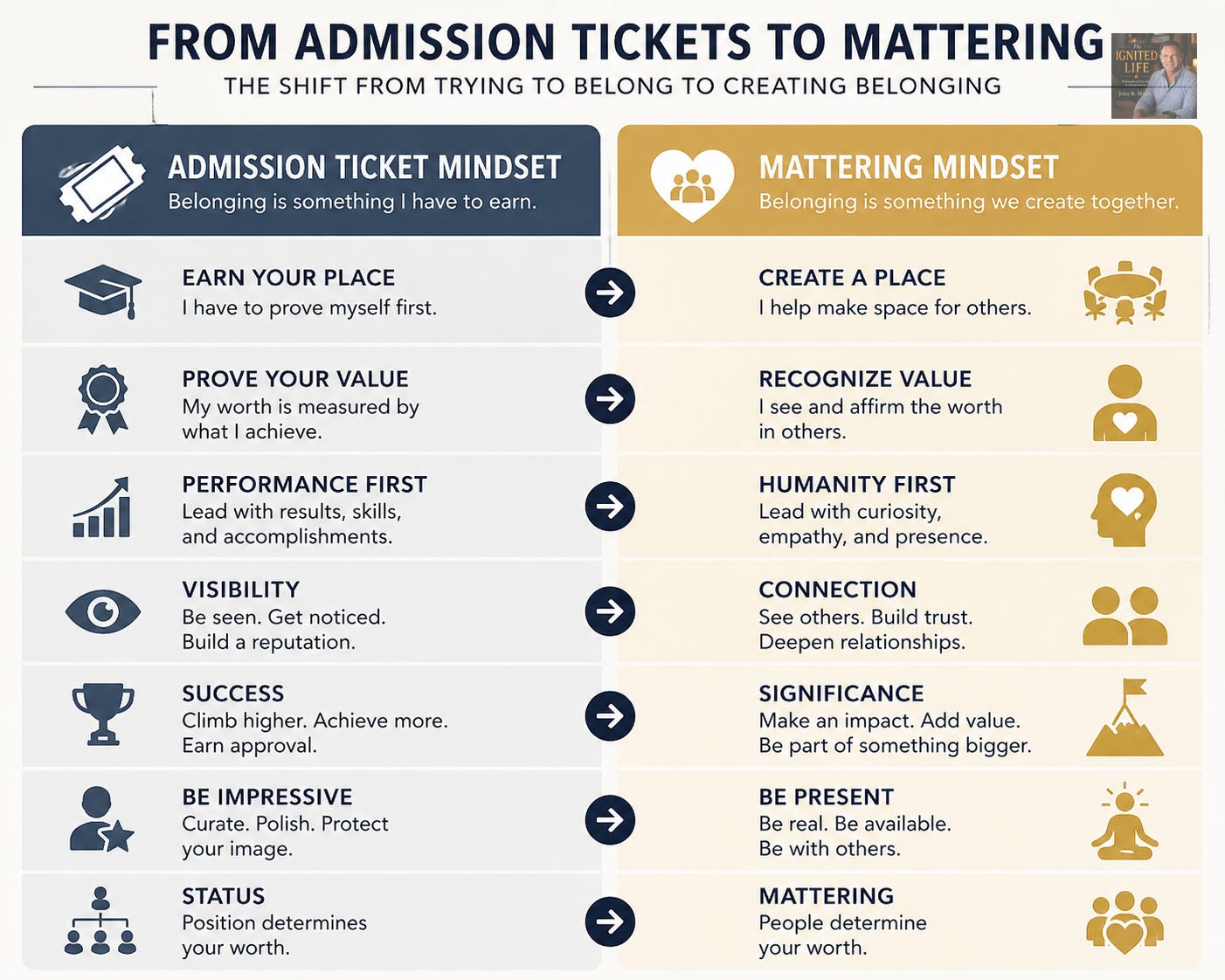
When we are uncertain of our standing within these adult hierarchies, we fall into a psychological trap: The Admission Ticket Problem.
Most of us absorbed an unexamined message early on that our raw, authentic self is insufficient to guarantee safety or acceptance. To protect ourselves, we try to buy our way into significance through performance.
A student anchors their identity to academic marks to earn parental validation.
An employee turns themselves into a transactional machine to earn leadership’s praise.
An executive uses professional results as a shield, hoping success will protect them from a world where they still feel like an outsider.
As Adam Grant has noted in his research on organizational culture, when we over-index on being ambitious, we stop bringing our full selves to the room. Success becomes a mandatory admission ticket we present to our peers to prove we have earned the right to occupy space. The tragedy is that the world celebrates what you produce, while the human being behind the output remains anonymous.
Loosening the Grip on Inherited Labels
Overcoming this disconnection requires a fundamental shift in how we manage the boundaries around us. A powerful framework for this is found in the historical narrative of Peter in Acts 10.
Peter operated in a society governed by rigid cultural and ancestral divisions. However, when he encountered individuals outside his designated social identity, he chose to look beyond the era's classifications. He prioritized shared humanity over systemic labels—an act that fundamentally expanded the circle of his world.
We face the same challenge daily. We encounter people through job titles, political identities, and socioeconomic labels. These categories help us pigeonhole others, but they prevent us from ever really seeing them. Genuine connection begins when we possess the courage to drop our “performance armor” and choose to see the individual before the label.

Four Research-Backed Shifts Toward Mattering
True significance is a relational byproduct. It can only be realized when your presence carries weight within a community that reflects your value back to you. Here are four practical shifts to reclaim that connection:
Audit your survival stories. Take ten minutes to look at the defensive scripts you wrote in middle school or early in your career (e.g., “Vulnerability is dangerous”). Ask: Are these stories still serving the relationships I am trying to build today?
Catch yourself presenting your “admission ticket.” In your next high-stakes meeting, notice the urge to lead with your credentials or latest win to secure your place. Practice letting your presence be enough, decoupled from your latest output.
See the individual before the label. Before your brain categorizes someone by their politics or job title, pause. Ask yourself: “What might this person be carrying that I can’t see?” Curiosity is the antidote to premature judgment.
Shift from performance questions to mattering questions. Instead of the generic “How are you?”, ask questions that signal their presence carries weight: “What’s been weighing on you lately?” or “What are you hoping will be different six months from now?”
Download the FREE Companion Guide & Digital Workbook
The Relational Nature of Significance
This is a core insight of my work on mattering: we cannot hack our way to feeling significant in isolation. The human mind evolved for connection. Heavy self-focus often amplifies anxiety rather than relieving it. Real significance emerges as a byproduct—when our presence carries weight in the eyes of others who truly see us.
By bringing our cafeteria narratives into awareness and courageously expanding our circles, we begin to dismantle the quiet systems of isolation that surround us.
"You end up trapped in a loop where the world continuously celebrates you for what you produce, while the true human being behind the output remains completely unseen."—John R. Miles
As you move through your week, pay attention to the people around you. Many are still scanning invisible rooms, wondering if there’s space for them. The future of connection may not belong to those endlessly seeking belonging. It may belong to those willing to create it—table by table, conversation by conversation.
Turning this into reflection:
What “cafeteria table” are you still trying to earn your way into?
Which old survival story about belonging is ready to be updated?
Whose circle might grow larger simply because of your willingness to see them this week?
I’d love to hear your honest experiences in the comments. What moments of real connection have stayed with you? Where do you still feel the ache?
I would love to hear your raw thoughts, experiences, or reflections.
Listen to the full audio exploration of this episode 780:
Every 🧡, restack, or comment you share here on Substack acts like a signal flare. It helps this message find the person who is still walking their own schoolyard alone. Thank you for being part of this ecosystem.
© John R. Miles 2026. All rights reserved.
This post really brings relationship back to the fundamentals. As a teenager, I have seen countless adults saying things are different when you grow up.
But I ask them how different? They tangent to something else.
In truth, after hearing at situations and learning a bit of psychology, there is nothing different. Hate in adult is still the hate experienced in children. Therefore, what is left is the fundamentals of relationship that is very universal for you to pick up and adjust.
This resonated so much. It's leaving me wondering what small changes I can make that might help my own team feel valued and seen aside from just being appreciated for their work 🤔