

Why You Must Be the CEO of Your Health
Maria Menounos on Health Advocacy, Intuition, and the Choice of Wonder Over Worry


The world knew her as a red-carpet powerhouse—a journalist who had interviewed everyone from world leaders to the biggest stars in Hollywood. But behind the glitz and the television lights, Maria Menounos was navigating a reality that no amount of professional poise could mask. While caregiving for her mother during a brutal battle with glioblastoma, Maria began to feel the signals of her own body shifting.
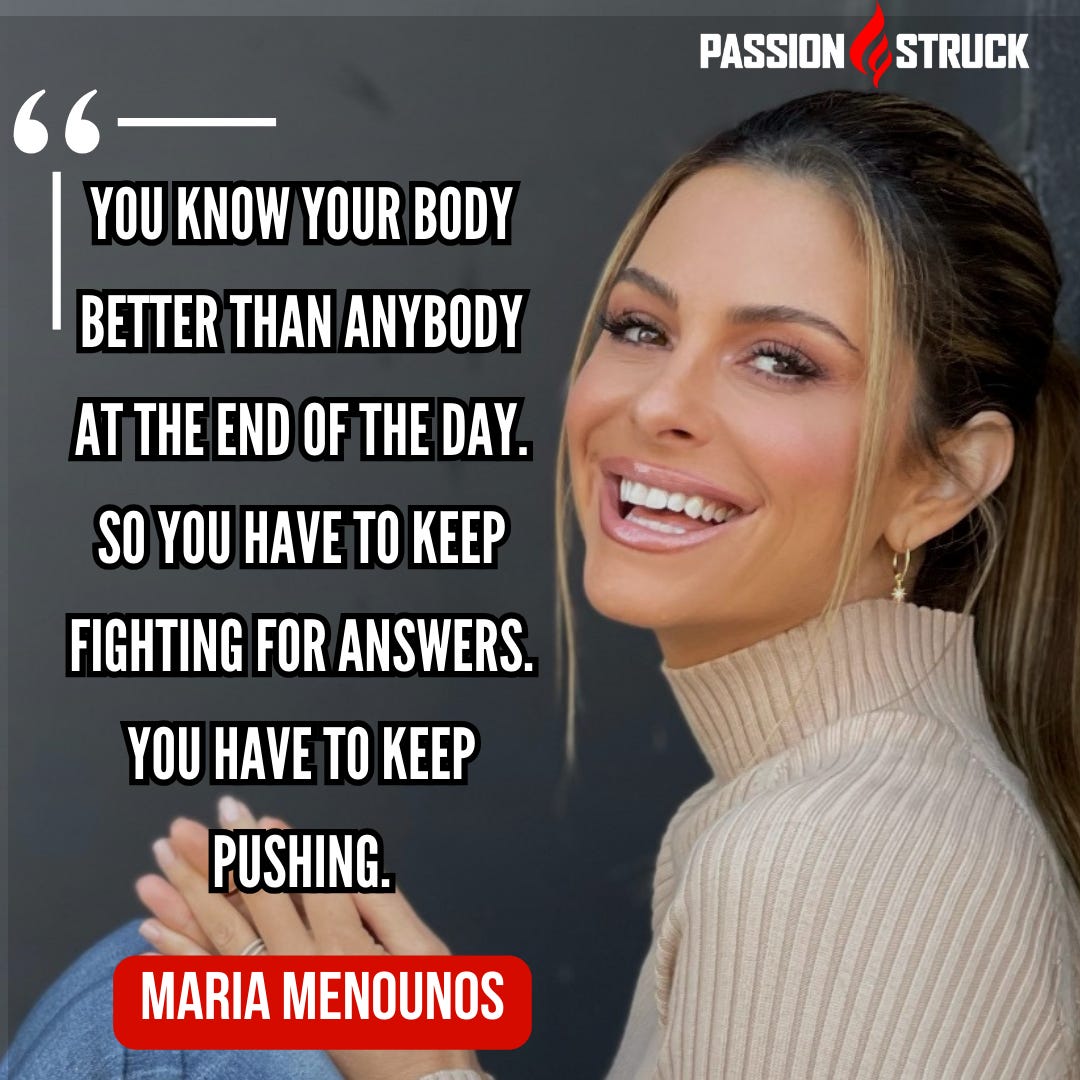
Despite the flat stomach and fitness she was known for, a persistent, basketball-sized bloat appeared. She sought help, underwent scans, and was told everything was fine. But the pain persisted—and as Maria often says, “If the pain persists, so should you”.
What she discovered through a year-long quest for answers is a masterclass in Cognitive Agency: Your intuition is often a more accurate diagnostic tool than a rushed reading of a CT scan.
On Passion Struck, I sat down with Maria Menounos to discuss her harrowing journey through a brain tumor and a neuroendocrine pancreatic cancer diagnosis. We moved past the headlines to explore the Self-Advocacy Mindset—the refusal to be “gaslit” by a flawed system and the courage to become the CEO of your own healthcare situation.
The Flaw in the “Fine” Scan
Maria’s journey exposed a critical vulnerability in modern medicine: human error within an overwhelmed system. After being told her initial hospital scans were clear, she later learned that a two-centimeter tumor had been visible but missed by the radiologist.
By the time she pushed for an outside full-body MRI months later, the tumor had doubled in size.
What you’re learning: Doctors are human, exhausted, and often working within silos. If you have a scan and still feel pain, the “manual” requires a second opinion on the data itself.
The Application: You must be your own “Internal Auditor.”
Don’t accept “Normal” if you feel “Broken.” Use your intuition as a prompt to seek outside facilities or secondary readings of your imaging.
Document the Evidence. Maria took photos of her symptoms in the mirror to ground her reality when the system suggested nothing was wrong.
Choosing “Wonder Over Worry”
When faced with a diagnosis that feels like a dead end, your brain naturally defaults to predicting the worst possible finale. Maria credits the work of Dr. Joe Dispenza and Tony Robbins with helping her rewire these fear-based thoughts to calm her nervous system.
She adopted a specific cognitive tool: Wonder Over Worry.
What you’re learning: Instead of a 0/10 fear-based loop, you can shift the brain’s “expectancy engine” by asking curious, positive questions.
The Application:
Instead of “What if the surgery fails?” ask: “I wonder what it will feel like when the doctor calls with good news?”
Instead of “Why is this happening to me?” ask: “I wonder how this is happening for me to redirect my path?”
The Caregiver’s Release: Meeting Them Where They Are
Maria’s resilience was forged while watching her Greek immigrant parents fight through disease with a “warrior” spirit. Yet, as a caregiver for her mother, she had to learn the hardest lesson of all: you cannot fight a battle for someone else if they are ready to rest.
What you’re learning: Caregiving is an emotional journey where you must eventually meet the patient where they are, rather than where you want them to be.
The Application:
Prioritize the Conversation Over the Cure. Maria mustered the courage to cry with her mother and ask for forgiveness for the “short” moments of stress.
Release the Guilt. By having the tough, awkward conversations early, you release the “Identity Tax” of regret after they are gone.
Takeaways
Assume the CEO Role: Doctors are overwhelmed; you are the only person who knows your body’s baseline. If the system gaslights you, find a new doctor.
Audit Your Health Literacy: Just as you manage financial literacy, you must manage your health data. If you get a “clean” scan but the pain persists, seek a second opinion immediately.
Use the “Yet” Strategy: As my guest, Jen Gottlieb, suggests, if you aren’t good at navigating the system yet, recognize that it is a skill you can learn and implement.
Practice Predictive Wonder: Shift your internal narrative from “worst-case scenario” to curious possibility to lower your cortisol and anxiety.
Build Your Support Network Before You Need It: Maria’s recovery was supported by a husband, father, and friends who stepped up when her own strength was depleted.
Final Reflection
Maria Menounos’s journey from cleaning nightclubs in Boston to surviving two “fatal” diagnoses shows us that resilience is not a personality trait—it is a decision. It is the steady work of listening to the “quiet voice” of your body over the loud, busy noise of the medical system.
Where have you been ignoring your own intuition? What is the one “uncomfortable” conversation or medical second opinion you’ve been putting off that could reclaim your agency today?
Leave a comment below. Let’s keep this conversation grounded in what works.
Check out the full conversation with Maria Menounos below
Thoughts? Let me know below this essay!
Every 🧡, restack, or comment you share here on Substack
is like a signal flare…..
It helps this message find the person who is still walking
their own “schoolyard” alone.
Thank you for being part of this ecosystem.
I love turning these essays into a two-way conversation
So please let me know your thoughts below.
© John R. Miles 2026. All rights reserved.