

When You Fail as Yourself
The hidden shame of burnout isn't exhaustion. It's self-erasure.


There is a particular kind of shame that arrives not when you fail, but when you fail as yourself.
Guy Winch has spent his entire career studying emotional health. He knows the anatomy of a panic attack. He knows, almost instinctively, how to talk someone down from the ledge of their own fear. Compassion is not just his profession — it is, by every account, his nature.
So when a neighbor in an elevator began pounding on the doors, hitting every button, dissolving into panic, Guy knew exactly what to do.
And he snapped at him instead.
Not a gentle redirection. A sharp, uncharacteristic “this is my nightmare” — the kind of response that belongs to someone depleted, not to someone whose life’s work is the opposite of depletion. He was one year into his dream career. He had nothing left to give.
I’ve been thinking about that elevator moment ever since our conversation. Not because it’s a cautionary tale about burnout — we have plenty of those. But because of what it quietly reveals about the nature of the grind.
It doesn’t announce itself. It doesn’t arrive with a warning label or a dramatic breaking point. It seeps. It finds the edges of who you are and slowly, almost imperceptibly, begins to soften them. And you don’t notice until the moment you act like a stranger to yourself — until you snap in an elevator, or come home and have nothing left for the people you love most, or sit across from your own life and feel oddly absent from it.
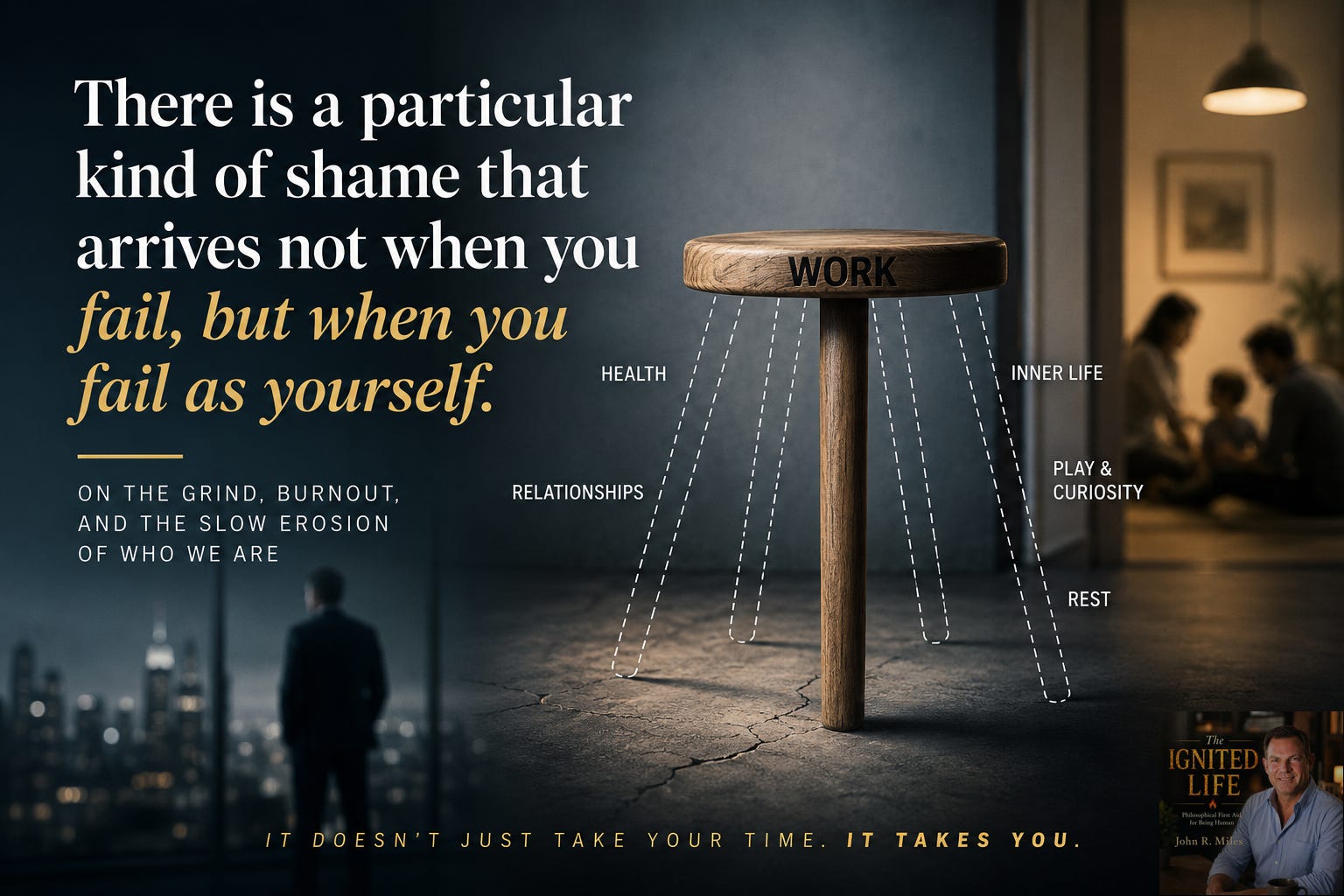
That’s the thing nobody tells you about working too hard. It doesn’t just take your time. It takes you.
The Stool With One Leg
In Passion Struck, I used an image to describe burnout — because I lived it long before I had words for what it was.
Imagine a stool. Not a chair — a stool, the kind that requires balance. It has several legs: your health, your relationships, your inner life, your sense of play and curiosity, and rest.
And then there is work.
When the grind takes hold, work doesn’t just grow — it crowds. The other legs don’t snap dramatically; they quietly dissolve. You don’t notice you’ve stopped calling your friends until months have passed. You don’t notice you’ve stopped feeling things until you’re sitting in an elevator next to someone in crisis and realize, with a jolt of recognition, that you have nothing left to offer.
You are balanced on a single leg. And the strangest part? From the outside, you still look fine. Productive, even. Impressive.
Guy described what happens inside that imbalance as numbness — and he was careful to say that we don’t numb selectively. We don’t get to turn off the stress and keep the joy. When we shut down to survive the grind, we shut down everything. The motivation. The connection. The small, quiet pleasures that make a life feel like yours.
We go on autopilot. And autopilot, it turns out, has no memory. You can spend years on it and look back to find almost nothing there.
The Hamster Wheel We Can’t See
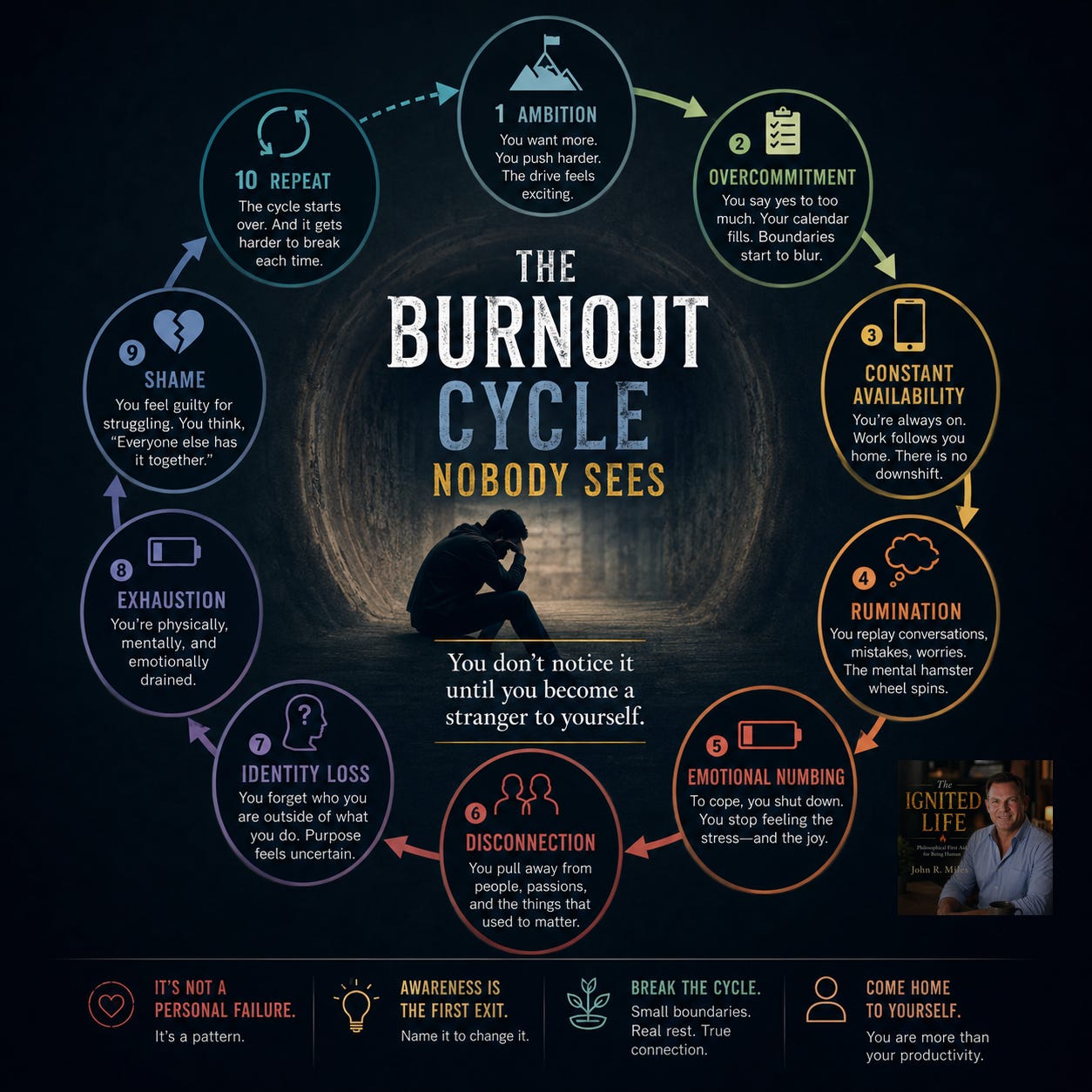
Here is what I didn’t fully understand until this conversation: the grind doesn’t stay at the office.
It follows you home in the form of rumination — that involuntary, compulsive replaying of the difficult moment, the dismissive comment, the meeting that went sideways. Guy explained that rumination isn’t reflection. Reflection moves toward insight. Rumination just churns. It reactivates the original stress response — the cortisol, the tension, the unresolved feeling — without offering anything in return.
A two-minute conflict at work becomes two hours of suffering at home. And here is the part that stopped me: it’s contagious. When you carry that tension through your front door, the people who love you begin to absorb it. Partners of people experiencing burnout can develop symptoms themselves. The grind doesn’t just take you. It reaches for the people standing closest to you.
And still, we can’t simply decide to stop. That’s the cruelty of rumination. It’s involuntary. You can’t think your way out of it by telling yourself to think about something else.
What you can do is learn to ask one question when you notice the wheel spinning: What is the action item here? If there isn’t one, it’s not reflection. It’s rumination. And the only exit is to gently and deliberately redirect.
Playing to Win vs. Playing Not to Lose
One of the quieter insights from our conversation has stayed with me in the days since.
Guy talked about what researchers call challenge-threat theory — the idea that how you perceive a stressful moment changes your actual biology. Not metaphorically. Physiologically.
When you walk into a high-stakes meeting believing you are equipped for it, your body responds accordingly. The hormones that sharpen focus and support performance show up. You are playing to win.
When you walk in braced against failure — trying not to lose rather than trying to succeed — your body responds to that, too. You become tentative. You second-guess. The defensive posture, it turns out, predisposes you to the very outcome you were trying to avoid.
I think about how many of us move through our entire careers in threat mode without ever naming it. How much of what we call ambition is actually just a very sophisticated form of fear.
What “Balance” Actually Means
We have been thinking about work-life balance wrong for a long time.
We treat it as an equation: if I add enough yoga and enough weekends, the hours at the desk become acceptable. But Guy’s point — and I think it’s an important one — is that the “life” in work-life balance isn’t a compensatory activity. It’s just life. Making dinner. Walking the dog. Sitting with your child while they do homework. Being present in the unremarkable moments that, accumulated over years, become the texture of a life well-lived.
You haven’t finished work when you close the laptop. You’ve finished when you stop thinking about it.
That distinction used to feel abstract to me. Now it feels like the whole thing.
The Line You Keep Moving
Most of us don’t fail to set boundaries because we don’t know we need them. We fail because we wait too long — until the resentment has already quietly built, until the yes we keep saying has hollowed something out.
Guy told me about people who finally draw a line, say the words carefully and clearly, and then assume the work is done. It isn’t. That’s the part nobody warns you about. The boundary isn’t the conversation. The boundary is everything that comes after — the patient, unglamorous repetition of holding it, again and again, without anger, without apology.
He called it a spoonful of sugar. Not because it’s sweet, but because the way you deliver a limit determines whether the other person can actually hear it. Most people aren’t trying to take more than you have. They’re just on their own autopilot, reaching for what was always available before.
What strikes me about this is how much it mirrors the grind itself. We don’t lose ourselves in one dramatic moment. We lose ourselves in the accumulated weight of every line we meant to draw and didn’t. Every time we answered the email at midnight. Every time we said I’m fine when we weren’t. Every small surrender that felt, in the moment, easier than the alternative.
The boundary isn’t a wall. It’s the practice of knowing where you end and the grind begins — and choosing, quietly and repeatedly, to stay on your own side of it.
The Person in the Elevator
I keep coming back to Guy in that elevator. Not to judge him — the opposite, actually. Because there is something clarifying about watching someone who knows better get swallowed by the grind anyway.
It means the grind isn’t a character flaw. It isn’t a failure of discipline or self-awareness. It is a system — a powerful, culturally sanctioned system — that is very good at making its costs invisible until they show up somewhere you didn’t expect. In a sharp word. In an empty feeling. In the quiet realization that you’ve been so busy becoming successful that you forgot to remain yourself.
The question Guy’s story leaves me with isn’t how do I avoid burnout. It’s something more personal than that.
Which pillar has been quietly dissolving while you weren’t looking? Your health? Your curiosity? The simple capacity to be present in your own home, in your own life, with the people who chose you?
And what would it mean — not dramatically, not all at once — to begin rebuilding it?
Our full conversation in EP 767 of Passion Struck is linked below.
Download the FREE Companion Reflection Guide here.
Guy Winch’s new book, Mind Over Grind, is available now.
Thoughts? Let me know below this essay!
Every 🧡, restack, or comment you share here on Substack
is like a signal flare…..
It helps this message find the person who is still walking
their own “schoolyard” alone.
Thank you for being part of this ecosystem.
I love turning these essays into a two-way conversation
So please let me know your thoughts below.
© John R. Miles 2026. All rights reserved.
The hidden shame of burnout isn't exhaustion. It's self-erasure" — this stopped me. Because exhaustion we know how to name. Self-erasure we've spent years calling something else entirely.
What strikes me most is that self-erasure rarely feels like losing yourself in the moment. It feels like devotion. Like being a good partner, a committed employee, a reliable friend.
And I think that's what makes it so hard to catch — because a lot of it is actually a protection strategy. If you give everything, no one can say you didn't care enough. If you disappear into the role completely, there's no "real you" left to be rejected.
The grind doesn't just exhaust you. It gives you a very convincing reason to keep going.
Great point: “When you carry that tension through your front door, the people who love you begin to absorb it. Partners of people experiencing burnout can develop symptoms themselves. The grind doesn’t just take you. It reaches for the people standing closest to you.”
The same is true when people are thriving. Data shows they are more likely to have thriving family members and other positive ripple effects in the community. Career well-being is a huge component of thriving. Work has a huge impact on quality of life and that’s too often ignored.