

The Self-Help Monastery Trap
Why Healing Was Never Meant to Be a Solo Journey


Over the past generation, we have fundamentally changed how we think about healing.
Not long ago, most personal transformation happened inside relationships. We learned resilience from our families, mentors, faith communities, coaches, neighbors, and close friends. Growth wasn’t something we pursued in isolation; it emerged through the daily work of learning to trust, forgive, cooperate, repair conflict, and belong. Whether those environments were healthy or deeply dysfunctional, they were the places where our identities were formed.
Today, healing has increasingly become something we pursue as individuals. The language of therapy has entered everyday conversation. Millions of people can identify their attachment style, describe the effects of childhood trauma, explain nervous system regulation, and recognize patterns that previous generations struggled even to name.
That represents genuine progress. Conversations that once remained hidden behind closed doors have become part of everyday life. More people are seeking therapy. More parents are trying to break generational patterns. More leaders are recognizing that emotional health influences everything from family life to organizational culture.
Yet alongside this growing awareness, loneliness continues to rise. Close friendships have become harder to sustain. Rates of anxiety and depression remain stubbornly high. Many young adults describe themselves as emotionally exhausted while simultaneously feeling disconnected from the very relationships they hope will bring them meaning.
Those two realities seem difficult to reconcile. If greater self-awareness naturally produced healthier relationships, we would expect the most psychologically literate generation in history to be the most relationally secure. Instead, we often find ourselves remarkably good at understanding why we struggle, yet increasingly uncertain about how to move beyond those struggles.
So what explains the gap? Why has unprecedented psychological insight not translated into greater relational security?
I don’t think the problem is therapy. Nor do I think the problem is self-awareness. In many ways, those are among the greatest advances of modern psychology. The problem is that somewhere along the way, we quietly began treating healing as something that could be completed alone.
The Rise of the Self-Help Monastery
Much of today’s self-improvement culture assumes that transformation is primarily an individual project. The message is rarely stated outright, but it is woven through countless books, podcasts, and online conversations.
Heal yourself before entering a relationship.
Become emotionally healthy before allowing yourself to become vulnerable.
Read more.
Journal more.
Meditate more.
Understand your past more completely.
Learn enough about yourself, and healthy relationships will naturally follow.
Every one of those practices has value. Reflection matters. Therapy matters. Meditation matters. Self-awareness is one of the greatest gifts psychology has given us. But somewhere along the way, those practices stopped becoming preparation for relationship and quietly became substitutes for it. We began to confuse understanding connection with experiencing it, as though healing could be accomplished primarily through insight.
It reminds me of a monastery—but not the kind monasteries actually were.
Historically, monasteries weren’t places where people escaped relationships. They were communities organized around shared discipline. People prayed together, worked together, shared meals together, confessed failures together, and held one another accountable. Solitude had a purpose, but it always existed within community.
Our modern monastery looks very different. Its walls are built from books we’ve highlighted but never fully lived, podcasts we’ve consumed without discussing, journals that know our deepest fears better than our closest friends, and endless hours spent trying to become healthy enough to finally begin living.
The danger isn’t self-improvement. The danger is mistaking preparation for practice.
What My Conversation with Adam Lane Smith Revealed
That was the thought I kept returning to after my recent conversation on Passion Struck with attachment specialist Adam Lane Smith.
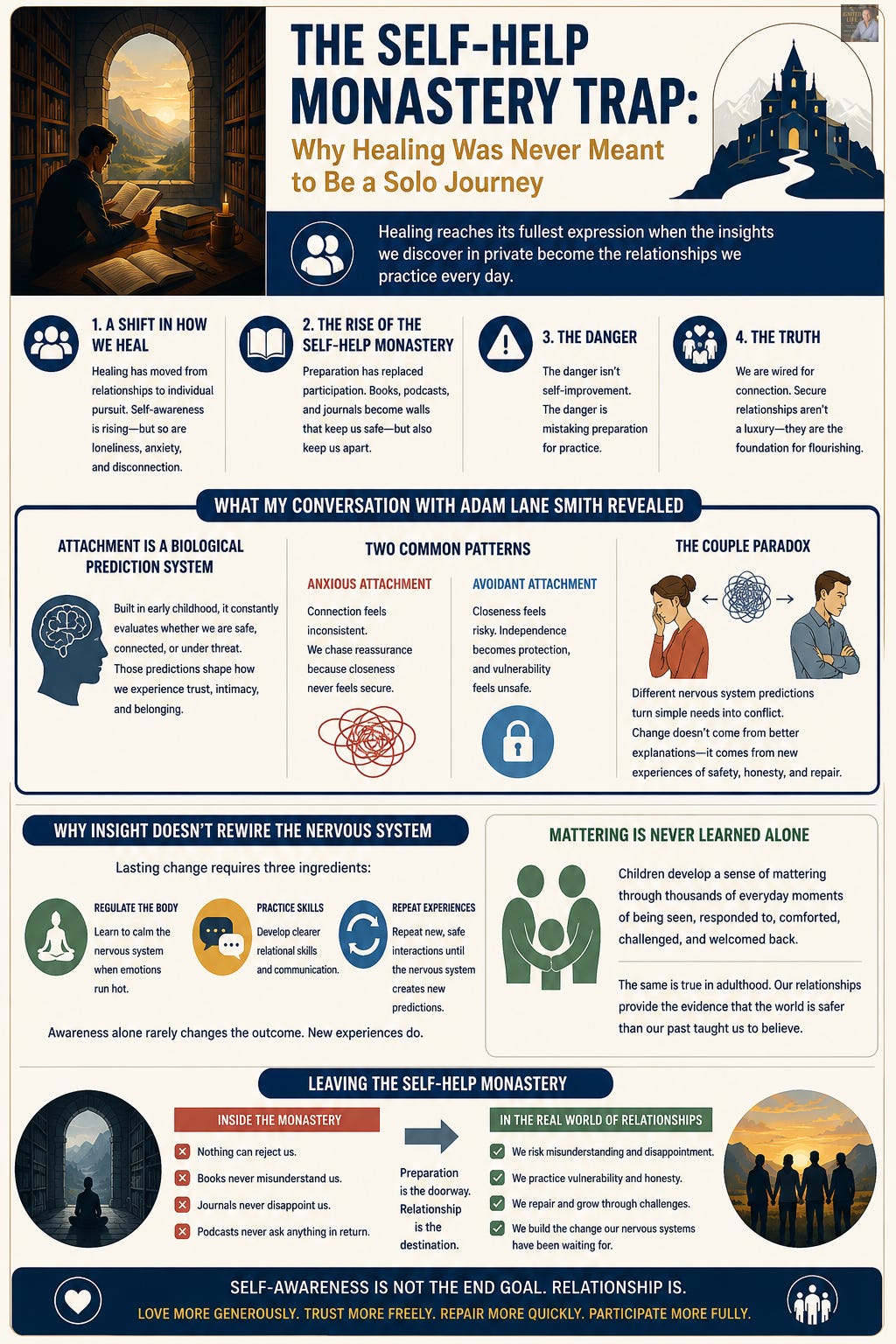
After more than two decades working with couples, families, trauma survivors, and executives, Adam encouraged me to think about attachment less as a personality framework and more as a biological prediction system — the nervous system’s internal map, built in early childhood, that constantly evaluates whether we are safe, connected, or under threat. Those predictions shape how we experience trust, intimacy, and belonging.
Anxious attachment develops when connection feels inconsistent. The nervous system learns to chase reassurance because closeness never feels entirely secure. Avoidant attachment develops when closeness becomes associated with criticism, unpredictability, or emotional neglect. Independence becomes protection, and vulnerability begins to feel like risk.
Why Insight Doesn’t Rewire the Nervous System
Adam argues that lasting change requires three things: learning to regulate the body when emotions run hot, practicing healthier relational skills, and repeating those experiences often enough that the nervous system begins making new predictions. In other words, healing isn’t simply about changing what we know. It’s about changing what our bodies come to expect.
He illustrated this with a situation almost every couple has experienced.
Imagine an avoidantly wired partner arriving home after a demanding day, emotionally depleted. All they want is a few quiet minutes to reset. Their anxious partner, who has been looking forward to reconnecting, experiences that silence very differently. What feels like necessary recovery to one partner feels like rejection to the other.
Within minutes, a familiar cycle begins. Questions meant as bids for connection start to feel like pressure. Withdrawal feels like abandonment. Defensiveness rises on both sides. Two people who genuinely care for each other find themselves reenacting a pattern neither consciously chose.
Most of us assume the problem is communication. Adam argues the deeper issue is prediction.
One nervous system has learned that closeness can overwhelm depleted emotional resources. The other has learned that distance often signals abandonment. Neither response is deliberate. Both are the nervous system acting on expectations formed long before the current relationship began.
That is why insight, by itself, rarely changes behavior. Understanding your attachment style doesn’t automatically teach your nervous system that closeness is safe. Knowing where your patterns came from doesn’t erase them.
What ultimately changes those predictions isn’t a better explanation. It’s a different experience: small, repeated moments of honesty, consistency, repair, and emotional safety that gradually teach the nervous system a new way of relating.

Mattering Is Never Learned Alone
While researching The Mattering Effect, I found myself returning to the stories of children who were deprived not of food or shelter, but of consistent human connection. Paralympian Oksana Masters has spoken movingly about growing up in a Ukrainian orphanage where neglect shaped not only her childhood but her expectations of the world. Developmental psychologists studying institutionalized children have documented similar patterns for decades. What changes those trajectories isn’t simply rescue. It’s relationship.
Children don’t develop a sense that they matter because someone explains their worth. They develop it because thousands of ordinary interactions teach them that they are seen, responded to, comforted, challenged, and welcomed back after mistakes. Those repeated experiences become the foundation of identity.
The same principle follows us into adulthood. We don’t become more secure because we’ve accumulated another insight. We become more secure because our relationships begin giving us evidence that the world is safer than our past taught us to believe.
Leaving the Self-Help Monastery
Adam’s work also made me reconsider a broader cultural trend. The modern loneliness epidemic, the dramatic reversal in how we meet partners (from 65% through family and friend networks in 1995 to 65% via apps today), and the corporate “cortisol ladder” where high performers climb into isolation all point to the same truth: We are relational beings. Secure connection isn’t a luxury. It’s the biological foundation for flourishing in every domain.
The self-help monastery is comfortable because nothing inside its walls can reject us. Books never misunderstand us, journals never disappoint us, and podcasts never ask anything in return. Relationships, however, require something very different. They ask us to risk misunderstanding, disappointment, vulnerability, and repair. That is precisely why they become the place where lasting change occurs.
The irony of the self-help monastery is that real monasteries were never designed to keep people apart. They were communities organized around shared practice, mutual accountability, and a common search for meaning. Solitude had a purpose, but it always existed within relationship.
Perhaps that is the lesson modern self-improvement needs to recover. Reflection, therapy, meditation, and learning all prepare us for growth. But they are not the destination. They are the doorway.
Healing reaches its fullest expression when the insights we discover in private become the relationships we practice every day.
Perhaps that’s why the goal was never simply to know ourselves better. It was to become the kind of people who could love more generously, trust more freely, repair more quickly, and participate more fully in the lives of others. Self-awareness remains one of the greatest gifts of modern psychology. But its highest purpose is not self-understanding. It is helping us build the kinds of relationships in which human flourishing has always been possible.
Joining the Conversation
Where in your life have you mistaken preparation for practice?
Listen to the Full Episode Here
Download the Free Companion Guide and Digital Workbook
Learn More about Adam Lane Smith
Every 🧡, restack, or comment you share here on Substack helps this message reach someone who is still running an outdated schoolyard race. Thank you for being a vital part of this community.
© John R. Miles 2026. All rights reserved.