

Revenge Isn’t Personal. It’s Patterned.
It turns out revenge isn’t nearly as personal as we think. It’s patterned. Predictable. Practically automated.

Last month, I was at a coffee shop. A man picked up my mobile order from the counter. He looked at the name on it. Then he shrugged. He walked out holding my latte. My latte was the thing I needed to start my day and feel okay.
Something inside me broke like a charging cable that’s stretched too far.
In my head, I became Liam Neeson.
“I will find you, and I will reclaim my oat milk.”
Never mind that I had no plan.
Never mind that he was already in his car.
My brain had started to plan a big payback. In another time, this plan might have needed me to wear a trench coat and play some music in the background.
When the barista gave me another coffee and I started to feel better, I sat there with one question I could not avoid:
Where did that movie trailer for getting back at someone even come from?
It didn’t feel thoughtful or moral.
It was a natural feeling. It happened by itself. It was like someone pushed a button behind a part of the brain called the amygdala.
And that small but very strong moment stayed with me when I talked with James Kimmel Jr. This is because what happened in that coffee shop—the shock, daydream, the happy feeling, and what happened after—was a small bit of the thing he has spent his life looking into.
The Moment That Changed Everything for James
James didn’t stumble into this field from an academic distance. His entry point was far darker than a stolen latte.
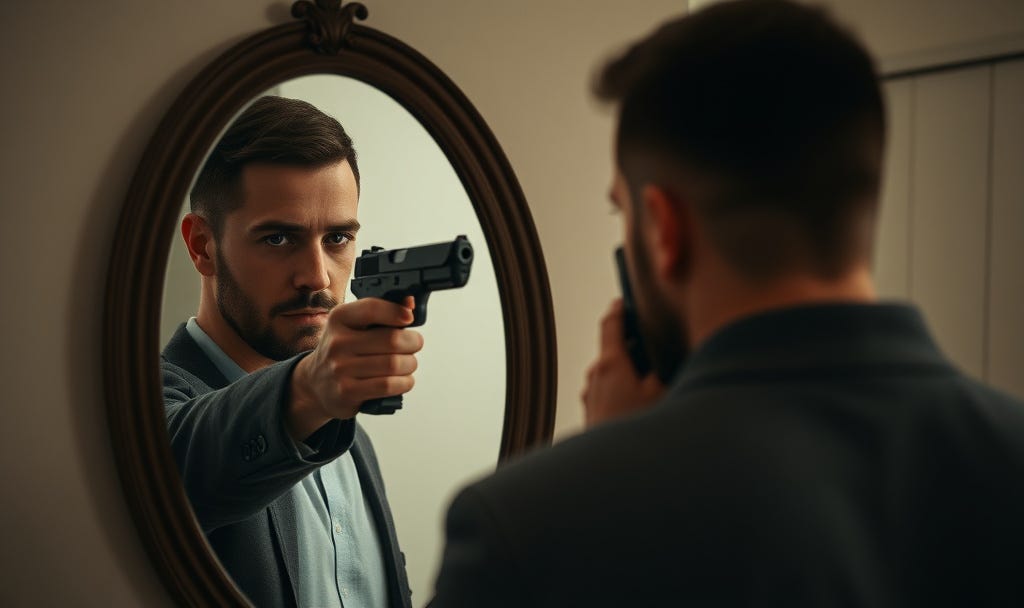
Growing up on a farm, he endured years of bullying that left deep emotional grooves. And one night, after the boy who tormented him most shot his dog, James snapped. He grabbed a revolver, drove after the boys, cornered their truck, and stepped out ready to do something he would never be able to undo.
He told me about that night with a clarity that made the room feel smaller. The cold air. The gravel. The pulse in his fingertips. And then — the flicker. A two-second window where he saw not them, but himself. The version he didn’t want to become.
That was the moment he stepped back, walked away, and eventually became the backbone of his research.
Because once he came down from the adrenaline, he knew it hadn’t been “character” that almost tipped him into violence. It was something deeper. Something faster. Something his brain had rehearsed long before he ever picked up the gun.
That realization became his life’s work, and eventually, it became the reason he sat across from me on the show.
The Life-Changing Experience For James
James did not fall into the science of revenge through academics; he entered the field through much darker means.
James spent a good portion of his young adult life as a victim of bullying on a family-owned farm. Eventually, after being bullied by one boy in particular for years, when the boy shot his dog one evening, James reached his breaking point and he snapped. He took a revolver, followed the boys, cornered their truck, and exited with the intent to take action that would forever be impossible to reverse.
James explained this night with a level of detail that seemed to make our meeting room even smaller. He explained the coldness of the air, the roughness of the gravel beneath his feet, and the pulse of blood running through his fingertips. And then, there was the flicker. A two-second window in time that allowed James to see not the bullies, but himself. Not the man he wanted to be.
It was at this point that James chose to step back, walk away, and later become the foundation of his research.
After the adrenaline wore off, James realized that what nearly caused him to commit violence was not “character” that nearly got the best of him, but rather something deeper. Something quicker. Something his brain had rehearsed before he could pick up the gun.
This realization is why he has spent his entire career researching this topic, and ultimately why he sat before me on television that day.

When Forgiveness Stops Being Sentimental and Starts Being Useful
James does not talk about forgiveness as if it’s just a nice or soft thing people do. Instead, he talks about it like a neuroscientist. That is because he is one.
In his view, forgiveness is not the same as saying everything is okay.
It is more like a break in what is happening.
This is what takes place when you stop feeding the habit for some time. Then, your clear mind can come back in charge. This is what happens when you feel less urge for it. This is what happens when you choose not to accept the role the habit wants to give you.
Forgiveness in James’s world is not soft. It is a smart plan. There is a reason behind it. There is a way to take charge. It can also mean leaving the race for good.
When you see it this way, forgiving someone is not about helping the person who hurt you. It is about saving yourself. It is about helping you grow into the person you want to be.
The Thing I Hope You Take From This
(And the thing James made impossible to ignore)
Revenge isn’t proof that we’re broken.
It’s proof that we’re human.
We all feel that surge sometimes. It can be a small one when you have coffee. It can be even worse when someone hurts you. It can also be a gentle one from a pain that is not seen by others. The way it looks doesn't matter. What matters is what you do right after it happens.
The moment when you feel like you want something, but you choose for yourself. You remember that you still get to pick what happens.
The brain can start things. But who you are decides how it finishes.
And think about the one question that really shows what your life will be like.
Who are you if you keep giving in to the loop? And who are you if you don’t?
Listen to the full Ad-Free conversation below:
Wow… this really hits. I love how you show that revenge is natural, but choosing forgiveness is actually taking control of yourself. Powerful reminder that who we are is defined by how we respond, not just what we feel.
Superb! Doesn’t it boil down to learning the difference between feeling, reacting and choosing. It seems to take practice- honoring the emotion, acknowledging and accepting it while choosing to act or not act. Then I wonder- how have our communities, our tribes begun to fail at teaching us this.