

The Backpack We Never Chose
Recognizing the hidden attachments that shape our lives and choosing what stays


Imagine I handed you a backpack. I told you that you would have to wear it every single day for the rest of your life, but you wouldn’t get to choose what went inside. Other people would.
Every criticism you received, every rejection you endured, and every quiet moment you felt completely unseen would add to the weight. Every time you were made to believe that love had to be earned, another stone was slipped inside.
One more weight. One more thing to carry.
At first, the backpack wouldn’t seem very heavy because you were young and adaptable. But after twenty, thirty, or forty years of carrying that invisible weight, something remarkable happens: You forget you are carrying a backpack at all. You simply call the heavy burden on your shoulders “me.”
But simply recognizing that you are carrying a heavy backpack isn’t enough to change the trajectory of your life. Intellectualizing the burden doesn't make it any lighter. The real question we have to confront goes much deeper than where your armor came from: Which of those survival scripts are still actively running your life right now?
The profound psychological truth is that we don’t remember childhood exactly as it happened; we live through the adaptations our past installed.
When we are young, we don’t possess the perspective to analyze the complex stresses or emotional limitations of the adults raising us. A child doesn’t look at a distant, completely checked-out parent and say, “My parents are under enormous financial pressure and are simply burning out from their corporate careers.”
A child cannot comprehend that. Instead, they look at that cold distance, turn it completely inward, and ask a much simpler, heartbreaking question: “What is wrong with me?”
Because children cannot change the adults who control their world, they do the only thing they have the power to do: they change themselves.
To stabilize an unpredictable environment, a child’s brain writes a silent script to secure safety and attention. If love feels inconsistent or tied exclusively to performance, the child internalizes it as a rule. They drop a heavy adaptive strategy right into their backpack, deciding that if they are completely flawless, never ask a single soul for help, or stay entirely invisible, they will finally be safe from the pain of rejection.
We carry these early adaptations into adulthood unconsciously. The real tragedy is that so many of us spend our entire adult lives protecting a version of ourselves that a frightened child invented.
When Survival Becomes Identity
As we step into adulthood, our environments change completely, but the contents of that backpack remain perfectly intact. We turn our old protective strategies into lifelong emotional contracts, entirely forgetting that these roles were originally meant to be shields, not our actual skin.
In my upcoming book, The Mattering Effect, I explore this exact phenomenon as “the slow fade”—a hidden epidemic of identity loss where people gradually disappear beneath achievement, productivity, caregiving, and the roles they’ve learned to perform. We don’t cling to our relationships nearly as tightly as we cling to the versions of ourselves those relationships allow us to be, because identity often feels safer than intimacy.
To help visualize how these invisible forces operate beneath our conscious awareness, look at the breakdown in this diagram about our hidden attachments.
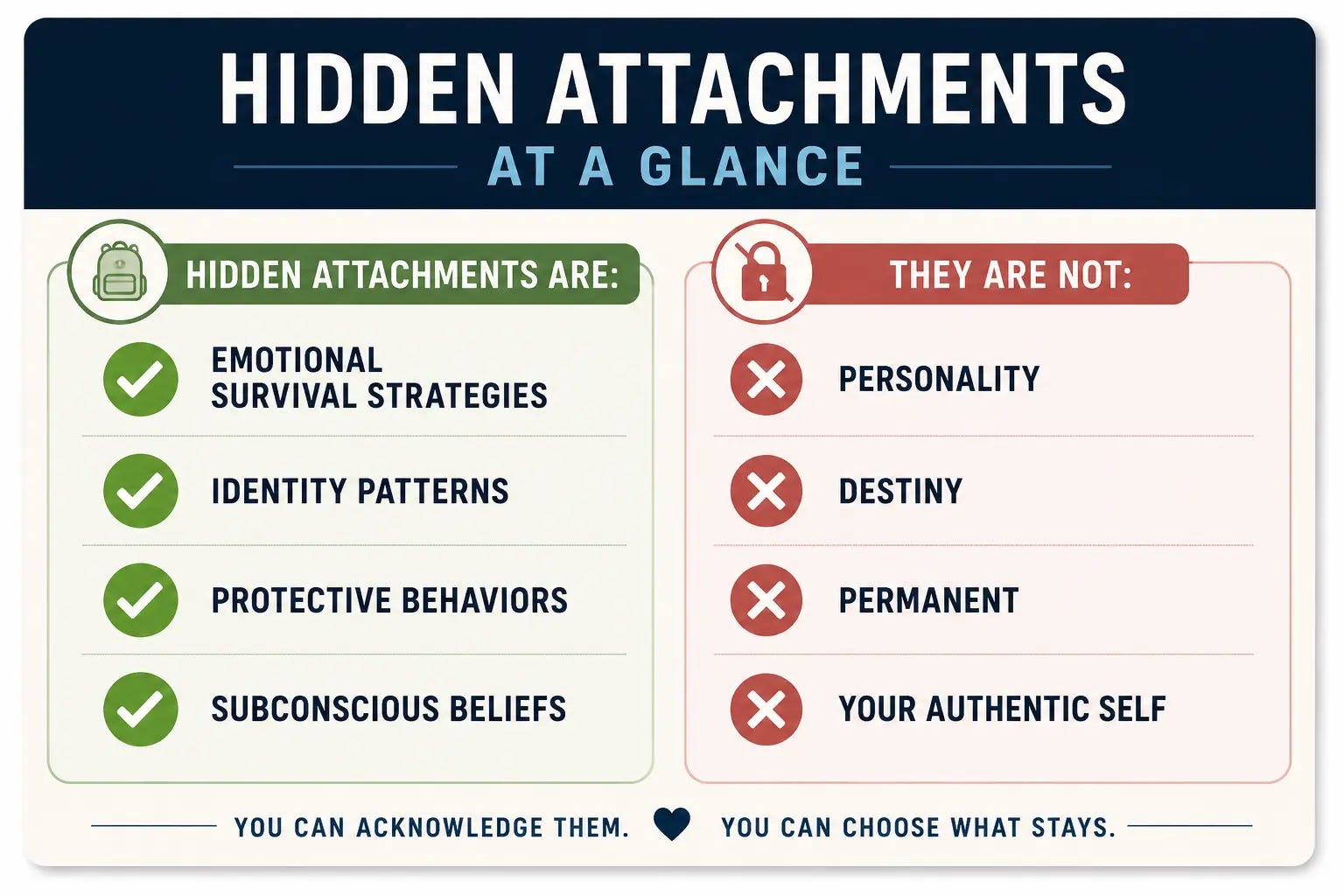
As the chart illustrates, these survival strategies are not your actual personality, nor are they permanent life sentences. Yet by default, we treat them as permanent emotional contracts. Consider how these hidden loops manifest in everyday life:
The Fixer: People who become deeply attached to being needed. They answer every phone call at midnight and solve every family crisis, willingly carrying everyone else’s burdens while ignoring their own exhaustion. Their silent contract reads: “If no one needs me, no one will love me.”
The Hyper-Independent: Those who build an entire identity around the pride of never needing a single soul, entirely unaware that their emotional armor is actually just a calcified fear of being let down.
The Achiever: Individuals obsessively attached to execution and status. They run on a relentless corporate treadmill, fueled by an underlying belief that their human worth is tied strictly to what they produce.
I know this trap intimately because for years, I carried my own heavy backpack into every boardroom. From the outside, my life was the perfect blueprint of success. I was outperforming everyone around me, running on the frantic fuel of 100-hour workweeks and non-stop global travel.
What I couldn’t see back then was that I had become so attached to the identity of being indispensable that I had completely forgotten how to simply be present.
The Hidden Cost of Staying Safe
Why do our minds fight so fiercely to maintain these identities, even when they cause us immense personal loneliness?
The reality is that your brain is far less interested in making you happy than it is in making tomorrow look exactly like yesterday. From an evolutionary perspective, the familiar is always processed as safe, while the volatile uncertainty of true intimacy is flagged as an immediate crisis.
This neural programming triggers a state I refer to in my research as The Performance-Freeze Paradox. On the outside, you look exceptionally successful, reliable, and driven. On the inside, your nervous system is completely locked down to protect itself from threat."
When an interaction touches an ancient childhood wound, your survival brain instantly hijacks your body, taking your communication skills and best intentions entirely offline. Your system drives you to protect the trap because opening your fist and letting go of that protective identity feels like stepping off a cliff. We settle for a predictable, isolated routine because our primitive wiring would rather keep us lonely than risk the vulnerability required to be truly seen.

Choosing Freedom Over Familiarity
Breaking free from these hidden attachments requires us to fundamentally shift the questions we ask when we look in the mirror. True self-reclamation doesn’t happen when you simply label your behavior with an attachment style and treat it like a permanent life sentence. Instead of asking, “What attachment style am I?” you have to courageously ask:
“What identity am I absolutely terrified to lose?”
More than a century ago, the psychologist William James made a brilliant distinction that helps clarify this internal tension. He argued that there are two distinct dimensions to who we are: the self-as-object, which he called the “Me,” and the self-as-subject, which he called the “I.”
The graphic The Polarity of Self maps out this exact psychological split:
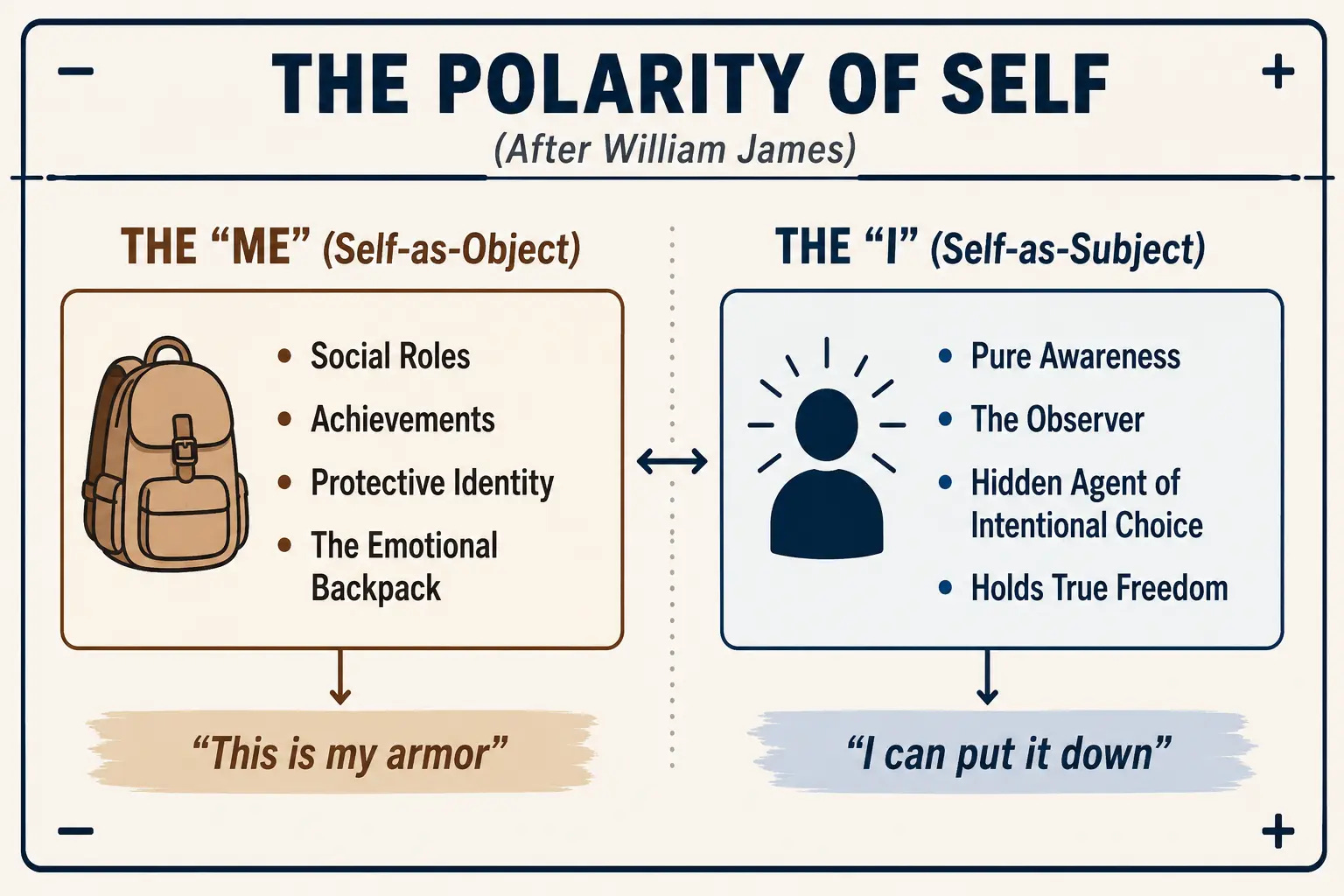
The backpack you’ve been dragging around, the perfectionism, the hyper-independence, the exhausting need to be indispensable, belong entirely to the historical “Me.” It is the armor you built to survive. But the conscious presence capable of sitting down, opening that backpack, looking inside, and asking, “Does this actually belong to me?” is the observing “I.”
And that is exactly where your internal freedom begins.
To step into a life of authentic connection, we have to realize that setting the backpack down is completely different from throwing it away. Putting it down requires self-compassion and small, deliberate micro-choices, rather than massive, overwhelming resolutions that cause your survival brain to freeze and retreat.
True ownership begins when you stop trying to think your way out of an emotional storm and instead use physical techniques to actively soothe your dysregulated nervous system. When you calm your biology, your logical brain comes back online, allowing you to deploy clear, honest communication—openly stating your needs rather than dropping passive hints and resenting people for failing to read your mind.
When you replace self-judgment with curiosity, you discover the ultimate realization: the version of you that learned how to survive your past is not the version of you that is meant to lead your future.
An Intentional Model for Self-Reclamation
To move from automated survival into true personal sovereignty, we need a reliable framework to guide our steps. We cannot simply intellectualize our way out of the heavy burdens we carry; we have to consciously choose a new path forward.
The framework in The Backpack We Never Choose Infographic outlines this progressive journey of recovery:
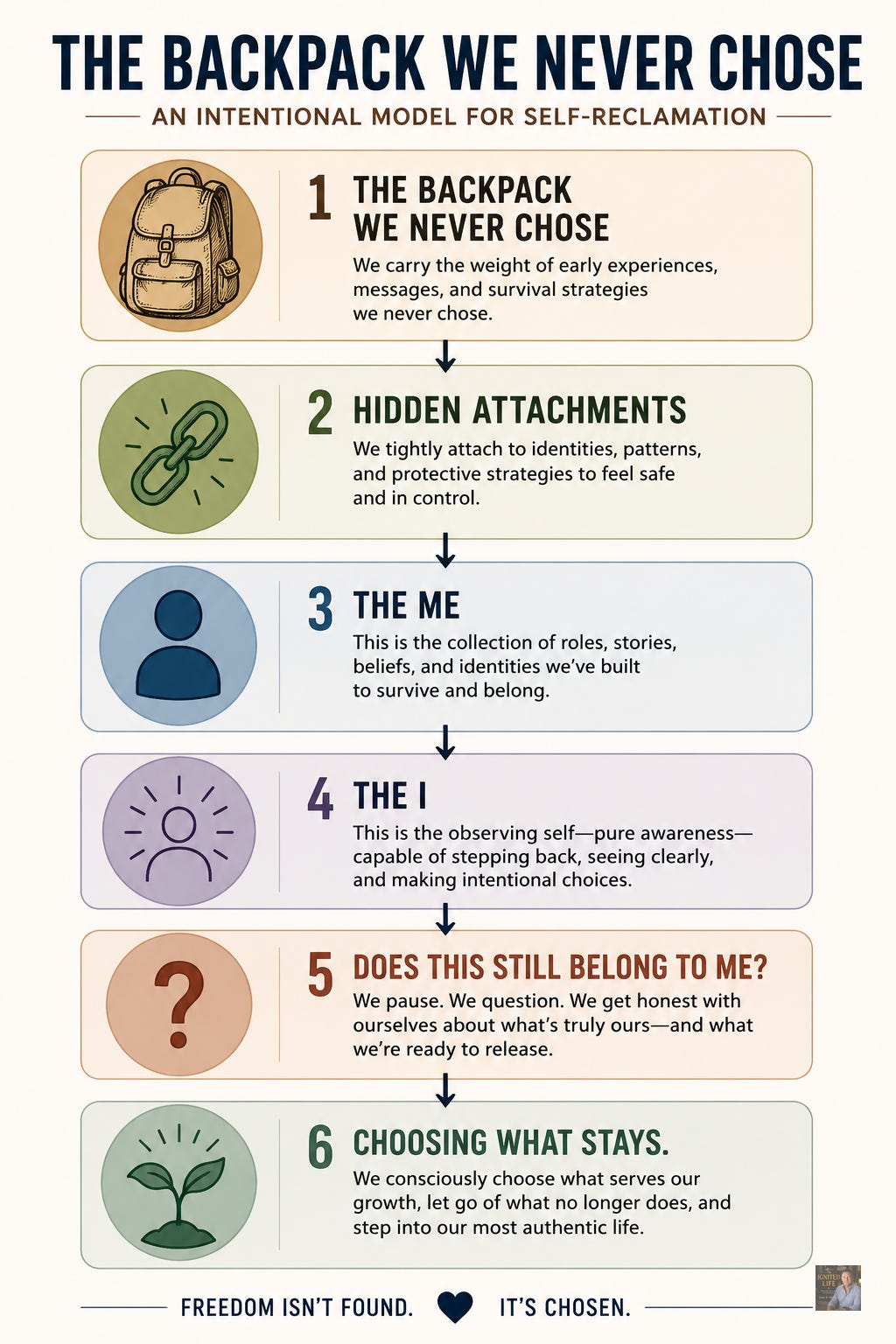
As this intentional model shows, freedom isn’t something we accidentally stumble into. It is a conscious, active choice to evaluate the contents of our emotional armor, challenge what no longer serves our growth, and step definitively into our most authentic lives.
Unpacking the Weight
I encourage you to ignore the natural instinct to rush out and find a fast solution. Instead, let these four reflections sit quietly in your mind and see what surfaces:
What is inside your backpack right now that you have mistakenly called your personality?
What emotional strategy once protected you as a child, but is now actively standing in the way of intimacy in your adult relationships?
Where in your life are you completely exhausting yourself trying to earn a sense of worth that is already fundamentally true?
Who would you actually be if you didn’t have to perform anymore?
Maybe today isn’t about unpacking the entire backpack all at once. Maybe today is simply the day you realize it was never supposed to become a part of who you are.
Open it. Look inside. Pick up one belief you’ve been carrying for decades. Turn it over in your hands. Look at it with curiosity.
Then ask one simple question: Does this still belong to me?
Listen to the Full Episode Here
Download the Free Companion Guide and Digital Workbook
Every 🧡, restack, or comment you share here on Substack helps this message reach someone who is still running an outdated schoolyard race. Thank you for being a vital part of this community.
© John R. Miles 2026. All rights reserved.
Lovely picture