

The Body as Foreign Country
Reclaiming astonishment in the one home we cannot leave

While preparing for my conversation with Whitney Otto, I found myself standing in front of the mirror longer than I intended. I wasn’t evaluating my appearance or planning changes. I was simply looking — really looking — at the body that has carried me through every chapter of my life. And I realized how rarely I meet it with anything resembling curiosity anymore.
That quiet moment stayed with me through the interview. Whitney Otto, a former World Champion rower, Olympic alternate, executive coach, and co-author with Deb Schachter of Body Image Inside Out, didn’t offer the usual advice about loving your body more fiercely. She offered something subtler and more radical: the possibility that our bodies have been speaking to us all along, and we have mostly been trying to manage or silence them instead of learning to inhabit them with wonder.
I grew up with a traumatic brain injury that affected my speech and, for a time, left me carrying extra weight. Mirrors were not kind to me then. They became a daily accounting of what felt wrong — the way I moved, the way I sounded, the shape I took up in the world. Later, as a Division I athlete and in the military, I transformed that body through relentless discipline. I looked stronger. I performed better. But the internal critic didn’t disappear. It simply changed roles. It went from shaming my limitations to guarding my achievements.
The body, I learned, can become both project and armor. We use it to prove we belong. We shape it in hopes it will finally make us feel safe. And still, many of us — especially high performers — walk around feeling like visitors in our own skin.
The Intelligence Hidden in Discomfort
Whitney described negative body image as a kind of survival strategy. It often holds emotions we don’t know how to name — fear, grief, the ache for belonging, the disorientation of life transitions. When feelings overwhelm us, the mind does what it knows: it turns toward the body, something we believe we can control.
She and Deb call the familiar loop the Body Image Rotary.
Overwhelming emotion leads to uncomfortable sensations in the body, which quickly trigger the urge to “fix” ourselves — through stricter diets, harsher workouts, or renewed self-criticism. We go around and around, never quite addressing what started the spin in the first place.
The way out, they teach, begins with three quiet capacities they call the BodySelf Muscles: mindful awareness (noticing what’s happening), curiosity (asking why it’s happening), and self-compassion (meeting ourselves with the kindness we’d offer someone we love).
These are small, repeated turns toward the body instead of against it.
Jealousy as a Quiet Compass
One idea from my conversation with Whitney has stayed with me.
Jealousy can be a teacher rather than a tormentor.
When we feel that sharp pang looking at someone else’s ease or confidence in their body, we can pause and ask: What do I believe they get to experience because of how they look?
The answer usually reveals something we long for — rest, freedom, belonging, vitality. The work then shifts from trying to reshape our body to gently pursuing those experiences in our actual life.

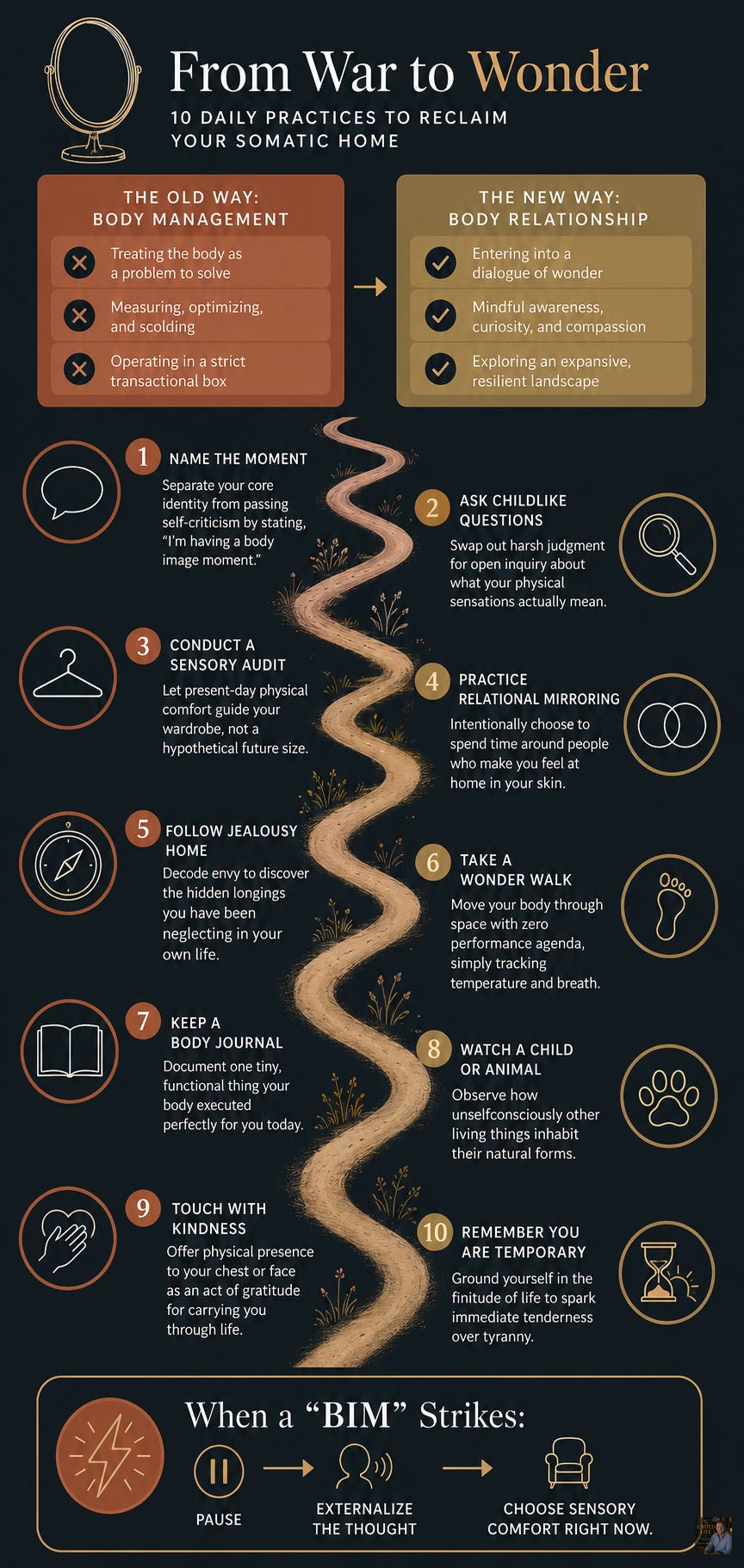
Ten Ways to Begin Seeing Your Body Again
Wonder is not something we manufacture. It is something we remember. Here are a few quiet practices that may help:
Name the Moment — When criticism arises, simply say, “I’m having a body image moment.” Externalizing it creates a little space for breath.
Ask Childlike Questions — Instead of “What’s wrong with me?” try “What might this sensation be trying to tell me?” or “How does my body feel right now, apart from judgment?”
Conduct a Sensory Audit — Stand in your closet and notice what actually feels good against your skin today. Let comfort, not someday-size, guide you.
Practice Relational Mirroring — Notice which people leave you feeling more at home in your body and which ones tighten the critic’s grip. Choose your mirrors with care.
Follow Jealousy Home — When envy appears, write down what you imagine that person experiences. Then ask: How might I invite a version of that into my own life?
Take a Wonder Walk — Move your body without agenda. Notice textures, temperature, breath, the simple fact of being alive in space.
Keep a Body Journal — Each evening, note one thing your body did for you that day—no matter how small. Digestion. Balance. A good stretch. The ability to laugh.
Watch a Child or an Animal — Observe how unselfconsciously they inhabit their bodies. Let their ease remind you of what is possible.
Touch with Kindness — Place a hand on your chest, your belly, your face. Not to measure, but to offer presence. This is the body that has carried you through every hard and beautiful day.
Remember You Are Temporary — The body is not a permanent sculpture but a living, changing miracle. Like all things, it will one day return to the earth. That finitude can inspire tenderness rather than tyranny.
Coming Home
I spent years believing that if I worked hard enough, disciplined myself enough, and achieved enough, I would finally feel at home in my body. What Whitney helped me see is that home is not a destination we earn through perfection. It is a relationship we learn to inhabit with presence.
This body has never abandoned me. It has been the constant witness to every fear, every triumph, every ordinary day.
Perhaps astonishment begins exactly there. Not in forcing ourselves to love every part, but in remembering that we have never traveled alone. We have always been carried.
I’m still learning what it means to meet my body with wonder instead of management. Some days are better than others. But the mirror feels a little less like a courtroom and a little more like a threshold these days.
I’d love to know: When was the last time you felt even a flicker of curiosity or gratitude toward your body? What helped?
Listen to Passion Struck Episode 787 with Whitney Otto
Download the FREE Companion Digital Workbook.
Body Image Inside Out by Whitney Otto and Deb Schachter
Thank you for thinking with me here. These conversations matter.
© John R. Miles 2026