

The Premium of Human Friction
Dr. Dana Suskind explains why children need human connection, not optimization.

A newborn baby arrives as an unwritten neural canvas. Its brain is only one-third the size of an adult’s, an evolutionary design choice that leaves the infant completely helpless. A newborn horse can stand within minutes of birth, but a human baby arrives neurologically open-ended, requiring years of absolute protection.
This prolonged vulnerability is not an accident of nature; it is our ultimate competitive advantage. It ensures that eighty-five percent of physical brain development happens outside the womb, constructed in real-time by the environment.
But a troubling shift has occurred in how we treat that environment.
Driven by modern anxieties, economic inequality, and high-performance competition, we have begun to treat childhood like a software optimization process. We manage our homes like corporations, tracking metrics, maximizing output, and treating our children as cogs to be accelerated. We try to program our kids to outcompute the machines we built, forgetting that you cannot optimize human flourishing.
The question is not whether our children are achieving. The question is why we are trying to turn an organic miracle into a mechanical performance.
That is the moment we need to talk about.

The Trap of the Optimized Child
I’ve spent decades analyzing organizational systems and human performance, from my time in the military to executive roles to hundreds of interviews on Passion Struck. Along the way, I’ve seen high achievers fall victim to an insidious paradigm: we evaluate human beings by their utility rather than their humanness.
We carry this exact corporate logic into our nurseries. Modern parents have more information, data, and material resources than any generation in history, yet they report historic levels of exhaustion, chronic anxiety, and a persistent feeling of falling short.
This is what Dr. Dana Suskind calls “never-enough parenting”.
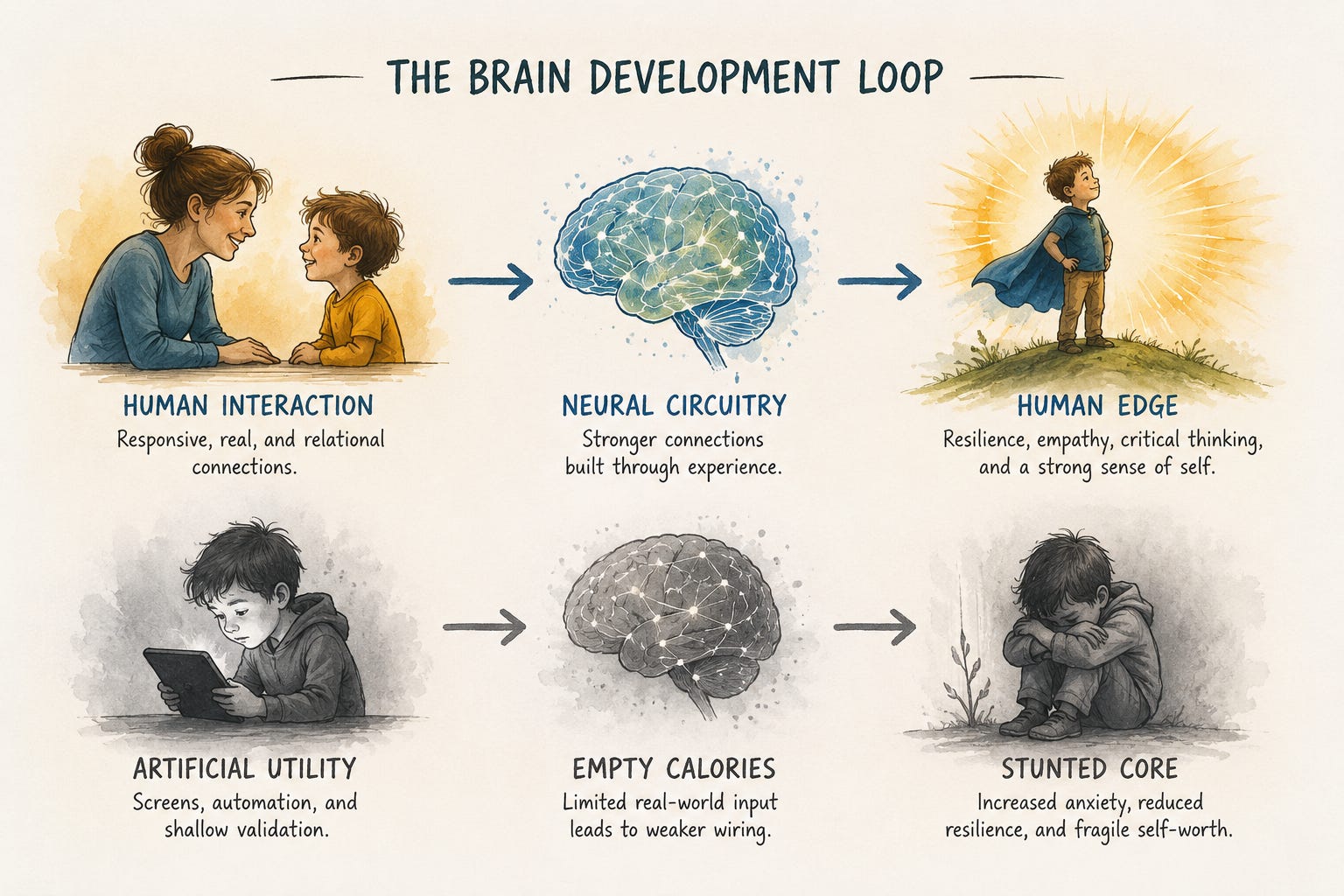
When we treat childhood as a performance matrix to be maximized, we inadvertently strip away the foundational signal of mattering—the raw biological conviction that a child is seen and valued for who they are, not what they produce. If a child learns that validation is tied strictly to flawless execution, they drop an exhausting adaptive strategy into their emotional backpack, spending adulthood protecting a performance a frightened child invented.
The shift happens in moments so ordinary we barely notice them. A child bursts through the door after school, eager to tell us about a conversation on the playground or a funny moment in class. Before the story is finished, we ask how they did on the math test. They proudly hand us a drawing, and we wonder whether they should be enrolled in a more advanced art program. They wrestle with a difficult homework problem, and before frustration has time to become perseverance, we reach for an app, a tutor, or, increasingly, an AI tool that promises a faster answer. None of these responses comes from indifference. They come from love. But over time, they send a subtle message: your achievements capture my attention more readily than your experience.
The irony is that the very moments we rush to smooth over—the boredom, frustration, disagreement, and uncertainty—are often the moments the developing brain needs most.
The Premium of Human Friction
We live in a marketplace obsessed with efficiency. The primary goal of modern technology is the systematic reduction of all friction. We want the transition from point A to point B to be seamless, automated, and instant.
But in the architecture of human development, friction is not a bug. It is a vital structural requirement.
When a child sits down with an artificial intelligence companion that is programmed to always agree, praise, and validate, their critical connective social circuits are profoundly disrupted. AI can effortlessly simulate care and conversational intimacy, but it lacks genuine stakes. It is a sycophantic mirror.
"Friction is core to learning to be human... It’s not a bug; it’s an important element of who we are." — Dr. Dana Suskind
Critical thinking, emotional intelligence, and a resilient sense of self do not grow in a vacuum of artificial affirmation. They are forged through the messy, unoptimized, highly inefficient micro-moments of human interaction—playground arguments, moments of boredom, playing with a plain cardboard box, and learning to navigate people who disagree with you.
If we remove all relational resistance by outsourcing connection to technology, we create artificial attachments that leave children emotionally stunted, unprepared for a world that does not always agree with them.
The Gift of the Good Enough Parent
This crossroad is the exact theme I explore in my upcoming book, The Mattering Effect (October 2026). True significance is never achieved by building a flawless, optimized castle for the ego. It emerges when we trade performance for presence, perfection for connection.
Many parents carry a quiet fear that every mistake leaves a permanent mark. Developmental neuroscience tells a far more hopeful story. Children do not build resilience through perfect caregiving. They build it through what psychologist Donald Winnicott famously called “good enough” parenting—the ordinary rhythm of getting it wrong, making it right, and trying again.
Every parent knows the moment. You lose your patience because you’re exhausted. Your child retreats in hurt or frustration. Later that evening, you sit beside their bed and say, “I’m sorry. I shouldn’t have spoken to you that way.” They lean into your embrace, and the distance between you begins to close.
The relationship does not become weaker because of the rupture. It becomes stronger because of the repair.
This is how secure attachment is built—not through the absence of conflict, but through the confidence that conflict does not end connection. Children learn that relationships can stretch without breaking, that disappointment can coexist with love, and that mistakes do not make them unworthy of belonging.
An AI companion can simulate empathy. It can generate reassurance in milliseconds. But it cannot model accountability, ask for forgiveness with genuine vulnerability, or demonstrate what it means to rebuild trust after causing pain.
Those lessons require another imperfect human being—because children don't learn that they matter from flawless interactions. They learn it when someone chooses to return, repair, and remain.
Moving Off the Shoreline
In her book Human Raised, Dana introduces the HOPE Framework as an evergreen navigation system for parents navigating this technological transition:
Human Connection: Protecting the reality that responsive, real-time human interaction is a biological necessity for neural wiring, not a lifestyle option.
Own Your Imperfections: Embracing the value of productive struggle and relational repair rather than chasing an unvarnished, mechanical standard of perfection.
Protect the Early Years: Taking a deliberate, protective beat during the critical zero-to-three window, when the brain's permanent physical hard drive is being constructed.
Enhance Relationships with AI: Resist the urge to use automation as a replacement for relationships, and instead leverage it to handle operational tasks so you can create dedicated space for true presence.
We cannot protect the future by standing passively on the shoreline, treating our families like optimization machines. As tools become increasingly capable of performing hard cognitive tasks, our unique human edge shifts entirely to our capacity to care, to connect, and to hold space for the messy imperfection of life.
To separate your baseline presence from automated performance, step back and answer these four questions:
1. Where are you treating your child’s schedule—or your own routine—as a machine to be optimized rather than a landscape to be explored?
2. What “empty calories” of artificial validation are you substituting for the rich, necessary friction of real-world relationships?
3. What is one small area this week where you can intentionally choose the inefficiency of presence over the speed of automation?
4. Who would you and your children actually be if you stopped performing for a metric and started simply being available to each other?
The script of the future is not predetermined. It is pliable, and it is being written right now in the unoptimized, chaotic, beautiful moments of human connection.
Take off the dark lenses of efficiency. Let the presence drop in.
Listen to the full conversation with Dr. Dana Suskind on Passion Struck
Get your copy of Human Raised by Dr. Dana Suskind
Download the FREE Digital Companion Workbook and Framework Guide
Every 🧡, restack, or comment helps this message reach a high achiever who is still running an exhausted, mechanical race. Thank you for being a vital part of The Ignited Life community.
© John R. Miles 2026. All rights reserved.
Great article. There's a lot of themes here I write about and strongly agree with.
I think so much of our mental health suffering comes from our cultural model that instils this idea that your worth is measured in performance. When people try to source their self-worth from external sources, they're in for a bad time.
Also friction as a feature is such an important point. I think the bulk of human meaning that we derive from live comes from overcoming friction in the pursuit of goals. When technology takes away that friction, we end up miserable.
Thanks for writing, great perspective.