

Your Gut Was Right. You Just Called It Doubt.
How to stop betraying the one voice that’s never lied to you

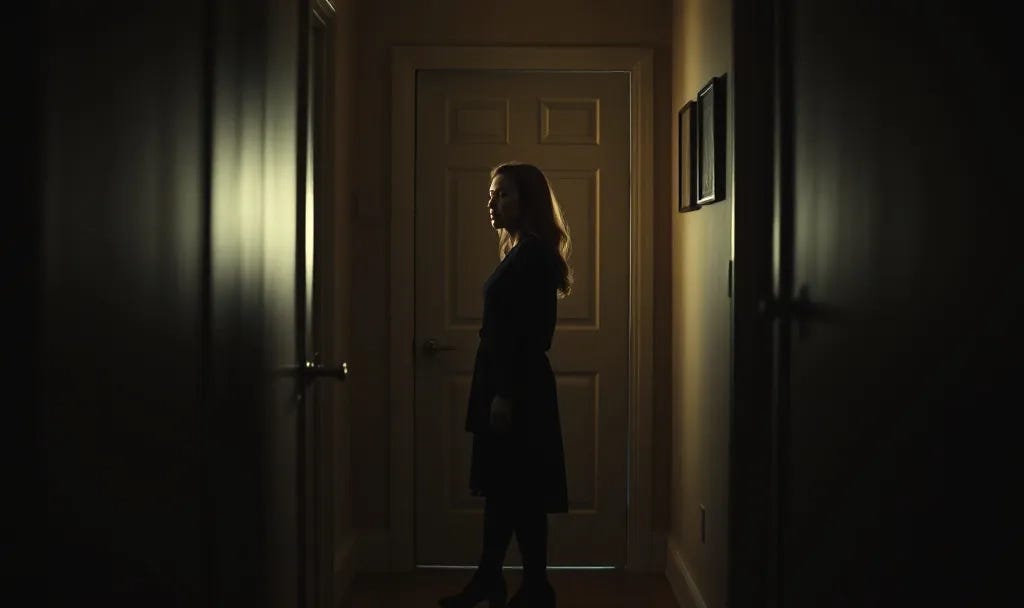
She stands in a narrow hallway washed in muted light, the kind that softens everything except the truth. The door in front of her is one she’s opened a thousand times. Out of habit. Out of expectation. Out of fear of choosing anything else.
Then her stomach turns over once. Not a slow, deliberate roll. Something sharper, older. It isn’t fear. It’s recognition. A warning disguised as déjà vu.
Her breath catches. Her jaw tightens. The hallway seems to shrink around her as if the walls know the truth she’s about to ignore. She closes her eyes and finally understands: the life she was about to step into isn’t the wrong one because it’s bad. It’s the wrong one because it was never hers.
She loosens her grip on the doorknob. The metal is still warm from all the years she spent trying to love a life that didn’t fit.
The Night I Sold My Own Soul for Seven Figures
A few years ago, I did the very thing she’s now refusing to do.
I sat across from people who spoke in the language of my ambitions: big numbers, bigger stages, the kind of partnership that would make my younger self feel like he’d finally won. On paper, it was flawless. In my body, it was war. My chest tightened the moment the pen was slid toward me. Migraines arrived the same week. I woke up at 3 a.m. with my jaw clenched so hard it clicked. I told myself these were the growing pains of success, the price of “leveling up.”
I signed anyway.
Six months later, the entire thing detonated exactly the way my body had rehearsed in private for half a year. The money evaporated, the reputation hit was brutal, but the worst part wasn’t the external fallout. The worst part was looking in the mirror and realizing I had become a man who no longer trusted himself. That betrayal hurt worse than the money or the public humiliation, because every morning I still had to shave the face of a man who’d lied to himself on purpose.
I was still paying the interest on that mistake when I sat down with Susan Grau.
The Woman Who Returned With the Volume Turned Up
Susan doesn’t talk about intuition the way most people do. She doesn’t call it a gift or a mystical whisper. She treats it like Wi-Fi: it’s always broadcasting; most of us just walk around with our receivers turned off.
She should know.
When she was four years old, Susan accidentally got trapped inside a stand-up freezer in her family’s garage. The door slammed shut, the light went out, and within minutes she was clinically dead. Her mother found her, pulled her out, and brought her back, but Susan returned with the volume turned all the way up.
Colors became louder.
People’s hidden feelings rose off people like heat.
Truth glowed.
For years afterward, she couldn’t walk past a refrigerator or freezer without smelling that same metallic, icy cold she breathed in the moment her heart stopped.
Why You Ignore Intuition
Science has spent decades catching up to what Susan learned in a freezer at four. Your body detects truth in milliseconds and delivers the verdict as a feeling we’re expertly trained to dismiss as spam.
We label certainty as fear, then march straight into the mistake anyway. Your vagus nerve reads emotional truth in another person’s voice before your ears have even translated the words. All of that information arrives as a quiet knowing we immediately drown out with stories about why we’re “overreacting.”
And that’s how it begins: the lifelong habit of abandoning ourselves.
The Twelve Quiet Ways We Abandon Ourselves
Susan and I spent an hour unpacking the quiet ways we all abandon ourselves. The patterns were so familiar they hurt.
Here are twelve of them.
(Read slowly. Count the ones that feel like home.)
You justify relationships and opportunities that felt wrong from day one.
You call the tightness in your chest “overreacting.”
You stay in conversations where your shoulders creep toward your ears.
You hear the whisper and reach for the noise.
You fall in love with someone’s potential while ignoring their pattern.
You explain your boundaries away with bulletproof logic.
You make rash decisions just to end the discomfort.
You treat red flags like personal-growth projects.
You fill every hour with activity to avoid the truth underneath.
You poll ten friends before you dare ask yourself.
You avoid silence because that’s where your real voice lives.
And afterward, when it falls apart exactly as you feared, you say, “I should have known.”
Because you did.

Your intuition will not get louder. Your life has to get quieter. That was the line Susan dropped that I still can’t shake.
“Your intuition won’t get louder. Your life has to get quieter.”
— Susan Grau
You don’t build intuition through force. You uncover it through subtraction:
fewer distractions
fewer forced yeses
more honest pauses
less performance
more presence
Intuition isn’t a feeling that comes and goes. It’s a conversation you’ve been interrupting for years.
One Practice That Will Change Everything
The next time your body votes no while your mouth is forming the word yes, stop. Place your hand on your chest, take one slow breath, and ask yourself a single question:
If I weren’t afraid of looking stupid, weak, ungrateful, or left behind, what would I do right now?
Whatever answer rises in that moment before fear rushes in to edit it—that is your intuition finally being allowed to finish a sentence.
It’s been waiting a long time to be heard.
Stop hitting snooze.
P.S. Reply with nothing but the number you scored on the list of 12. I’ll know what it means.
You’re not alone, and you don’t have to stay stuck.
12