

Why Your Body Rejects the Indoor Life
Dr. John La Puma on the Indoor Epidemic and the Science of Ultra Processed Time

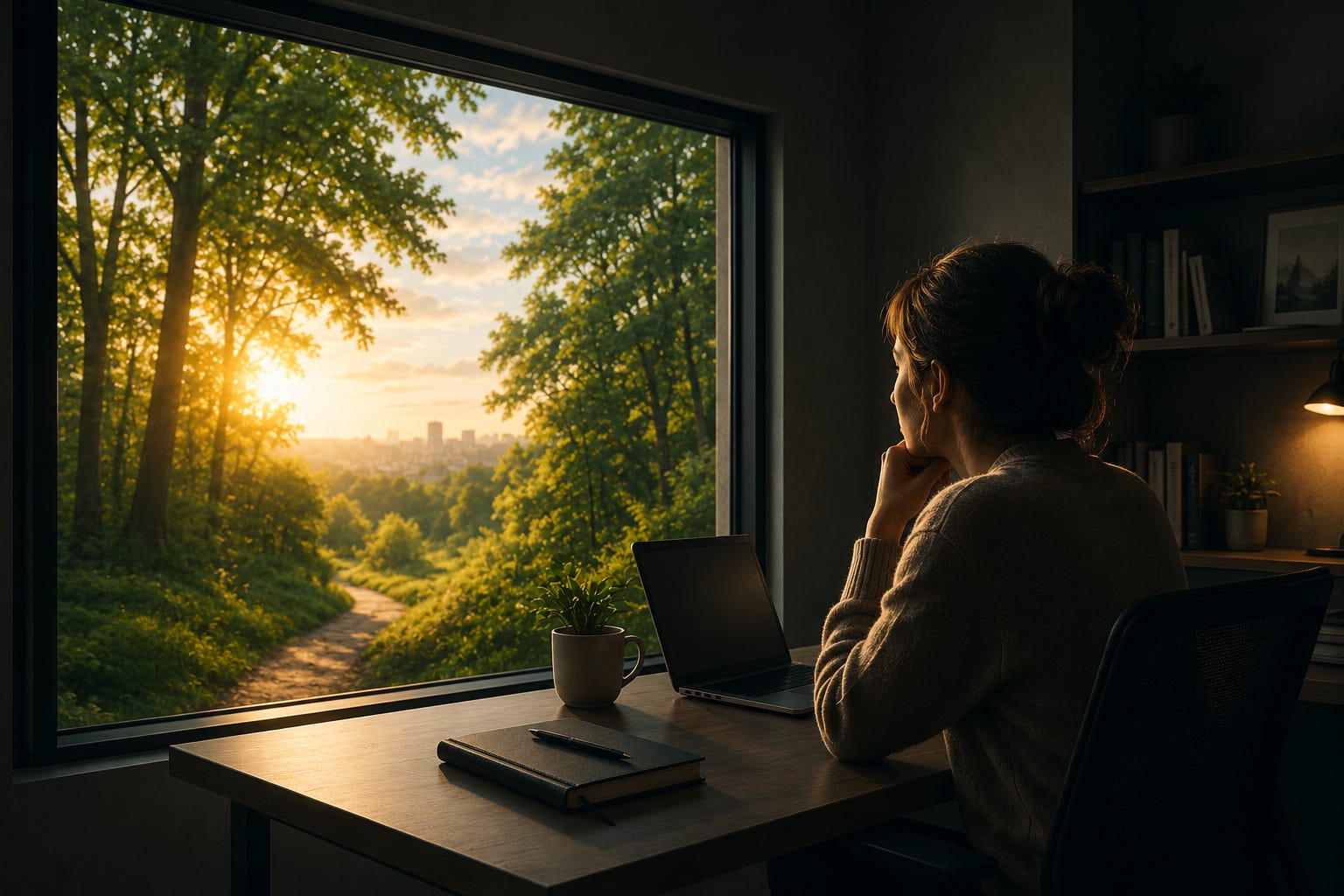
Sitting in that examination room during my annual physical at the VA medical facility recently, I found myself thinking about the physicians who spend decades working in spaces like this. The room had no windows, no natural light, and no visual connection to the outside world. Yet nobody seemed to regard that as unusual; it was simply how healthcare was delivered.
What struck me wasn’t the room itself. It was how completely we had normalized environments that would have seemed strange for most of human history. How did we arrive at a point where we treat total sensory detachment from the natural world as a standard baseline for daily life?
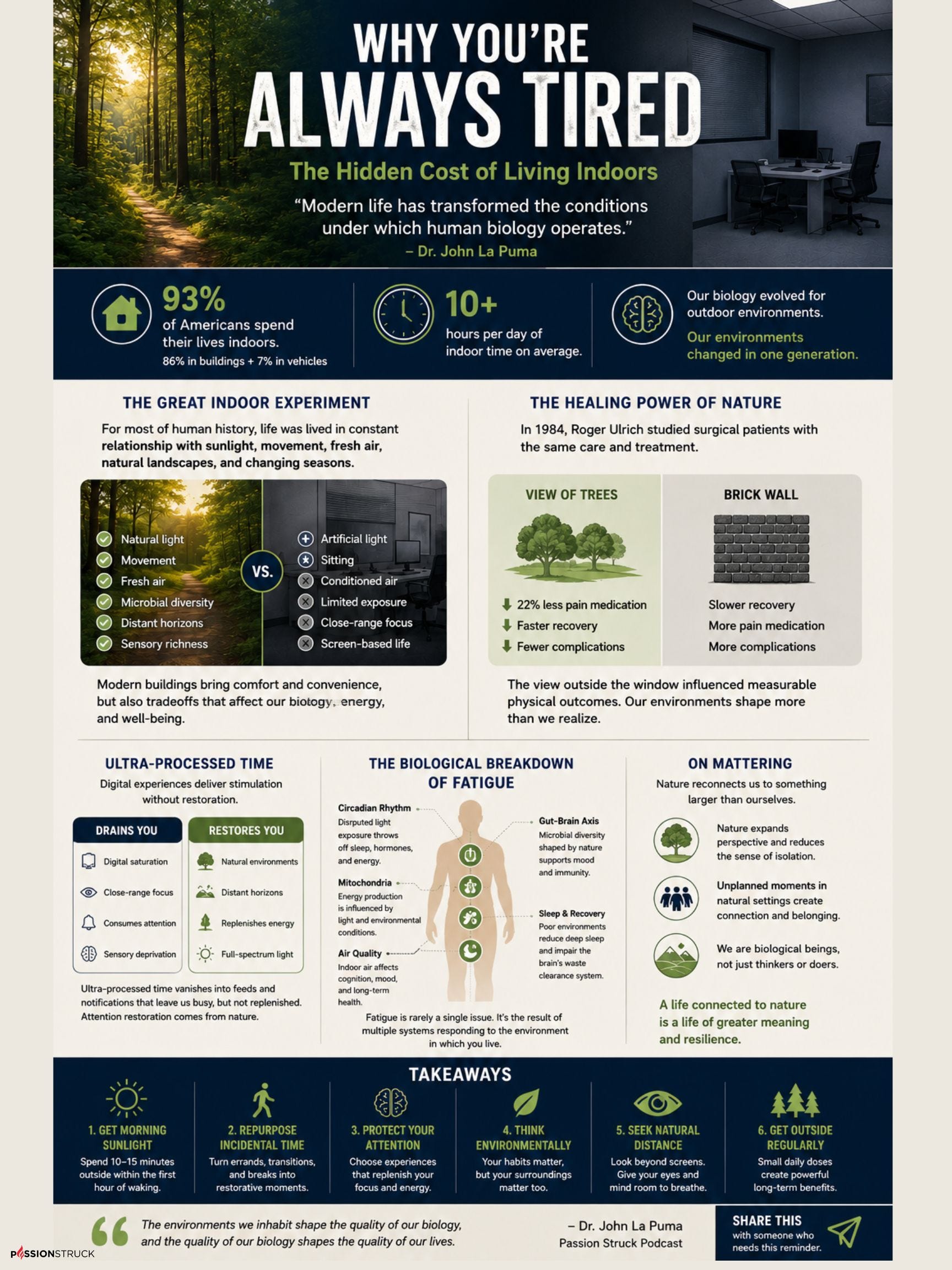
In 1984, environmental psychologist Roger Ulrich published a study that quietly challenged one of medicine’s most enduring assumptions. He examined patients recovering from the same surgical procedure in the same hospital, all of whom received nearly identical medications, nursing care, and medical attention. Yet one group consistently recovered more quickly, required 22% less pain medication, and experienced fewer complications.
The variable was their physical view: some patients looked out onto a stand of trees, while others faced a blank brick wall. Ulrich’s findings suggested that healing is intimately shaped by the architectural context in which recovery unfolds.
This week on Passion Struck, I sat down with physician, bestselling author, and lifestyle medicine pioneer Dr. John La Puma to discuss what he calls the indoor epidemic. Across more than 2,000 medical and environmental studies, Dr. La Puma has examined how modern indoor living influences sleep, energy, focus, mood, and long-term health. His work raises a compelling question: What happens when a species shaped by outdoor environments spends nearly all of its time indoors?
Modern life has transformed the conditions under which human biology operates, and many of the physical and psychological challenges we experience may be downstream effects of that transformation.
The Great Indoor Experiment
For most of human history, the rhythms of daily life were synchronized with the natural world. Morning sunlight signaled the beginning of the day. Movement occurred naturally throughout waking hours. Attention shifted between immediate tasks and distant horizons. Air quality changed with the weather conditions. Microbial exposure came through direct contact with soil, plants, animals, and other people.
These conditions formed the baseline environment in which human physiology evolved.
Today, Americans spend approximately 93 percent of their lives indoors—86 percent inside buildings and another 7 percent inside vehicles. Work, exercise, entertainment, shopping, and even social interaction increasingly occur within controlled environments designed for comfort and convenience. The transition happened gradually enough that it rarely attracts our attention, yet it represents one of the most significant environmental shifts in our species’ history.
Modern buildings solved many genuine problems. They protect us from extreme weather, reduce exposure to environmental hazards, and make year-round productivity possible. Those gains are real. Yet every technological solution changes the conditions under which human beings live. Indoor environments reduced certain risks while simultaneously reducing exposure to many of the environmental signals that helped regulate sleep, movement, attention, and physiology. Understanding those tradeoffs requires looking beyond comfort and convenience to examine how human biology responds to the environments we create.
The Rise of Ultra-Processed Time
One of the most memorable ideas from my conversation with Dr. La Puma was his concept of ultra-processed time. The phrase draws a parallel to what happened with our food supply, where manufacturers learned how to engineer products that delivered intense flavor, immediate satisfaction, and extraordinary convenience.
A similar process appears to be occurring with attention.
Digital experiences are designed to capture and sustain focus. Notifications, social feeds, videos, recommendations, and endless streams of content create a constant flow of stimulation. Hours disappear quickly because these systems are optimized to hold our attention.
The analogy is useful because both forms of consumption exploit the same tendency. Ultra-processed food delivers stimulation without nourishment. Ultra-processed time often does the same, vanishing into feeds and notification streams that occupy attention without creating true restoration, learning, or the deep connection we hoped to find. We feel busy, but not replenished. Pixels become the new calories, and doom scrolling becomes the high fructose corn syrup of your daily schedule.
Researchers studying attention restoration have found that natural environments engage the mind differently. Looking across a horizon, watching water move, or observing the patterns of a forest activates what psychologists call soft fascination. These experiences hold our attention without demanding continuous effort. The brain remains engaged while also gaining an opportunity to recover from the cognitive demands of focused work. A short walk outside changes the quality of attention itself, removing some of the hidden drains on our focus.
The Biological Breakdown of Fatigue
Energy is often discussed in terms of motivation, discipline, or stress management. Dr. La Puma’s research expands the conversation by examining the biological systems that regulate energy in the first place.
Consider the circadian system alone. Every morning, the brain looks for environmental signals that help it distinguish day from night. Sunlight is among the most important of those signals. When exposure is filtered through windows or artificial fixtures, the timing of hormone release, alertness, metabolism, and sleep can drift out of alignment. Many of the symptoms associated with modern fatigue—brain fog, poor sleep, afternoon crashes, and reduced concentration—appear when these rhythms lose alignment.
Similar disruptions occur in other biological systems, including mitochondrial energy production, communication between the gut and brain, and the glymphatic process that clears metabolic waste during deep sleep.
During deep, non-REM sleep, the brain shrinks slightly, allowing cerebrospinal fluid to wash away toxic proteins like beta-amyloid. This internal cleaning cycle relies directly on morning light exposure to anchor its timing. Simultaneously, our gut-brain axis depends on microbial diversity, which is shaped in part by outdoor environmental exposure. Viewed individually, each disruption may seem modest. Together, they create the conditions for chronic fatigue.

On Mattering: Reclaiming Our Relationship with Reality
One reason nature may be so powerful is that it changes the quality of our relationship with the world around us. Indoor environments often place us in highly controlled spaces designed for efficiency and predictability. Natural environments require participation; they invite attention, curiosity, movement, and encounter.
A walk through a neighborhood park frequently includes small moments of connection—with a stranger, a dog, a changing season, or a view that reminds us we are part of something larger than our immediate concerns.
Those experiences contribute to a sense of embeddedness that many people increasingly lack. Human beings flourish through relationships. We thrive when we experience meaningful connections with other people and our communities, a sense of purpose, and the broader systems that sustain life. Nature strengthens that awareness by placing us within a larger context, reminding us that we participate in a living world rather than merely operating inside constructed boxes.
Takeaways
Establish daytime before screen time. Spend 10 to 15 minutes outdoors during the first hour after waking to support circadian health and energy regulation. Leave your sunglasses inside and step away from the windows so your retinal receptors can capture the full spectrum of morning blue light.
Repurpose incidental hours. Walking to your car, running errands, and moving between appointments can become valuable opportunities for restoration. Put your phone away, look at the furthest point on the horizon, and let your eye muscles relax.
Protect your attention. Different environments shape attention differently. Pay close attention to which daily environments actively replenish your baseline energy and adjust your exposure patterns accordingly.
Think environmentally. Sleep, focus, energy, and resilience emerge from an interaction between personal habits and physical surroundings. Audit your primary workspaces for carbon dioxide buildup and light deprivation.
Seek natural distance. Regularly looking beyond screens and close-range work helps restore visual and cognitive systems designed for broader, more expansive environments.
One of the most striking aspects of Dr. La Puma’s research is how ordinary many of the interventions appear. Morning sunlight. A walk through a neighborhood park. Time spent gardening. Looking beyond the distance of a screen.
None of these actions feels revolutionary because they are not new technologies. They are ancient experiences. Yet their familiarity may be precisely why we underestimate them. The human body evolved in constant conversation with these conditions. Reintroducing them is less about adopting another health practice and more about restoring a relationship that was once unavoidable.
Read the FREE Companion Guide & Digital Workbook for this post.
Final Reflection
The environmental conditions that shaped human beings were once unavoidable. Sunlight, movement, fresh air, changing weather, and regular contact with the natural world formed the backdrop of daily life. Today, those experiences often require deliberate effort.
That shift helps explain why many people feel disconnected from their energy, attention, and physical well-being. The issue is rarely a single habit or a single intervention. Human biology responds to patterns of exposure accumulated over days, months, and years. The environments in which we spend our time become part of the equation.
Dr. La Puma’s work offers a useful reminder: health is not produced solely by what we consume, track, optimize, or measure. It also emerges from the places we inhabit.
A walk outdoors, exposure to morning light, time spent among trees, or even a few minutes spent looking beyond the boundaries of a screen may seem insignificant in isolation. Yet these experiences reconnect us with environmental conditions that have shaped human physiology for thousands of generations.
The modern world has changed rapidly. Human biology changes more slowly. Understanding the relationship between the two may be one of the most important health conversations of our time.
Check out the full conversation with Dr. John La Puma below:
BOOK: Indoor Epidemic: 93% Inside Steals Sleep, Focus & Years
Dr. John La Puma’s Website: indoorepidemic.com / drjohnlapuma.com
Thoughts? Let me know below this essay!
Every 🧡, restack, or comment you share here on Substack
is like a signal flare…..
It helps this message find the person who is still walking
their own “schoolyard” alone.
Thank you for being part of this ecosystem.
I love turning these essays into a two-way conversation
So please let me know your thoughts below.
© John R. Miles 2026. All rights reserved.
This is literally a conversation my wife and I have regularly, remembering that being outside is where we belong.
This really resonates 🌿. I work a lot with women who have built lives that look “right” from the outside, while quietly feeling disconnected from themselves on the inside (while spending most of their lives, well, inside). I love the way you name the tension between success, mattering and the human need to feel truly alive - outside. 👩🏻🤝👩🏼🌿