

Why Success Destroys Our Best Intentions
Eric Ries on financial gravity, the hidden vulnerability of winning, and how to protect what matters before it's too late.


Most founders don’t set out to lose their soul.
They start with a real problem they want to solve, a group of people they want to serve, and a set of values they believe will guide them through the hard days. They pour everything into building something meaningful.
Yet time and again, something shifts. The company they created slowly becomes unrecognizable to their customers, their employees, and often to themselves.
When entrepreneur, author, and Lean Startup creator Eric Ries joined me on the Passion Struck podcast, to discuss his new book, Incorruptible: Why Good Companies Go Bad and How Great Companies Stay Great, he offered a sobering answer. The greatest threat to an organization’s character usually isn’t failure.
It’s success.
Success Doesn’t Protect You—It Makes You More Vulnerable
We tend to believe that once we hit product-market fit, raise enough money, or reach a certain size, we’ll finally have the freedom to run things the right way. We assume our values will be safe.
This assumption is entirely wrong.
The reality is that the more successful an organization becomes, the more valuable it is as a target for extraction.
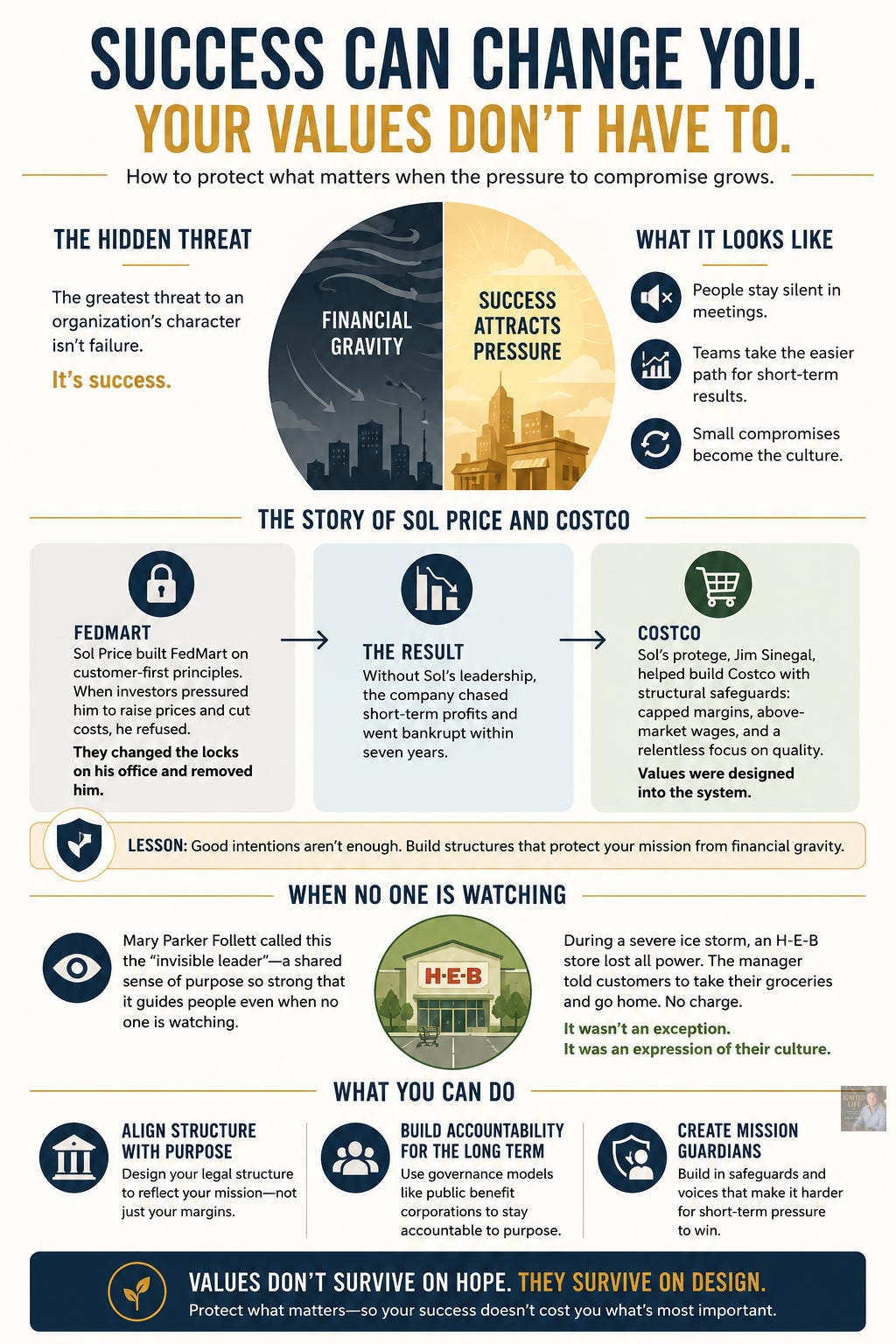
Eric has watched this play out with countless founders. The more successful the company becomes, the more it attracts pressure to extract value at the expense of everything that made it special. He calls this force financial gravity, an invisible pull that quietly reshapes decisions, priorities, and eventually culture.
Financial gravity shows up in small moments: when someone chooses not to speak up in a meeting because “investors might not like it.” When a team opts for the easier, slightly compromised path because it looks better on next quarter’s numbers. Over time, these small choices become the default. What starts as survival becomes habit, and habit becomes culture.
The Story of Sol Price and Costco
One of the clearest examples comes from retail legend Sol Price.
In 1954, the brilliant attorney-turned-retailer Price founded FedMart on a simple but radical idea: the customer is my client, and I have a fiduciary duty to them. He built the modern discount retail model with extraordinary integrity, once posting competitors’ ads in his own stores with signs that said, “Don’t buy this from me. You can get it cheaper down the street.”
FedMart thrived. But going public brought relentless pressure to raise prices and cut costs. Price refused. So his investors changed the locks on his office and removed him. Without his guiding hand, the company pursued faster profits and went bankrupt within seven years.
But the story doesn’t end there.
A young executive named Jim Sinegal had quit FedMart in protest when Price was ousted. He later helped Price launch Price Club and eventually co-founded Costco. Today, Costco is a $400 billion public company that still operates with the same customer-first principles: capped margins, above-market wages, and a stubborn refusal to compromise on quality.
The difference? Costco was built with structural integrity and governance choices that protect the original mission from financial gravity. Good intentions weren’t enough. They created safeguards.
Costco’s success reveals something important. Values don’t survive because leaders talk about them. They survive because they’re embedded in the structures, incentives, and stories that shape everyday decisions.
Which raises an important question: What happens inside an organization when no leader is present?
When No One Is Watching
This is where leadership gets interesting.
Most important decisions in a company happen when no manager is in the room. Will the customer service rep go the extra mile? Will the product team resist making it just a little worse to hit margins? Will someone speak up when they see the company drifting?
Eric draws on the work of Mary Parker Follett, a pioneering thinker from the 1920s, who introduced the idea of the invisible leader, a shared sense of purpose so strong that it guides people even when no one is watching.
A powerful example comes from HEB, the beloved Texas grocery chain. During a severe ice storm, one of their stores lost all power, including backup systems. Point-of-sale terminals went down. Customers who had stocked up for the storm suddenly couldn’t pay.
Instead of waiting for headquarters or calculating the cost, the store manager told everyone to take their groceries and go home. No charge. This wasn’t an exception to HEB’s culture. It was an expression of it.

Good Intentions Are Not Enough
Eric’s message isn’t that leaders should abandon growth. It’s that growth without protection eventually puts purpose at risk.
Whether you’re leading a company, a team, or even a family, values survive when they’re reinforced by structures, habits, and accountability rather than good intentions alone.
As leaders, we can’t simply command culture or values into existence. These are emergent properties, like health in the human body. You can’t order your body to heal faster, but you can create the conditions that make healing more likely.
That’s why I talk about gardener leadership. In the military, especially in special operations, you can’t micromanage teams operating far away. You give them a clear purpose, strong training, and the right environment, and then trust them to execute. The same principle applies in business, teams, and even families.
Your job is to cultivate the conditions where the right things happen naturally.
Protecting What Matters
The companies that endure don’t rely on good intentions alone. They build structures that protect what matters when pressure arrives.
The same principle applies to our teams, our families, and our lives. Values erode when we assume they’ll survive without deliberate protection.
In the end, the ultimate measure of our work is not how much success we manage to accumulate. It is how deeply we protect our humanity, our trust, and the people who rely on us while we are still here to lead.
[Read the FREE Companion Guide & Digital Workbook for this post.]
A Question for You
Have you ever watched an organization you cared about, whether a company, a team, or even a community group, slowly drift away from what made it special?
What’s one structural or cultural choice you could make right now to better protect what matters most in your work or life?
Drop a comment below. If this resonated, share it with a founder, leader, or friend who’s trying to build something that lasts.
Listen to Episode 775 with Eric Ries for the full conversation on resisting financial gravity, mastering structural governance, and building an incorruptible organization that stands the test of time.
Every connection, restack, or comment you share here on Substack helps this message reach the leader who is currently struggling to defend their values in a transactional world.
Thank you for being an active part of this ecosystem.
© John R. Miles 2026. All rights reserved.