

The Waiting Room of Life
Why We Keep Postponing the Life We’re Already Living


A few weeks ago, I noticed something that, on its surface, seemed almost too ordinary to matter. I was driving home after a long day, the kind of day filled with productive things, conversations that moved projects forward, decisions that needed to be made, responsibilities that had been carried well enough to call the day successful. Yet somewhere in the middle of that drive, I had the unsettling realization that I could barely remember the day I had just lived.
I remembered what had been accomplished. I remembered the meetings, the outcomes, the obligations fulfilled. But the actual experience of the day, the texture of it, felt strangely inaccessible, as if I had moved through it without ever fully arriving inside it.
That distinction has stayed with me because it revealed something I think many of us quietly experience but rarely name. There is a difference between living a life and administering one. And modern adulthood, for all its complexity and rewards, has a remarkable way of training us to confuse the two.
We become highly capable at managing the logistics of existence. We know how to keep things moving. We know how to anticipate what is needed, to absorb pressure, to plan ahead, to stabilize uncertainty. These are not trivial capacities. In many ways, they are what adulthood requires. But the danger emerges when competence becomes our dominant way of relating to life itself, because competence is always oriented toward what comes next. It is built on anticipation. It lives in preparation.
And over time, that orientation can become so total that the present begins to feel less like a place we inhabit and more like a corridor we pass through on the way to somewhere else.
I’ve come to think of this as the waiting room of life.
What is the Waiting Room of Life?
The Waiting Room of Life is the psychological habit of postponing presence while waiting for future conditions to improve. Instead of fully inhabiting today’s experiences, people begin treating life as preparation for a later time when they believe they will finally have enough time, security, or success to feel fully alive.
How Postponement Becomes a Way of Life
What makes postponement so psychologically persuasive is that it rarely presents itself as avoidance. More often, it appears in the language of responsibility.
We tell ourselves that this is simply a demanding season. Once the current pressure passes, things will open up. Once the company becomes stable, once the children are older, once the finances feel secure, once the uncertainty settles, then we will become more present. Then we will rest. Then we will reconnect. Then we will return to the parts of ourselves that feel increasingly far away.
The logic sounds reasonable because, in practical terms, it often is. Life does have seasons. Some require extraordinary effort. Some require sacrifice.
But what begins as a temporary adaptation often becomes an enduring psychological structure.
This is where the waiting room becomes dangerous.
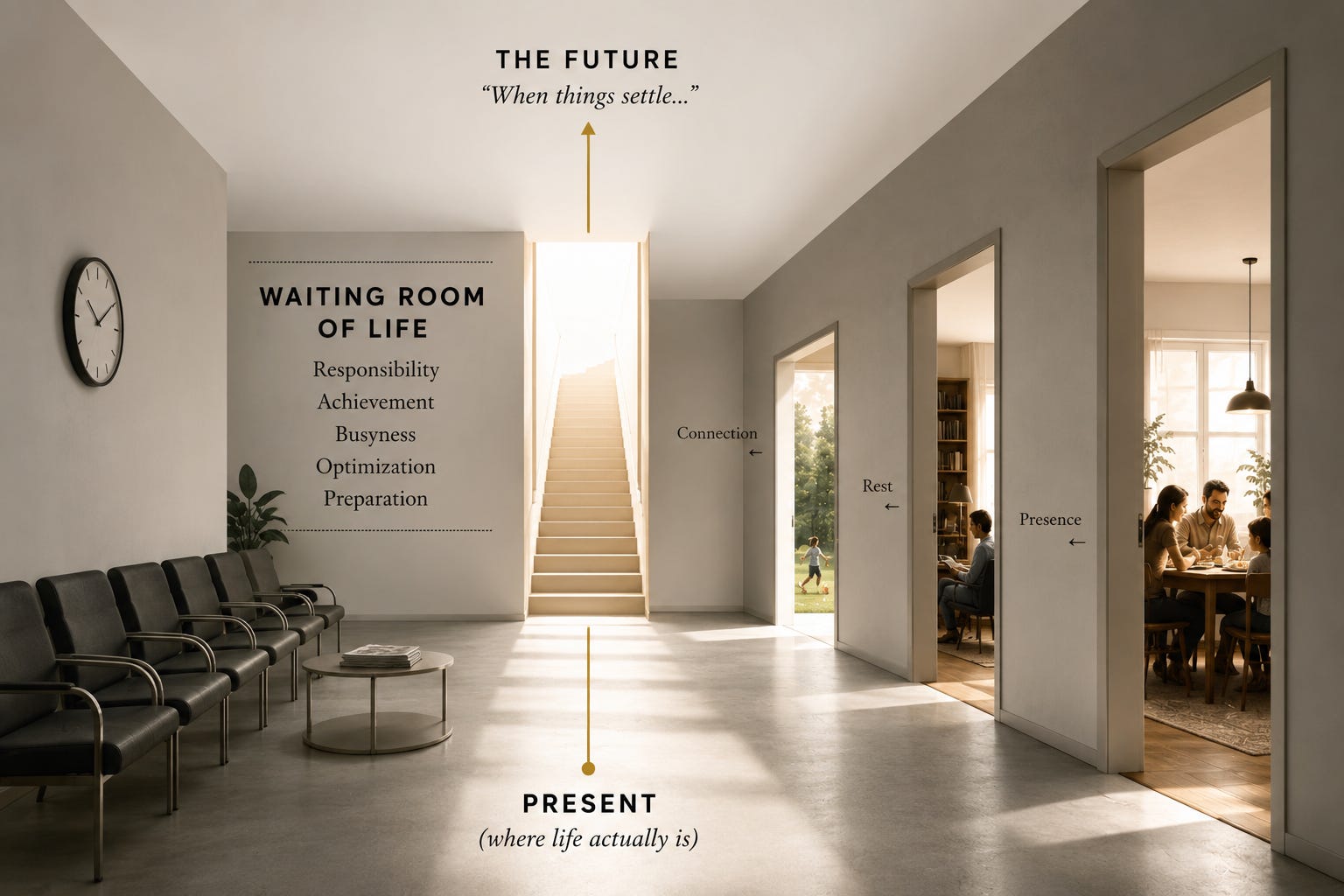
Because when the present is consistently framed as a bridge to a better future, its value becomes conditional. It matters only for what it leads to. The day itself is no longer an experience. It becomes a vehicle of transit.
This changes how we relate to everything.
Relationships begin to revolve around coordination rather than connection. Meals become interruptions between obligations. Weekends become recovery units. Even joy begins to feel transactional, something earned after enough work.
What erodes in this process is not merely leisure. It is aliveness.
And that erosion is difficult to detect precisely because the external life often looks intact. Sometimes it even looks impressive.
That is part of the tragedy. We can spend years building a life whose architecture is strong while remaining increasingly absent from its interior.
Why the Future Becomes So Seductive
I think the future exerts such a powerful psychological pull because it offers something the present often cannot: the promise of resolution.
The future is where our unfinished narratives get completed. It is where we imagine the anxiety will settle, the uncertainty will narrow, the effort will pay off. It becomes the place where coherence finally arrives.
This is not irrational. Human beings are meaning-making creatures, and much of our emotional life depends on projecting ourselves into the future. Hope itself requires some relationship with the future.
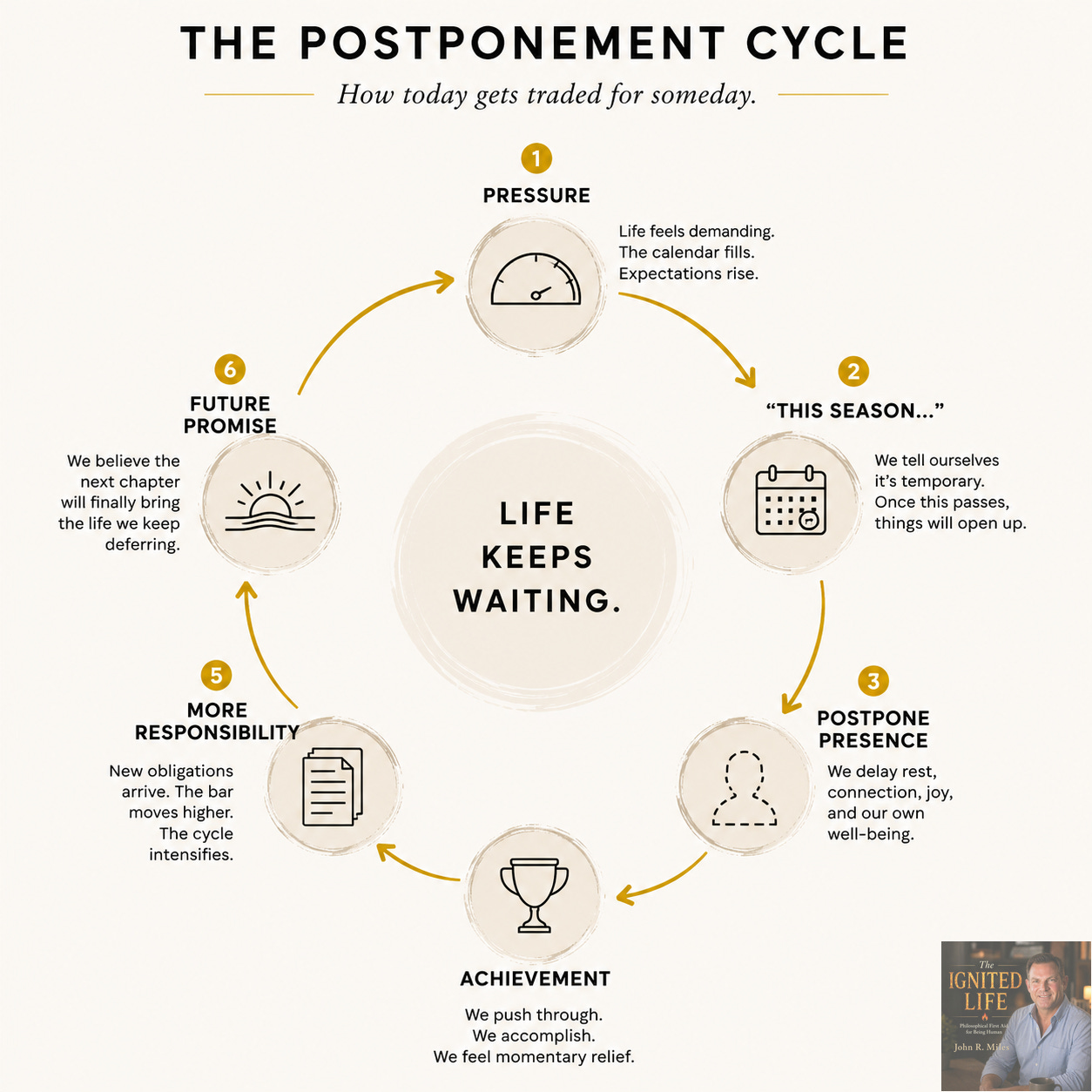
But hope and postponement are not the same thing.
Hope allows the future to inform the present.
Postponement allows the future to replace it.
That distinction matters because when we outsource our sense of life to future conditions, we create a chronic estrangement from what is here now. The mind becomes increasingly skilled at inhabiting what has not yet happened, while the body continues moving through what has.
This creates a peculiar fragmentation. We are physically present but psychologically deferred.
It is one of the defining conditions of modern adulthood, and I suspect much of our exhaustion has less to do with how much we carry and more to do with how rarely we fully arrive inside what we are carrying.

The Cost of Negotiating with Reality
One of the deepest forms of postponement appears when life changes in ways we did not choose.
Loss is often where this becomes visible.
A diagnosis. A divorce. A career collapse. A betrayal. A body that no longer behaves the way it once did.
These moments force a confrontation between the life we expected and the life that is actually here. And much of suffering, I have come to believe, emerges in the distance between those two realities.
Not because pain itself is avoidable, but because we often continue negotiating with what has already happened.
We replay alternate timelines. We measure the present against the lost past. We keep ourselves emotionally tethered to versions of life that are no longer available.
This is where radical acceptance becomes one of the most psychologically demanding acts a person can undertake.
Acceptance is often misunderstood as passivity, but in truth it is an act of profound engagement. It is the decision to stop investing psychic energy in resisting reality and to begin investing it in inhabiting reality.
That shift changes everything.
Because transformation cannot occur in the life we wish we had.
It can only occur in the life we are actually living.
And until we fully accept that life is the terrain of our becoming, we remain suspended outside it.
Why Achievement Often Deepens the Waiting Room
What makes this even more complicated is that postponement does not disappear when life goes well. In many cases, success makes it harder to see.
Achievement creates momentum, and momentum has its own seduction. The next goal feels meaningful because it is visible. The next milestone offers clarity. The next accomplishment provides a measurable sense of progress.
And for many people, especially high performers, progress itself becomes the organizing principle of identity.
This is where the waiting room takes on a different form.
It no longer says, “Life will begin when things get easier.”
It says, “Life will begin when I have finally done enough.”
That is a much more dangerous promise because “enough” has no stable endpoint.
There is always another horizon.
Another benchmark.
Another expansion.
Another version of the self to construct.
This creates a life that can be endlessly successful while remaining perpetually deferred.
The irony is that many people reach the goals they once believed would resolve their inner uncertainty, only to discover that the uncertainty remains intact. Not because the achievements were meaningless, but because they were answering the wrong question.
Achievement can validate effort. It cannot establish worth.
And when we ask it to do that work, we remain trapped in a system where our sense of aliveness is forever contingent on what comes next.
The Practice of Returning
The question, then, is not how to escape responsibility or ambition. The goal is not to dismantle the structures of adult life in search of some romanticized simplicity.
The deeper work is learning how to return.
Return to the present moment as a place of actual life rather than mere preparation. Return to relationships as sites of mutual presence rather than logistical exchange. Return to the body, which so often carries truths long before the mind can articulate them.
This is difficult work because it runs against many of the habits our environments reward.
Presence does not produce obvious metrics.
It cannot be optimized in the same way performance can.
Its rewards are quieter, slower, less legible to the outside world.
But they may be far more foundational.
A conversation fully entered.
The meal genuinely tasted.
A walk where attention remains with the world instead of fleeing ahead of it.
These moments seem small, yet they are where life accumulates. Not conceptually, but experientially.
And I suspect flourishing is built less through dramatic transformation than through the repeated recovery of presence in ordinary life.
Not because ordinary life is insignificant, but because it is where almost all of life actually happens.
Four Reflections to Carry This Week
Where have you been treating your present life as a temporary waiting room rather than the actual terrain of your becoming?
What future condition have you unconsciously made responsible for your ability to feel fully alive?
In what areas of your life has competence quietly replaced presence?
What would it look like this week to stop preparing for your life long enough to participate in it?
Listen to the Full Episode Below
Download the Free Companion Guide and Digital Workbook
Share The Ignited Life: Philosophical First Aid for Being Human
Every 🧡, restack, or comment helps this message reach someone who may be highly competent at carrying life, but is quietly wondering what it would mean to finally inhabit it.
© John R. Miles 2026. All rights reserved.