

The Visibility Illusion
Why people don’t experience our intentions—they experience our behaviors


Pat had worked at the bank for nearly thirty years.
She had rebuilt the company newsletter, created a network of correspondents across the organization, and transformed something that had become largely irrelevant into a publication people actually wanted to read. During a staff meeting, her manager held up the newsletter and publicly acknowledged her accomplishments.
Pat cried.
The story stayed with me because the reaction seemed disproportionate to the moment. Nothing extraordinary had happened. She wasn’t promoted. She didn’t receive a bonus. She wasn’t given an award.
Someone simply noticed.
That reaction reveals something important about human nature. Most of us assume people know how we feel about them. We assume respect is obvious. We assume appreciation is understood. We assume that because we value someone’s contribution, they know they are valued.
Often they don’t.
That disconnect comes from a misunderstanding that quietly shapes many relationships. We assume our appreciation is obvious. We assume our respect speaks for itself. We assume people know what they mean to us because we know what they mean to us.
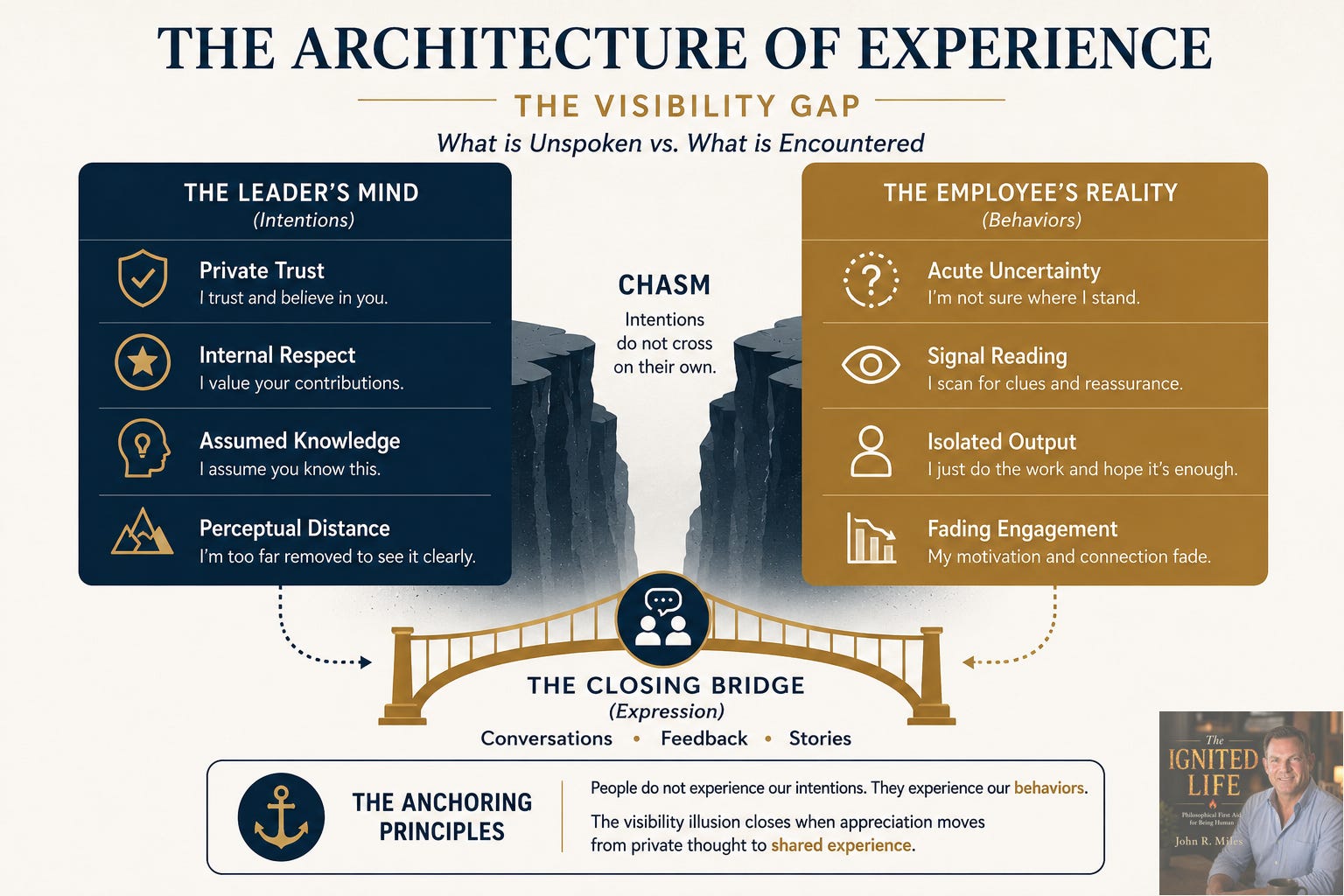
I think of this as the Visibility Illusion: the gap between what we feel and what other people actually experience.
The problem appears everywhere. Parents assume their children know they are proud of them. Friends assume their loyalty is understood. Leaders assume their teams know they are appreciated. Yet human beings build their understanding of where they stand in relationships from evidence, not assumptions.
We learn what matters through what is made visible.
Appreciation that remains unexpressed exists only in the mind of the person experiencing it.
People do not experience our intentions.
They experience our behaviors.
The Gap That Reveals the Illusion
The Visibility Illusion becomes apparent in a finding that recurs in leadership research.
Research consistently finds that managers rate themselves far more positively on recognition and communication than employees do. The exact numbers vary across studies, but the pattern remains remarkably consistent: leaders often believe they are communicating appreciation more effectively than their people experience it.
What’s interesting isn’t the size of the gap. It’s the persistence of it.
If the disconnect appeared occasionally, we could explain it away as poor communication or a handful of ineffective leaders. Instead, the pattern shows up across organizations, industries, and leadership levels.
The question is why.
Part of the answer is that leaders possess information their people do not. They know who they trust. They know whose judgment they respect. They know who has exceeded expectations and who has become indispensable. Over time, these assessments become so familiar that leaders begin treating them as shared knowledge.
They aren’t.
The employee only experiences what becomes visible through conversations, opportunities, feedback, recognition, and daily interactions. The leader may have tremendous respect for someone’s contribution, but respect that remains private never becomes part of the employee’s experience.
The Visibility Illusion lives in that difference between what leaders know and what other people actually encounter.
When People Stop Feeling Invisible
During my conversation with Adrian Gostick—one of the world’s leading experts on workplace culture and employee engagement, and the bestselling co-author of books such as Leading with Gratitude, The Carrot Principle, and Anxiety at Work—he shared a story that helped me see the Visibility Illusion from a different angle.
A food service manager at Norton Healthcare’s heart hospital inherited a department that ranked near the bottom nationally in customer satisfaction. Within a year, the same team had climbed to the 99th percentile.
The turnaround wasn’t driven by new technology, compensation changes, or a complete restructuring of the department.
It began with a shift in how people experienced their work.
The manager spent time learning people’s stories. He recognized small acts of care that previously went unnoticed. He helped employees understand how their daily responsibilities connected to patient outcomes and the broader mission of healing.
Over time, employees who had viewed themselves primarily as people delivering meals began to see their work differently. They weren’t simply completing tasks. They were participating in a patient’s recovery.
What makes the story interesting isn’t the improvement in performance. It’s what happened before the performance improved.
People’s understanding of their own contribution changed.
The work became more meaningful because it became more visible.
That’s one of the hidden consequences of the Visibility Illusion. When people lose sight of how their efforts contribute to something larger than themselves, engagement often fades. When people can see the significance of what they do—and when others acknowledge that significance—energy, initiative, and commitment often return on their own.
Anxiety as a Signal of Uncertainty
One of the things I kept thinking about after my conversation with Adrian is how closely visibility and certainty are connected.
The employees in the hospital didn’t simply become more engaged because someone recognized them. They became more engaged because they developed a clearer understanding of why their work mattered.
Human beings function remarkably well when they understand their role in a larger story. We struggle when that connection becomes unclear.
This helps explain why anxiety often rises in environments where people feel overlooked. The issue isn’t simply workload or pressure. It’s uncertainty. People begin wondering whether their contributions matter, whether their judgment is trusted, and whether their efforts are making a meaningful difference.
Once those questions take hold, attention shifts. Energy that could have gone toward creativity, problem-solving, or collaboration gets redirected toward interpreting signals and reading the environment.
The need beneath all of this is surprisingly simple. People want evidence that their presence counts. They want to know that what they do matters to someone beyond themselves.
Visibility provides that evidence.
Why the Illusion Deepens
If the Visibility Illusion is so common, the obvious question is why.
Part of the answer is that leadership changes what we see.
As responsibility grows, attention becomes increasingly consumed by decisions, priorities, and problems. Leaders spend more time looking at systems and less time experiencing the organization from the perspective of the people inside it.
That shift creates distance.
Not emotional distance. Perceptual distance.
The leader knows who is doing exceptional work. The employee only knows what has been communicated. The leader sees the larger picture. The employee sees the handful of interactions that shape daily experience.
Over time, leaders may come to assume that what is clear to them is clear to everyone else.
That assumption is the Visibility Illusion.
The challenge isn’t learning to care more. Most leaders already care deeply about their people.
The challenge is making what they already know visible to the people who need to experience it.

What We’re Really Searching For
The Visibility Illusion persists because most of us judge ourselves by what we feel and others by what they experience.
We know the respect we have for a colleague. We know the pride we feel in our children. We know the gratitude we carry for a friend, a partner, or a team member. Because those feelings are real to us, it becomes easy to assume they are equally visible to the people around us.
Often they aren’t.
Human relationships don’t operate on what remains unspoken. They operate on what becomes visible through attention, acknowledgment, presence, and action.
That’s why Pat’s reaction was so powerful. Nothing about her contribution changed that day. The newsletter was the same. The work was the same. What changed was that something previously held in another person’s mind became part of her experience.
She no longer had to guess.
The organizations and relationships that thrive aren’t the ones where people are constantly praised or celebrated. They are the ones where people receive enough evidence to know where they stand.
The Visibility Illusion closes when appreciation moves from assumption to expression, from private thought to shared experience.
The work of leadership and, honestly, the work of being human, is making sure the people around us don’t have to spend years wondering whether they register in our lives.
Three Invitations for Reflection
Who in your life might be carrying a contribution that has gone largely unseen?
Where might you be assuming that appreciation is obvious when it has never actually been expressed?
What is one thing you know about someone’s value that they may not know you know?
Listen to the Full Conversation
Listen to my conversation with Adrian Gostick on Passion Struck (Episode 785)
Download the free Companion Workbook with reflections and practices to help close the visibility gap in your leadership and relationships.
Learn more about Adrian’s work and books, including Leading with Gratitude and Anxiety at Work.
Continue the Conversation
What experiences have taught you the difference between being appreciated and knowing you are appreciated?
Have you ever discovered that someone valued you far more than you realized?
I’d love to hear your thoughts in the comments.
I read every comment.
If this resonated, restack it or share it with someone who needs to know they matter.
Every ❤️, comment, and share helps this message reach someone who may be quietly wondering whether anyone notices.
© John R. Miles 2026. All rights reserved.