

The Rooms That Raised You
How the environments you stopped seeing quietly became the person you think you are

Modern culture—and the self-help industry that serves it—rest on a single assumption: that the individual is almost entirely responsible for their own flourishing.
If your life isn’t working, look inward. Become more disciplined. More resilient. More intentional. Optimize your habits. Master yourself. It is an intensely appealing story because it promises absolute control.
It is also profoundly incomplete.
By treating behavior as something that emerges almost entirely from individual character, we have created a culture of quiet shame. When we pick up the phone again, skip the workout, or let the relentless hum of work bleed into family dinner, we assume we are weak. We retreat, promise to try harder tomorrow, and buy another planner.
But what if your lack of discipline is entirely an illusion? What if the battles you are losing every single day have nothing to do with your willpower, and everything to do with a silent, invisible architecture that has rigged the game against you before you even wake up?
This is what I discussed this week in my solo episode 795 of Passion Struck, where we broke down how our default spaces dictate our choices. To understand why we fall into this trap, we have to look closely at the modern cultural conditioning that forces us to prioritize external production over our internal humanity.
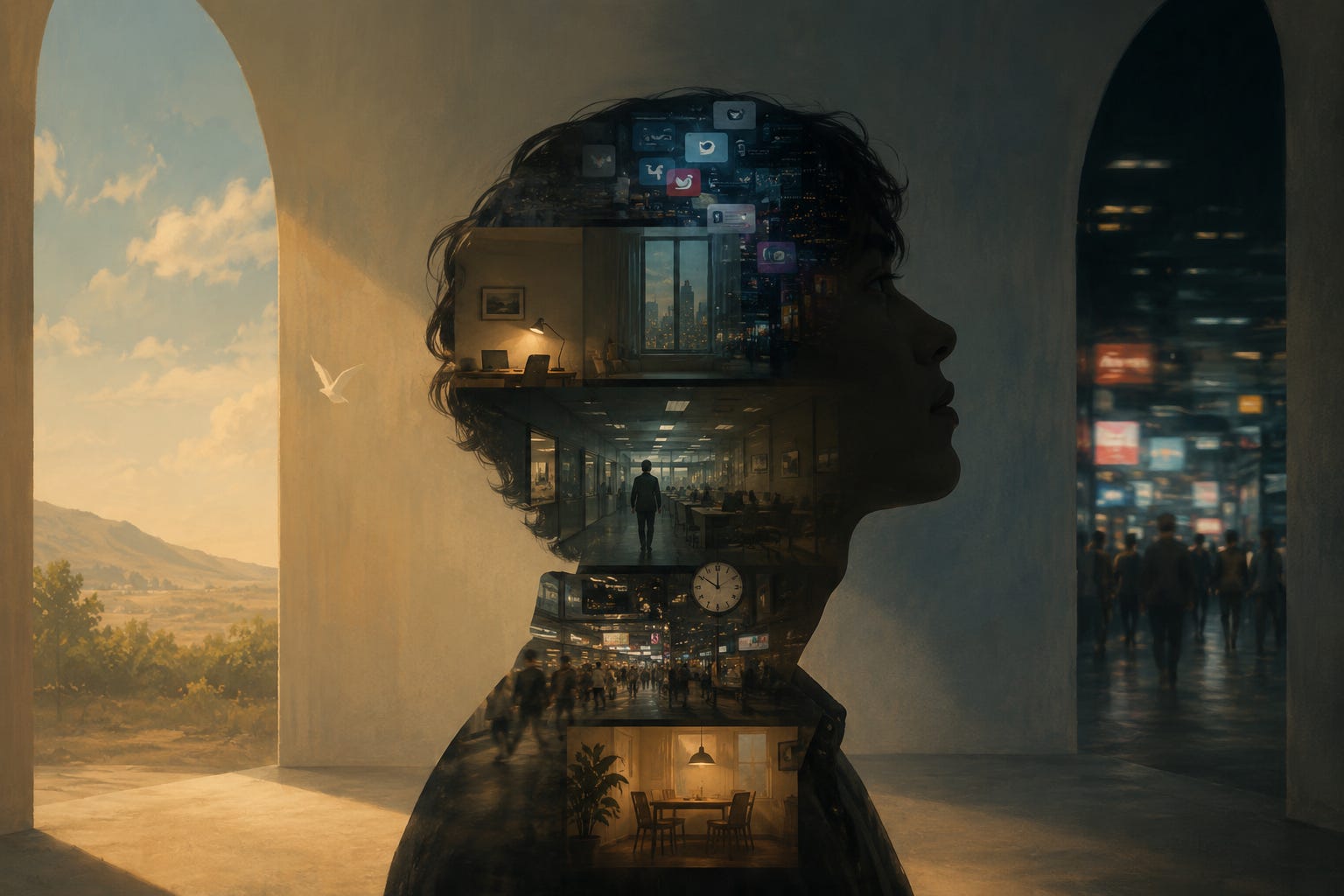
The Illusion of Pure Agency
We are obsessed with the idea of pure, unadulterated agency. We want to believe that our choices are forged in the quiet laboratory of our own minds, independent of the noise outside.
Decades ago, psychologist Kurt Lewin proposed a deceptively simple formula that challenged this exact delusion: B = f(P, E) — behavior is a function of both the person and the environment. Yet, look at where we choose to spend our energy. When we want to change, we direct 100 percent of our focus toward the person. We try to alter our internal chemistry—our drive, our rules, our thoughts.
Meanwhile, the environment remains completely untouched. We expect ourselves to plant a healthy life in depleted, stressful soil, and then we interrogate the seed when it fails to grow.
The self-help industry inherited this deeper cultural assumption—the myth of radical individualism—leaving it largely unquestioned. It is far easier to sell a book about developing grit than it is to dismantle an economic or digital ecosystem designed to keep you addicted, distracted, and exhausted. True agency does not come from pretending you are immune to your surroundings; it begins by recognizing—and then redesigning—the conditions that shape you.
Adulthood Is the Moment We Mistake Our Environments for Our Personality
This is the psychological blind spot where identity is quietly rewritten.
We spend years asking,
“Who am I?”
We rarely stop to ask,
“Who have my environments been rehearsing me to become?”
We rarely look at where our deep-seated preferences, anxieties, and compulsions actually came from. Instead, we simply inherit them from the worlds we inhabit, give them a name, and call them “myself.”
Think about how this actually functions over a lifetime.
Maybe what we call personality is often the result of prolonged exposure.
Spend twenty years inside a culture that rewards exceptionalism above all else, and urgency begins to feel like your nature. Spend a decade in institutions that measure your value by productivity, and eventually, productivity no longer feels like a metric.
It feels like identity.
You become most comfortable when there is just one more problem to solve, one more fire to put out, before you allow yourself to breathe.
We tell ourselves, “I’m just a naturally anxious person,” or “I just have a short attention span.”
Adulthood becomes the tragic moment where we stop noticing the rooms we are standing in and start assuming the walls are built inside our own minds.
We confuse adaptation with identity. Conditioning with character. Rehearsal with personality.
The Architecture of Rehearsal
Environments are never neutral. Every room makes some behaviors easier. Every technology privileges certain actions. Every institution rewards particular ways of being.
We rarely notice these designs because they become ordinary. And ordinary is the most powerful camouflage in the world.
This structural shaping starts earlier than you think. Dr. Dana Suskind, a pediatric surgeon and founder of the Thirty Million Words Initiative, argues that early childhood is the critical period when the brain’s physical hardware is built. Drawing on developmental neuroscience, she explains that everything coming later—our education, our adult habits, our self-help books—is just “software.” But software can only do so much if the hardware underneath it was wired under completely different constraints.
As adults, we assume we have left those early rooms behind. But we have simply moved from one classroom to another, constantly adapting. The curriculum changed. The shaping never stopped.
Every environment rehearses a way of being. Live long enough inside one that celebrates constant motion, and your nervous system begins to mistake urgency for safety. Live inside one that rewards productivity above presence, and eventually rest begins to feel like guilt.
None of this happens in a single moment. It happens through repetition. Day after day. Meeting after meeting.
Until the environment disappears... and only the identity remains.
We mistake the heavy coat of our conditioning for our actual skin.
Beyond the Cult of Self-Correction
Modern culture keeps asking us to become stronger, faster, and more resilient. It asks us to adapt to dysfunctional environments rather than question why those environments demand so much adaptation in the first place. We are treated like broken machines that need constant maintenance, missing the broader truth: behavior does not happen in isolation. It grows inside an environment.
What if flourishing isn’t primarily about strengthening the self? What if it is about becoming conscious of the worlds that have been quietly creating that self all along?
You do not become who you intend to become. You become who your environment repeatedly invites you to be.
If your surroundings constantly reward distraction, focus will always feel like an uphill battle. If your schedule leaves no room to think, presence will begin to look like an irresponsible luxury. If your workplace values panic, slowing down will feel exactly like falling behind.
These experiences are not telling you that something is fundamentally broken within your character. They are telling you something profoundly important about the world you have been adapting to.
The most influential teacher in your life probably isn’t your coach. It isn’t your therapist, and it certainly isn’t the latest book sitting on your nightstand. It is the environment you have stopped seeing.
Every room is extending an invitation. An invitation about how fast to move. What deserves your attention? What does success look like? What kind of person should you become?
The question isn’t whether you’ll accept an invitation. You’re already living inside one. The question is whether it’s the invitation you actually want to live into.
By embracing the Reciprocity of Place, we take back our agency. We realize that we are not passive victims of our surroundings, but active co-creators of them. The deepest work of adulthood isn’t becoming someone new; it is deliberately designing the environments that are authorized to write who we become.
Thought Experiment for the Week
Walk into the room where you spend the most time. Sit in silence for two minutes, step outside your default habits, and ask yourself: What is this space currently rehearsing in me? And what am I actively depositing back into this space?
Let’s start rewriting the loop.
Listen to my accompanying episode 795 of Passion Struck, expanding on these ideas.
© John R. Miles 2026. All rights reserved.