

The Ceiling of Adequacy
Jon Gordon on the trap of a perfectly good life, and why the hardest choice is letting go of someone else’s answer.

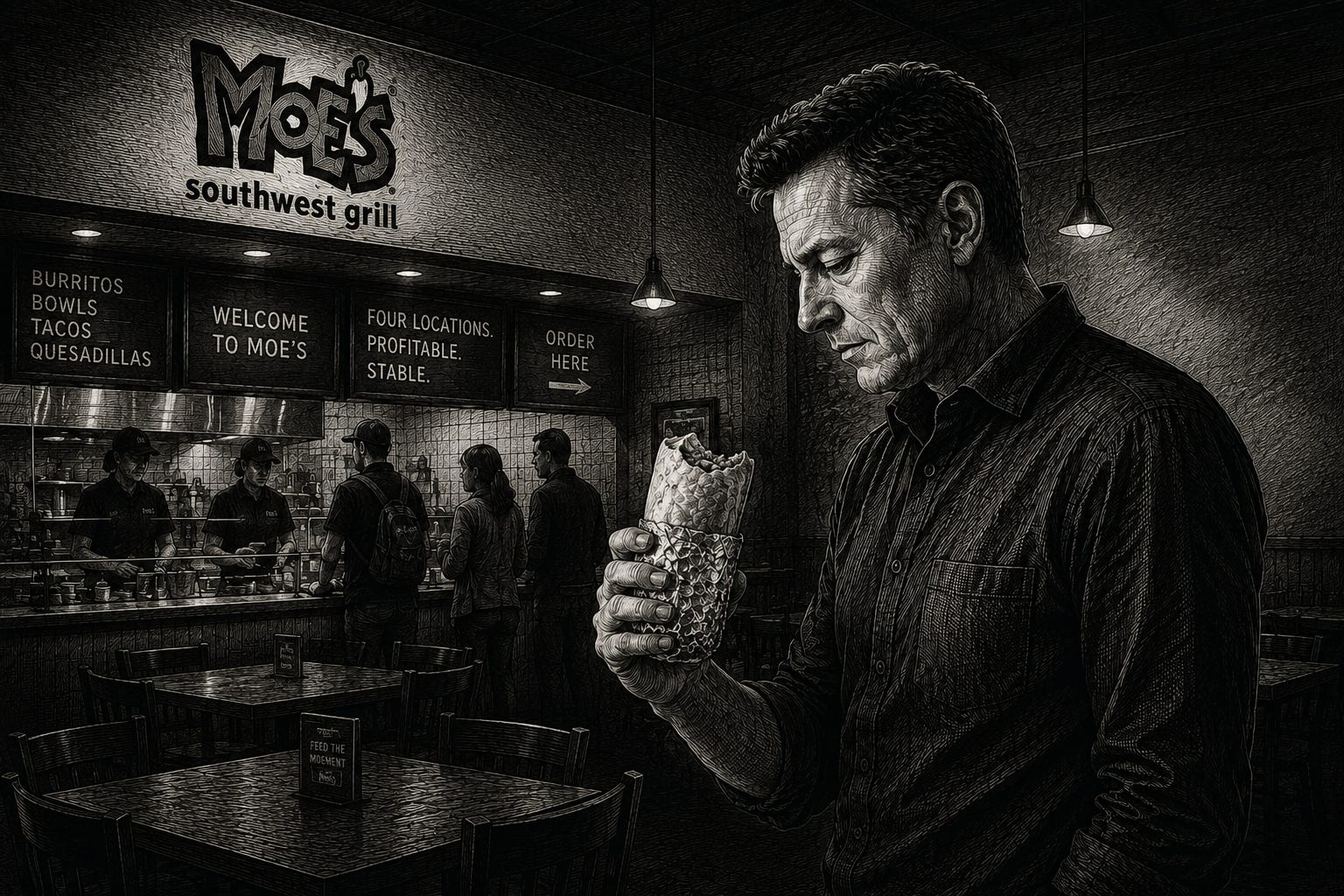
Jon Gordon had four Moe’s Southwest Grill locations. Profitable. Stable. The kind of success most entrepreneurs would call arrival.
Then one afternoon, standing in his restaurant, he looked at a burrito in his hand and saw something he couldn’t unsee: he was living inside someone else’s answer.
Not a bad answer. A successful answer. But an answer that had been written before he arrived.
He sold everything. He started writing and speaking. He became the Jon Gordon we know today.
The question is not whether he made the right choice. The question is why so many of us never even see the burrito in our own hands.
There is a phenomenon I have come to call the ceiling of adequacy. It works like this: you build a life that meets every external measure of success. You hit the numbers. You earn the approval. You check the boxes. And then, precisely because it all works, you stop looking for something else. The very success you built becomes the wall that keeps you from building anything more.
Adequacy is not failure. It is worse than failure. Failure leaves you hungry. Adequacy leaves you full—and still unsatisfied, but without a clear reason to move.
Jon Gordon recognized that his burrito was not his life. It was a symbol of a life that fit someone else’s blueprint. The hardest part was not the risk of leaving. It was admitting that a perfectly good life could still be the wrong one.
What burrito are you holding today?
Why the Ceiling Is Invisible
The ceiling of adequacy arrives quietly. It installs itself through a thousand small compromises, each one reasonable on its own.
You take the promotion that fits the trajectory. You buy the house that matches your income. You build the routine that maximizes output. Every decision makes sense. Every decision moves you closer to a life that looks complete.
Then one day you are holding a burrito, or staring at a spreadsheet, or sitting in a car you no longer notice. The life you built has become a container rather than a canvas.
The ceiling is invisible because it is made of good choices. Every brick was laid with intention. That is what makes it so difficult to see—and so difficult to leave.
Jon Gordon’s burrito was a crack in that ceiling. A sliver of light revealed the structure he had been living inside.
Most of us never see the crack. The ceiling is comfortable. It keeps us warm. It keeps us safe. And it keeps us exactly where we are.
The question is not whether you have a ceiling. The question is whether you are willing to look up.
The Day I Flinched in Lane Four
The real danger of living beneath the ceiling of adequacy is that it leaves you completely defenseless against horizontal comparison. When you organize your life around external benchmarks, you inevitably start measuring your unique progress against someone else’s highlight reel.
I learned this lesson the hard way a few years ago. My podcast numbers were solid, the company was breaking even, and by any normal metric, the container looked complete. But then I would look at global giants like Joe Rogan and instantly feel like a complete failure. I was measuring my chapter three against someone else’s chapter thirty, completely losing sight of my own race.
When Jon and I sat down on Passion Struck, he admitted he fought the exact same battle. Even after writing world-renowned bestsellers, his son looked at him one day and said, “Hey Dad, Gary Vaynerchuk has six million followers on Instagram. How many do you have?”
At the time, Jon had around 30,000—and despite his massive corporate impact, that single comparison made him feel like a total failure.
The turnaround came when he actively leaned into a fundamental daily habit: Run your own race.
Wanting someone else’s life means you are treating your own design like an accident. You aren’t meant to be them; you are meant to be you. When you compare, you despair.
What Jon Taught Me
Jon grew up with a naturally negative mindset, raised by a father who was a New York City undercover narcotics cop—an environment where scanning for danger was a necessity for survival. He learned that negative thoughts will constantly try to enter your mind and program you into an inadequate, defensive reality, but you don't have to agree with them.
The Dialogue Interrupt
Automated Lie → Body Constricts → Fear Default
Speech Interaction → Truth Spoken → Core Agency
You don’t choose the first thought that enters your mind, but you possess absolute authority over the second. Jon’s core mindset habit is simple: Talk to yourself instead of listening to yourself. When a default loop of self-doubt flares up, you must actively interrupt it and speak truth, encouragement, and purpose over the noise.
Turning Success Into Service
When we spend years forcing ourselves to chase purely outward markers of success, our lives naturally slide into chronic isolation. Jon points out that when you are focused entirely on “me” rather than “we,” you end up feeling separate, disconnected, and miserable.
This is the exact crisis of invisibility I explore in my upcoming book, The Mattering Effect (October 2026). So many high achievers do everything “right”—they hit the numbers, secure the titles, buy the franchises—yet they still wake up feeling fundamentally unseen and insignificant.
The path out of that emptiness doesn’t happen through a magical quick fix. It requires us to trade self-promotion for genuine service. True greatness isn’t about you; it’s about helping others be great. When you let go of your ego in the pursuit of helping your team, your family, or your community flourish, the invisible ceiling finally shatters.
Reclaiming Your Design
Jon’s book The Power of Positive Habits outlines 93 distinct practices that show lasting transformation is far more accessible and embodied than we’ve been taught to believe. You don’t have to settle for a good-enough life when you are fully capable of creating a great one.
To begin separating your authentic baseline from inherited performances, take off the armor of your old scripts and confront these three diagnostic questions:
1. What burrito are you holding today? Identify the areas where you are clinging to security or a comfortable routine because you are terrified of the rougher parts that come with starting a true passion project.
2. What past comparison is holding the pen to your current limits? Think about the moments when you horizontalized your success against an icon. Are you actively organizing your choices to avoid the discomfort of not measuring up? Or have you processed the file to run your own race?
3. What is one small daily habit you can start this week to choose service over success? Where can you intentionally pause, lose your ego, and use your unique strengths to help someone else catch a win?
Final Reflection
Transformation isn’t about fixing a broken, unoptimized machine. It’s about having the radical courage to stop running someone else’s race.
Your current wiring is a record of where you’ve been, but it holds no permanent authority over where you are going. You are allowed to look through the deck, discard the outdated survival armor, and choose the habits that match your true design.
The script is pliable. It’s time to take back the pen.
Listen to the full conversation with Jon Gordon on Passion Struck
Get your copy of The Power of Positive Habits by Jon Gordon
Download the FREE Digital Companion Workbook for this episode
Every ❤️, restack, or comment helps this message reach a high achiever who is still running an exhausted race. Thank you for being a vital part of The Ignited Life community.
© John R. Miles 2026. All rights reserved.