

The Hidden Cost of Being Seen
Why Privacy Isn't About Guilt—It’s About Protecting Your Humanity


A little over a decade ago, I was sitting in a boardroom reviewing a piece of tracking technology that felt like magic—and a little bit like a horror story.
We were able to match what someone was watching on their television, geolocate their mobile device, track when they pulled into a specific store, and instantly serve them a personalized advertisement based on their real-time location. We could do all of this without a loyalty card or an explicit sign-in, matching the consumer accurately over 90% of the time.
At the time, we framed it as optimization, personalization, and convenience. But as the years went on, a quieter, more unsettling truth took hold: when you turn human behavior into a constant stream of quantifiable data, you don’t just track someone’s life—you begin to shape their identity.
We have gradually entered a world where almost every movement, search, and private message is harvested, measured, and monetized. We have built a digital culture where visibility is mistaken for connection, followers are confused with friendship, and human worth is reduced to metrics.
When I sat down on Passion Struck with Silicon Valley insider, author, and venture capitalist Guy Kawasaki, we didn’t just talk about passwords or tech settings. We talked about what happens to the human soul when we surrender our right to remain unseen.
The Billboard Test: Why Privacy Does Not Equal Guilt
There is a pervasive, lazy myth in the digital age that goes something like this: If you have nothing to hide, you have nothing to fear.
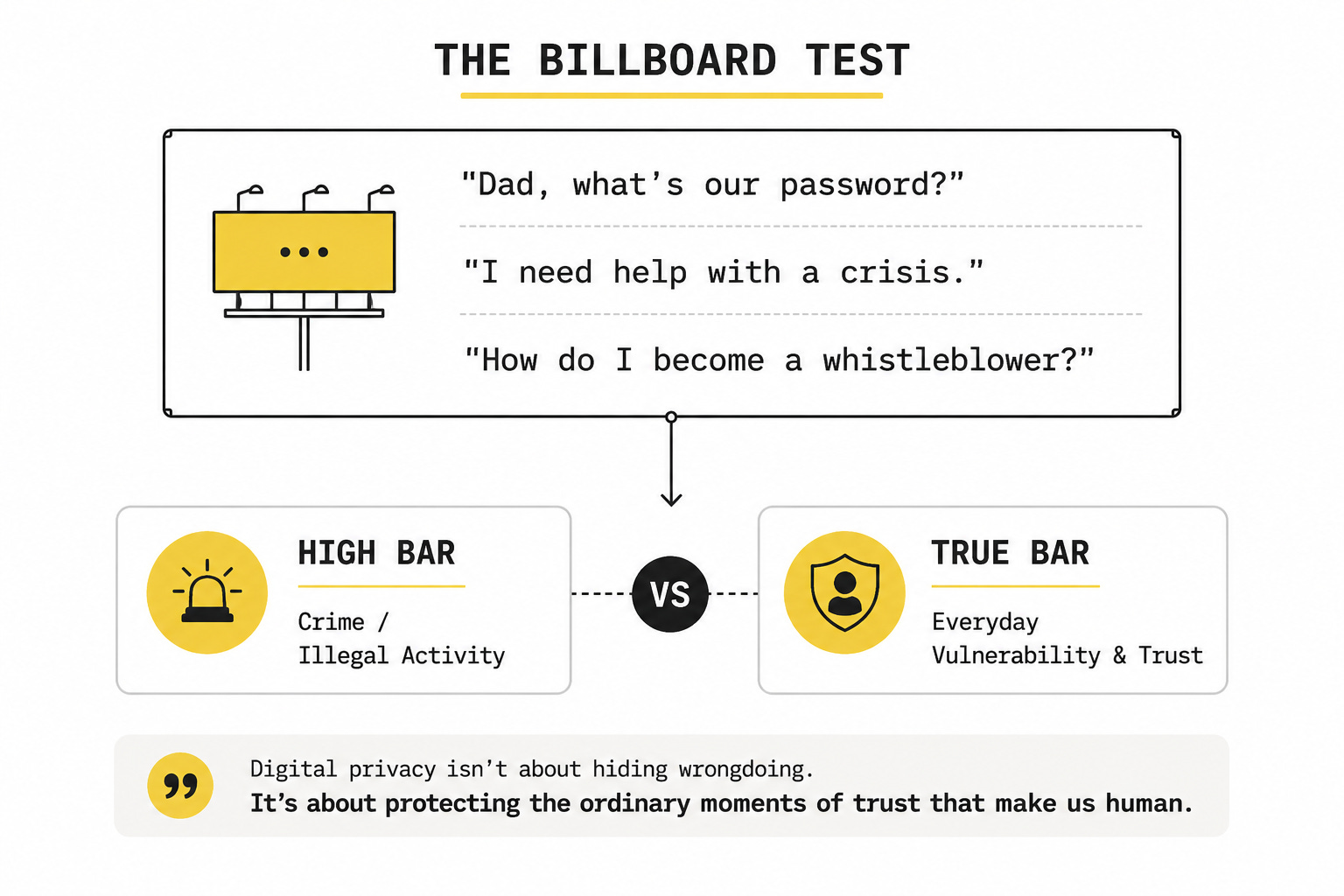
Guy dismantles this with a simple mental exercise he calls the Billboard Test. Picture yourself driving down the freeway, past a row of billboards — and on one of them, a rolling feed of your own text messages.
“Pretend that you’re driving down a freeway and there’s billboards, and on one billboard there are some of your text messages. So, if you’re listening to this, and you can say every one of my text messages can be on that billboard, because I have nothing to hide, you do not need to read my book. You also are probably the world’s most boring person.” — Guy Kawasaki
Privacy isn't about hiding bad behavior, illegal acts, or dark secrets. It's the quiet boundary required for basic human dignity, trust, and vulnerability.
It is asking a friend for advice when your marriage is struggling. It is helping a family member navigate a health crisis in confidence. It is a niece or nephew asking a grandparent for help when they are terrified and cannot tell their parents. When those personal spaces are surveyed and quantified, the quiet vulnerability that makes us human begins to evaporate.
When Innovation Outpaces Wisdom
Guy has spent decades at the center of Silicon Valley, helping launch the original Macintosh at Apple and watching the rise of social media firsthand. Reflecting on that arc, he was candid about the gap between intention and outcome.
“Part of my naivety, but in Silicon Valley, we wanted to make the world a better place, increase people’s creativity and productivity with a new computer... social media was to have more friends and family communicate,” Guy told me. “And the next thing, people are using it to create porn, and social media is about attacking people.”
I asked him directly whether he thought innovation had scaled faster than our ethical maturity as a species. He didn’t hesitate.
“I think that is the understatement of the day,” he said. “I look at these tech bros, and I just scratch my head — what the hell happened to them? You want to create a browser, you want to make information more accessible to the whole world, and the next thing you’re supporting building concentration camps for minorities... something happens when you cross the billion-dollar mark.”
When innovation scales faster than wisdom, tools designed to connect us can quickly turn into engines that isolate us. When technology measures everything you do, it subtly trains you to measure yourself the same way—evaluating your days by productivity metrics, your insights by social engagement, and your significance by public applause.
Metadata and the Envelope
Most people assume that as long as their messages are encrypted, their digital life is private. But as Guy explains in his book, Everybody Has Something to Hide, the real story is often written on the outside of the envelope.
Think of end-to-end encryption like mailing a letter. The message inside the envelope is scrambled so no one can read it. But the envelope itself—the metadata—shows the return address, the postmark, the time it was dropped off, and who it was addressed to.
Most major platforms retain that metadata. They know who you talk to, where you were standing when you sent the message, how frequently you communicate, and what your daily routines look like. Over time, algorithmic systems use that metadata to predict your choices, manipulate your attention, and quietly steer your behavior.
Data is no longer just information; it is behavioral power. When your daily choices are continuously predicted and nudged by systems engineered to keep you scrolling, you gradually surrender your agency. You stop choosing your life and start reacting to a feed.

What Left Behind Actually Means
Toward the end of our conversation, I asked Guy a question about what actually creates a truly meaningful life after spending decades around world-changing innovators.
His response wasn’t about technology, platforms, or net worth:
“I believe what truly creates a meaningful life is that you leave the world better than you found it, so that you make the world better for other people, not for yourself. If you said to me, ‘Guy, who’s the most remarkable person you know?’ I would probably say Jane Goodall. Jane Goodall left the world a lot better. Steve Jobs did it his own way... I rank people by how much you made the world a better place, as opposed to a richer place, as opposed to having their names on buildings, as opposed to the largest crypto account.” — Guy Kawasaki
When you stop treating your life like a performance designed for digital approval, you free up your energy to actually live it. Having fifteen genuine, deep relationships will always matter more than having millions of digital followers.
Privacy isn’t about building walls to shut the world out. It is about protecting the unmeasured spaces where real life happens—around the dinner table, on the water, in quiet conversations, and in the unrecorded moments that make us who we are.
Walk away from the feed.
Protect your quiet spaces.
Measure your life by who you serve, not who is watching.
The world doesn’t need your data. It just needs you to be present.
🎧 Listen to the Full Conversation
Catch my complete interview with Guy Kawasaki on Passion Struck (Episode 802) to dive deeper into digital autonomy, technology ethics, and the art of living a remarkable life.
📱 Listen on Apple: Stop Waiting to Feel Happy: The Mindset Shift Every High Achiever Needs
📺 Watch on YouTube: Dopamine Doesn’t Come From Winning—It Comes From This | Guy Kawasaki
📝 Download the FREE Companion Digital Workbook
🎁 Special Book Offer from Guy Kawasaki
Guy is personally offering a free copy of his latest book, Everybody Has Something to Hide (English or Spanish), to readers! Simply email [email protected] or [email protected] to request a copy, and his team will send you a gift link.
© John R. Miles 2026. All rights reserved.
Scary and true