

The Mosh Pit of the Soul
Why We are Dying for the "Ancient Good"

Close your eyes and feel the vibration of the world around you.
It is fast. It is loud. It is relentless. We are the first generation in history to be everywhere at once through our screens, yet feel like we are nowhere in our souls. We have traded the deep, slow rhythm of the seasons for the frantic, flickering pulse of an algorithm. We are connected, yet many of us feel a profound thinning of reality.
Martin Shaw calls this the thin and frantic life.
When I sat down with Martin to discuss his transformative New York Times bestseller, Liturgies of the Wild, we didn’t just talk about myths as dusty relics of the past. We talked about a crisis of the present: the ache of a life that has become spiritually shallow—a life where we have plenty of information but almost no meaning.
Martin lives in the “Celtic fringe” of Britain, a place where the Roman imprint ended and the wild imagination began. He grew up without a television, surrounded by the weight of ancient books and the living breath of the Devon woods.
In our conversation, he offered a radical invitation: to stop trying to “fix” our lives as if they were broken machines and to start living them as if they were myths.
The Modern Malady: A “Thin and Frantic” Existence
We live in an age of excess. We have more choices, more speed, and more availability than any humans in history. Yet, as Martin pointed out, this excess hasn’t made us deeper; it has made us more exhausted.
“Most people’s lives are becoming thin and frantic,” Martin observed.
We are constantly “swiping left” on our own existence, looking for the next hit of dopamine, the next achievement, the next distraction. We have lost the ability to sit with the “Ancient Good”—those enduring truths that require us to slow down, to fast, and to wait.
This thinning of reality happens when we prioritize consumption over devotion. When we treat life as a series of problems to be solved or metrics to be optimized, we strip away the mystery. To recover, we must move beyond the marketplace of personality and return to the liturgies of the wild.
Threshold I: The Liturgy of the Limit
In a world that tells you “you can be anything,” the most radical thing you can do is accept your limits.
One of the most profound insights Martin shared—and one that challenges the very core of modern “hustle culture”—is that meaning is found through limit, not excess.
He used a powerful analogy: A river without banks is not a powerful force; it is just a flood. It is shallow, destructive, and directionless. It is the banks—the limits—that give the river its depth, its current, and its purpose.
Our modern culture is a flood.
We want everything all at once. But depth requires friction. It requires the “No” that protects the “Yes.” Martin spoke of his experience in the Eastern Orthodox tradition, celebrating “Second Christmas.” It’s a rhythm of fasting before the feast. If every day is Christmas, then no day is sacred.
How to apply this
To find your way back to depth, you must find your banks.
You must choose what you will not do, what you will not buy, and where you will not go, so that the place where you actually are can finally become weighted with meaning.
Threshold II: Entering the Mosh Pit of Myth
Most people approach myth—and even their own lives—as observers. We stand at the edge of the circle, politely analyzing, explaining, and pathologizing our experiences. We look at our history through a clinical lens, trying to “diagnose” our way into a better future.
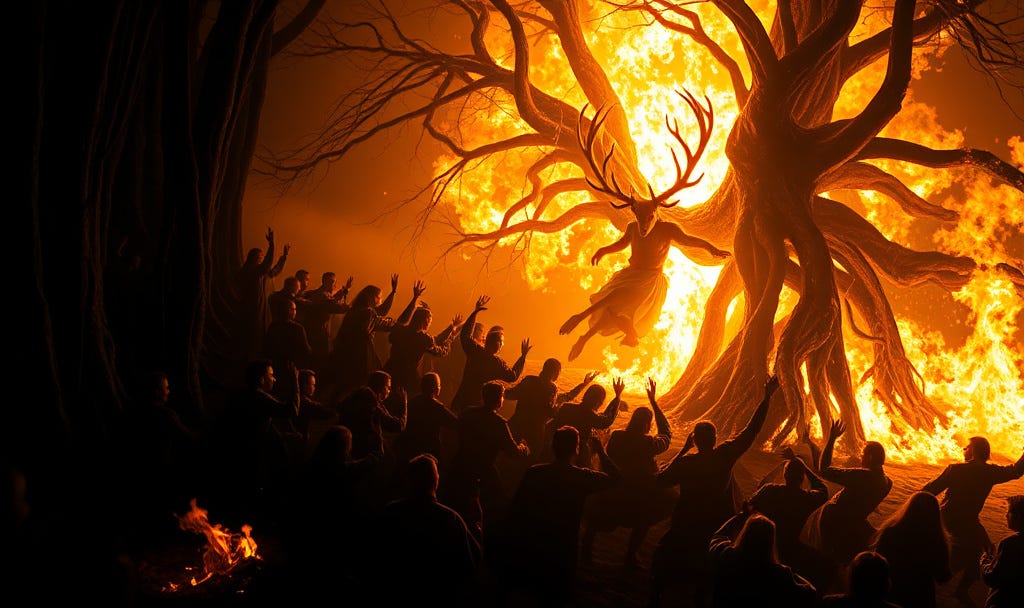
Martin has a different image: Myth is a mosh pit.
“What happens to a human being when they actually enter the mosh pit instead of standing at the edge?” he asks. To enter the mosh pit is to trade explanation for encounter. It is the move from “therapeutic” living to “mythic” living.
When you go to therapy, you often look for an explanation for why you are the way you are. You look for a way to fix the “parts” of yourself.
But myth doesn’t want to fix you; it wants to make you.
When you “story” your life mythically, your struggles aren’t just symptoms of a disorder; they are the thresholds of a great narrative. You move from being a victim of your history to a participant in a cosmic drama.
How to apply this
To reclaim your personal sovereignty, you must stop treating your life as a series of problems to be solved. Start by looking at your current struggle as an “initiation.”
Ask yourself: If this moment were a chapter in an ancient epic, what is being asked of the hero? When you stop explaining your life and start “storying” it, you move from being a spectator of your pain to a protagonist with a purpose.
Stop treating your story like a crumpled bus ticket and start living as if it were written on tablets of stone.
Threshold III: Ecclesiastical Counter-Magic
We often treat darkness and evil as psychological glitches—chemical imbalances or childhood traumas that just need the right "hack" to disappear. But anyone who has witnessed the “thinning” of the modern world knows that darkness has a weight and a presence of its own.
Martin introduced the concept of “ecclesiastical counter-magic.”
This isn’t about “polite” religion or "nice" spirituality that looks good on a coffee table. It is about practices, stories, and rituals strong enough to meet the darkness without becoming it. Religion loses its power when it becomes a set of rules for good behavior. It regains its power when it becomes awe-filled, urgent, and alive.
This counter-magic is the ability to stand in the mess of the world and find the Ancient Good that the darkness cannot touch. It is the discipline of protecting the sacred in a world that wants to commodify every experience.
How to apply this
In a world that feels increasingly heavy, you need a ritual that anchors you. This is about devotion.
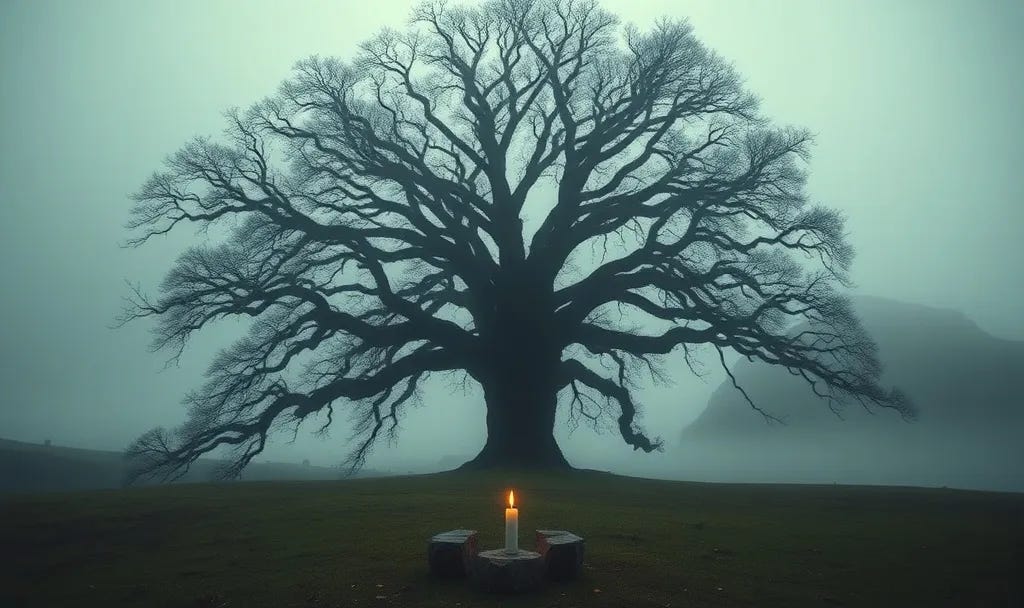
Pick one small act—lighting a candle in the dark, reading a poem before you check your phone, or sitting in silence for ten minutes. Treat this act as "counter-magic" against the noise.
By protecting this small, sacred space, you build the spiritual muscle needed to meet the world's darkness with a light that doesn't flicker. You are not just doing a task; you are practicing the discipline of being "awe-filled and urgent."
Threshold IV: The Discipline of Praise Making
The culmination of a mature human life is not achievement, status, or wealth. It is the ability to praise.
Praise is not about ignoring suffering or wearing a mask of toxic positivity. In fact, true praise is only possible because of suffering. It is the act of recognizing life as a gift even amid its wreckage.
Martin suggests that myth teaches us praise as a discipline—a way of binding ourselves back to the land, to each other, and to the Divine. In our “thin and frantic” world, praise is an act of rebellion.
To stop and offer awe-filled attention to a sunrise, a child’s laughter, or the curve of a stone is to refuse to be swept away by the frantic current. It is the realization that your worth isn’t tied to your performance, but to your ability to witness the wonder of creation.
How to apply this
Praise is a fundamental principle of mattering. Every day, find one thing to witness and praise that has nothing to do with your productivity.
Look at a tree, a piece of art, or a loved one, and speak the praise out loud or write it down. This act of attention pulls you out of the frantic “swipe-left” culture and anchors you in the present.
When you praise, you are saying, “I am here. This matters. I matter.” You are reclaiming your right to witness the world’s beauty, even when the world is breaking.
What is one thing you’ve seen today that is ‘awe-filled, urgent, and alive’?
Reclaiming Your Story
Liturgies of the Wild is ultimately an invitation to come home. It is a reminder that you are not a data point in an algorithm or a cog in a machine.
You are a character in an ancient, unfolding story.
The cure for the frantic life isn’t more information. It isn’t a new productivity app or a better “hustle.” The cure is to slow down long enough to hear the myth that is trying to live through you.
As you move through this week, I want to leave you with the question Martin poses to all of us:
What story are you living inside?
If your life feels thin, look for your limits. If you feel like an observer, jump into the mosh pit. And regardless of the mess you find yourself in, find one thing to praise.
Because when you do, you aren’t just surviving; you are becoming a “grown human being” capable of love, responsibility, and awe.
I’m on this path too, trying to trade the frantic for the mythic, and the thin for the deep. Let’s walk it together.
Of the four thresholds we discussed—Limit, Myth, Counter-Magic, or Praise—which one feels the most urgent for you right now?
Drop a single word in the comments, and I’ll share a specific reflection from the episode to match it.
Listen to the full conversation below:
Download the FREE Companion Digital Workbook here.
If this conversation with Martin moved you, don’t let the “thin and frantic” current sweep it away.
Comment: Share your mythic shift below.
Share: Pass this “liturgy” to someone who feels disoriented.
Subscribe: Stay tuned to TheIgnitedLife.net as we continue to explore the Ancient Good
Holy shit thank you for sharing this. I’m in treatment and this put into words a feeling I’ve been trying to possess. For me, service is one way to join the mosh pit.
There is no urgency