

Why Love Is the Most Powerful (and Most Ignored) Force in Business and Life
Marcus Buckingham on Designing Experiences That Make People Truly Flourish


I’ve spent years studying what drives human performance, from my time in the military through corporate leadership roles at companies like Lowe’s, to hundreds of deep conversations on Passion Struck.
But when Marcus Buckingham sat down with me and declared that love is the single most powerful predictor of productivity, loyalty, resilience, innovation, and long-term organizational value, I had to pause.
Love? In business?
It sounds too soft, too emotional, too abstract for the hard realities of KPIs, quarterly earnings, and competitive pressure.
Yet this isn't coming from a motivational speaker or workplace philosopher. Marcus is one of the world's leading researchers on strengths, leadership, and organizational performance, best known for helping redefine how companies think about talent through bestselling books such as First, Break All the Rules and Now, Discover Your Strengths.
After decades of studying what helps people and organizations thrive, he has arrived at a data-driven conclusion that challenges much of what we think we know about performance and leadership.
This week in Passion Struck EP 779, Marcus joined me to unpack his latest book, Design Love In. What emerged was one of the most thought-provoking conversations I've had in a long time about what it actually takes for people to flourish.
The J-Curve That Changes Everything
Most companies measure customer and employee experiences on a simple 1–5 scale. They treat the relationship between experience and outcomes as linear: move a 2 to a 3, a 3 to a 4, and you should see steady gains.
Marcus’s meta-analytic research reveals the truth is far more dramatic. The relationship is curvilinear, a sharp J-curve. Average experiences (the 3s and 4s) produce almost no meaningful change in behavior. Only the extreme positive experiences, the true 5s, drive massive shifts in productivity, advocacy, resilience, well-being, and loyalty.
Everything else is essentially noise.
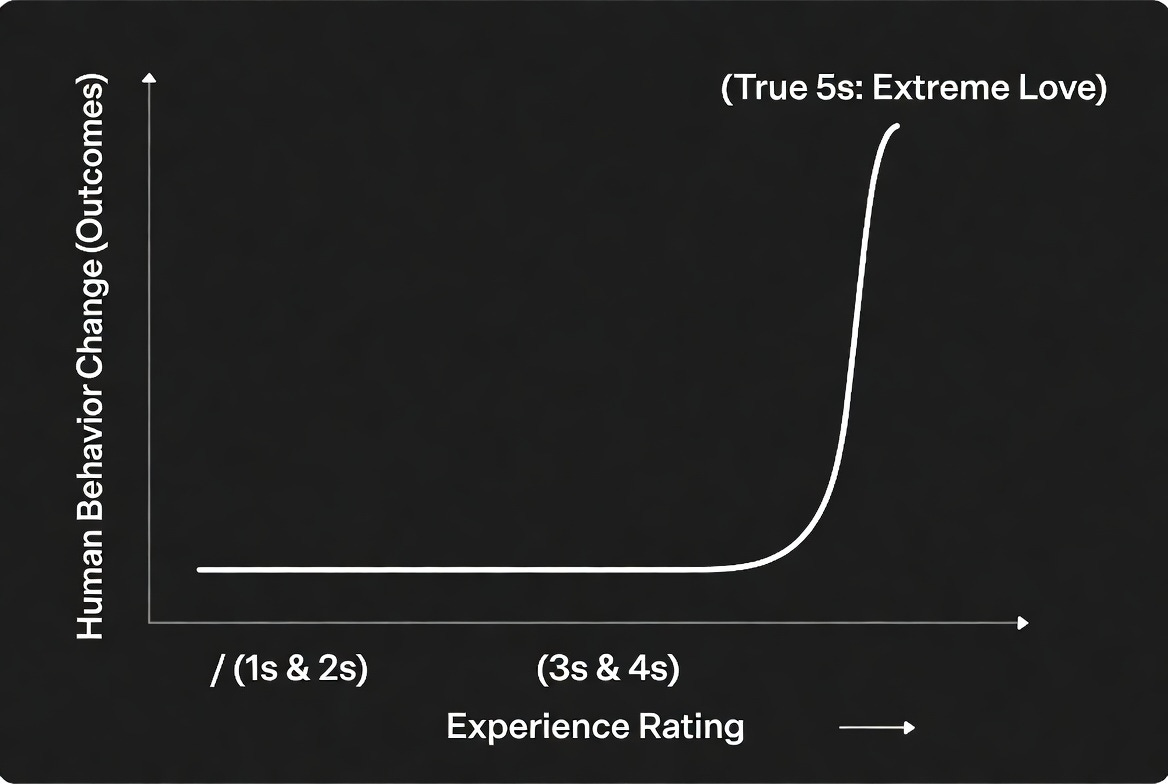
When people describe those rare 5-level experiences in open-ended interviews and focus groups, they don’t reach for corporate-friendly words like “engagement,” “satisfaction,” or “delight.” They spontaneously use one word: love.
“I love that team.”
“I love that leader.”
“I love shopping here.”
Love isn’t a soft coating of niceness. It’s a fierce performance force; the ultimate driver of productive human behavior.
What Love Actually Means — And Why It Matters
Marcus defines love as the deep and unwavering commitment to another person's flourishing, helping them become more fully themselves over time.
We go through life armored and defended against a tough world. But deep down, each of us has something unique we long to express. Any experience, no matter how small, that lets us shed even one piece of that armor feels like love.
That insight reframes leadership entirely. The best leaders aren’t just managers or strategists. They are experience designers who intentionally create conditions for human flourishing.

The Five Feelings That Create Love
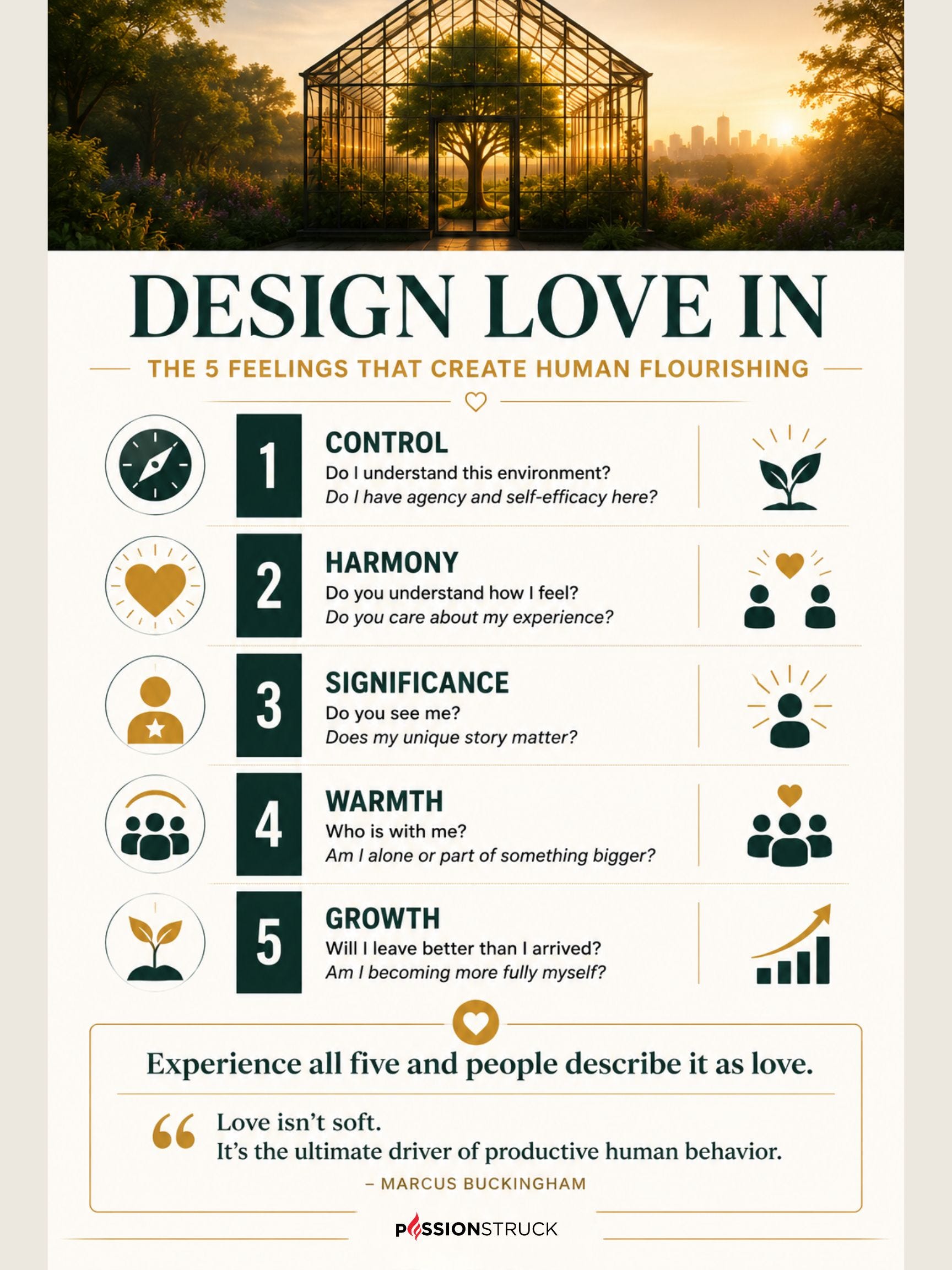
Marcus reverse-engineered love into five sequential feelings that form a blueprint every leader can use:
Control (Agency): Do I understand this environment? Do I have self-efficacy here? Without this foundation, people stay armored and helpless.
Harmony: Do you understand what I’m feeling right now, and do you care? Most experiences are deeply emotional. Meeting people where they are emotionally is critical.
Significance: Do you see me — my unique story, strengths, and background? Do things change because of what you know about me? This is where people feel truly seen.
Warmth of Others: Who is with me? Am I going through this alone or as part of something larger? Isolation kills flourishing.
Growth: Will I leave this experience more capable than when I entered? Love is forward-facing — it helps us become more fully ourselves.
Miss any step, and you create the shadow sides: powerless, jarred, unseen, isolated, or stagnant.
Lessons from the Field — Lowe’s, Zappos, and the Founder’s Flame
During our conversation, I shared my experience at Lowe’s working on “Total Closed Loop” — an ambitious effort to create a seamless, loved customer experience across every channel. Marcus validated that the best store leaders were masterful experience designers who treated the entire store as a stage and the customer as the audience.
We also discussed what happens when organizations lose the founder’s flame. Marcus shared his own story of building a company filled with love, selling it to a large corporation, and watching that love slowly die amid KPIs and compliance.
The tragic arc of Tony Hsieh at Zappos after its acquisition by Amazon hit particularly hard. Tony built a culture where people felt significant and mattered. When that was smothered by the “machine,” it contributed to a profound sense of disconnection.
This is the exact crisis I explore in my upcoming book The Mattering Effect (Penguin Random House, October 2026). So many high achievers do everything “right” — working hard, achieving outward success — yet still feel unseen and insignificant. The quiet erosion Marcus describes is the same one I’ve been mapping: the deep human need to matter.
Free Companion Workbook & Reflection Guide
The Business Case Most Leaders Miss
Marcus makes a compelling fiduciary argument: The two most important questions any leader should ask are:
Do we have more customers in love with us tomorrow than today?
Do we have more people who love working here tomorrow than today?
If you don’t know the answers, you’re failing your responsibility to long-term value. Short-term profitability through loveless systems may satisfy Wall Street temporarily, but it destroys sustainable vitality.
Practical Takeaways You Can Apply Immediately
Stop optimizing for average. Focus obsessively on creating true 5s.
Design experiences, not isolated moments. Moments are fleeting jolts. Experiences are integrated ecosystems of touchpoints that shape memory, emotion, prediction, and future behavior.
Audit every interaction. Treat your next email, meeting, 1:1, or customer touchpoint as a deliberate experience designed through the five feelings.
Protect against organizational drift. Without intentional design, cultures naturally slide toward lovelessness.
Measure what matters. Marcus is building tools (including LoveThat.com) to track love in systems — because what gets measured gets attention.
Final Reflection
In a world obsessed with metrics, optimization, and efficiency, Marcus Buckingham’s work is a powerful reminder that human flourishing isn’t accidental. The best leaders and organizations don’t just manage performance — they design the conditions for people to feel seen, valued, significant, and capable of growth.
Love, it turns out, isn’t soft. It’s strategic. It’s the force that turns good companies into beloved ones and good lives into meaningful ones.
The data is clear. The real question is whether we’re courageous enough to design it in.
What’s one experience in your work, team, or personal life right now that you could intentionally redesign using control, harmony, significance, warmth, and growth?
I’d love to hear your thoughts in the comments below.
Listen to the full conversation with Marcus Buckingham
Get the book: Design Love In by Marcus Buckingham
Download the FREE Digital Workbook specially designed for this episode.
Every ❤️, restack, or comment helps this message reach someone who feels unseen despite their achievements.
Thank you for being part of The Ignited Life community.
© John R. Miles 2026. All rights reserved.
Love, the very core of being human—our battery, so to speak.
John -- Buckingham's J-curve quantifies something The Resiliency Code Operating System makes clear: average experience is the output of self-interest without full consideration architecture. The flat part of the curve isn't a performance failure -- it's the predictable result of systems optimized for extraction of human capacity, dressed as service.
The founder's flame insight is the generational transfer problem in organizational form. First generation builds with consideration embedded in every decision. Second generation inherits the structure without learning or understanding the consideration architecture that produced it. The flame dies not from neglect but from the absence of the operating system to teach future generations the stewardship required to keep it alive.
What Buckingham's five feelings map to -- Control, Harmony, Significance, Warmth, Growth -- is the Connection and Vocation Fields operating as an integrated system rather than five separate metrics to optimize in isolation.
The question underneath his research: why does love disappear systematically? Not as organizational drift -- as structural design failure.
Self-interest without consideration architecture, now accelerated by AI and all related social mediums it touches, produces lovelessness automatically, at machine speed, every time.
That's the operating system problem he's circling.