

The Symphony of Systems Change: Collaborative Leadership with Jeffrey C. Walker
How Deep Listening, Humble Leadership, and Collective Action Create Lasting Change


In Passion Struck Episode 99, host John R. Miles sits down with Jeffrey C. Walker—philanthropist, systems thinker, musician, and former Vice Chairman of JPMorgan Chase. Together, they explore a radical departure from traditional, top-down metrics toward an operational framework of true collaborative leadership.
Moving completely past isolated organizational models, this conversation unpacks how to tackle the world's most complex challenges through systemic alignment. By blending the real-time improvisational listening of a jazz ensemble with elite corporate strategy and neuroscience, Walker delivers an actionable roadmap for leaders who want to stop competing in silos and start co-creating scalable social transformation.
The Jazz Principle of Problem Solving
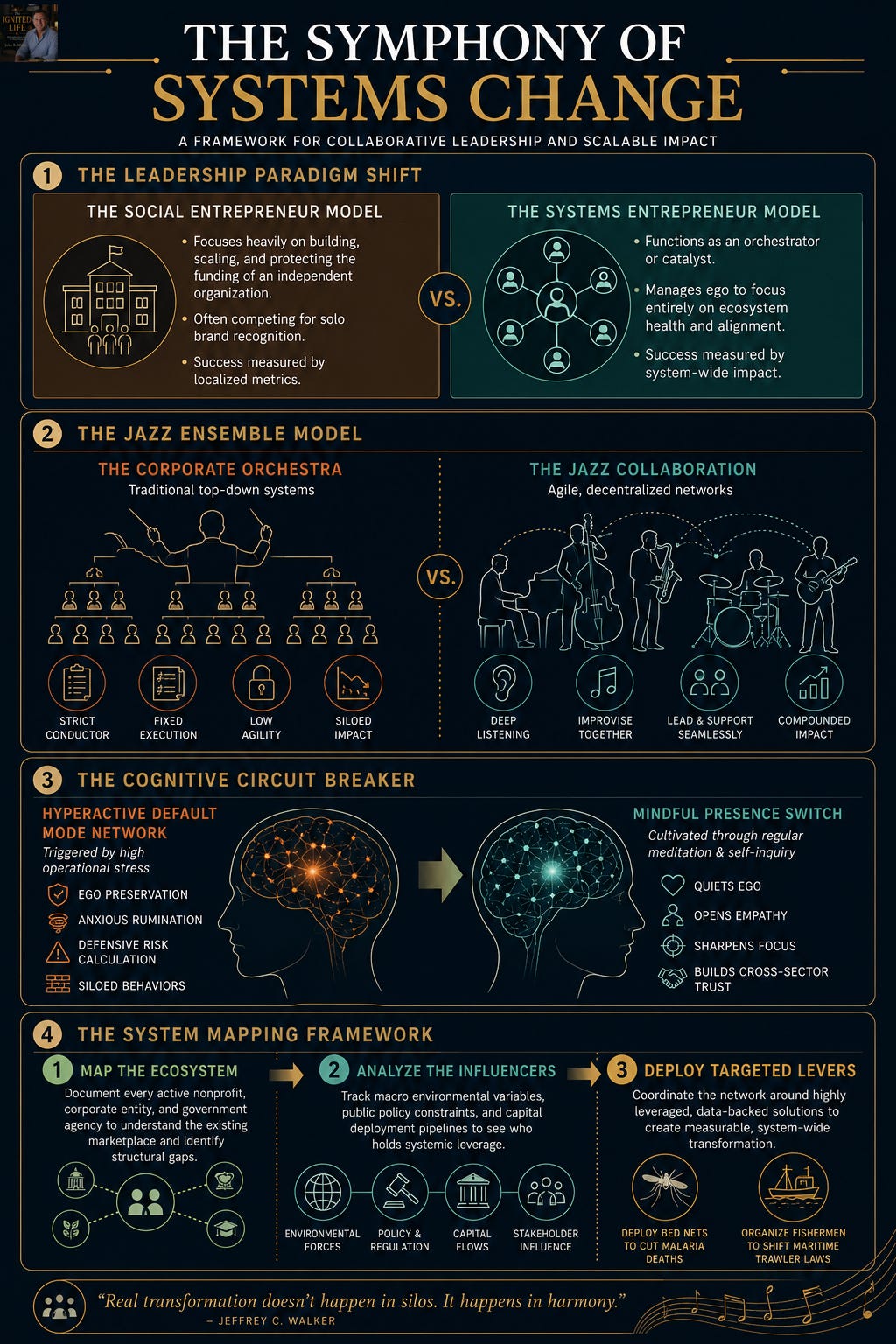
The foundation of effective collaboration is rooted in the dynamics of a musical ensemble. In traditional corporate hierarchies, leaders behave like classical conductors, demanding rigid execution of fixed notes. True systemic change, however, operates like a jazz ensemble. This model requires highly skilled individuals who excel at their independent instruments but prioritize the collective sound over a solo performance.
In a jazz group, musicians utilize deep listening skills to riff off one another’s sounds, creating a unified composition that no single member could achieve alone. Crucially, this approach maintains an active awareness of the audience, ensuring that the passion generated on stage directly connects with and stimulates the surrounding community. Systemic leaders must learn how to seamlessly alternate between leading a project and playing a vital supporting role when a partner is better positioned to hold the spotlight.
Shifting from Social Entrepreneur to Systems Entrepreneur
A critical barrier to large-scale social impact is the structural limitation of the independent innovator. Drawing from frameworks established by academic researchers like Juliet Delano, true systemic transformation requires three distinct forces to interact:
Innovators: Excellent non-governmental organizations (NGOs) and nonprofits that create entirely new ideas and localized programs.
Disruptors or Organizers: Individuals and advocacy movements that inject friction into the status quo to force systemic awareness.
Orchestrators or Systems Entrepreneurs: Strategic catalysts who map the marketplace, analyze environmental influencers, and align multiple conflicting stakeholders toward a singular objective.
While a traditional social entrepreneur focuses heavily on building, scaling, and securing funding for their specific organization, a systems entrepreneur focuses on the overall health and coordination of the ecosystem. They intentionally manage their ego, stepping away from the need for solo brand recognition and toward serving as the collaborative glue that unites corporate capital, public policy, and local actors.
The Neuroscience of Collaboration: Shifting the Default Mode Network
The primary obstacle to achieving authentic collaborative networks is the neural architecture of human self-preservation. Under high-stress corporate or operational environments, an interconnected brain network known as the default mode network becomes highly active. This network dictates ego-preservation, anxious rumination, self-referential tracking, and defensive risk calculation. When a leader operates with an unchecked default mode network, they view surrounding organizations with suspicion, hoard data, and operate in defensive silos.

To break this pattern, modern leaders must integrate intentional mindfulness practices into their core operations. Mindfulness serves as a rigorous cognitive tool that actively quiets the default mode network, opening up the specific neural pathways required for compassion, deep listening, and loving-kindness. By quieting the ego-driven center of the brain, leaders develop the mental agility to manage extreme uncertainties, tolerate complex team dynamics, and establish deep relational trust with external partners.
System Mapping and Market Analysis
To resolve grand challenges like global warming, healthcare access, or democratic instability, leaders cannot rely on linear solutions. They must build detailed market and influencer maps to identify hidden levers of change:
The Environmental Pivot: When analyzing ocean conservation, organizations like the Pew Foundation mapped global fishing ecosystems to shift the focus away from generalized climate talk and toward a single lever: banning trawling across millions of square miles. By partnering directly with local fishermen whose livelihoods were being devastated, they altered laws across more than fifty countries.
The Democratic Reform Map: Rather than relying on standard political donations, groups like the Leadership Now Project utilize comprehensive market maps that categorize 501(c)(3)s, 501(c)(4)s, independent funding, and state-level regulations. This map empowers donors to coordinate their capital strategically around systemic levers like voting rights and open disclosure laws.
The Eradication of Global Disease: Through collaborative funding vehicles, leaders like Ray Chambers and organizations such as Malaria No More mapped global supply chains, international funding pipelines, and local delivery networks. By pairing return-on-investment tracking with targeted bed net distribution, they raised public awareness from 20% to 70% and successfully reduced annual malaria deaths by one million over a ten-year period.
Six Strategic Pillars for Systems Change
Practice rigorous self-inquiry: Commit to personal mindfulness work to actively down-regulate your default mode network and manage your internal ego before attempting to manage external teams.
Build consensus-driven partnerships: Structure your senior teams and board meetings around a partnership-forum model, in which major operations require collaborative alignment rather than unilateral mandates.
Empower proximate, local actors: Transition away from paternalistic, top-down funding models and implement a locally driven yet network-supported approach, placing resources directly in the hands of leaders who live closest to the problem.
Deploy collaborative catalysts: Hire dedicated, neutral orchestrators whose sole professional responsibility is to maintain trust, share data, and coordinate action among diverse stakeholders.
Unify around collective data metrics: Follow the blueprint of models like Community Solutions—which drove homelessness to near zero across fourteen cities—by forcing local governments, businesses, and foundations to track success through a single, shared database.
Balance systemic suffering with joy: Ensure your organization’s ultimate mission is dual-aspected: intentionally working to minimize structural suffering while actively constructing spaces that enhance human joy and community flourishing.

Key Philosophical Quotes
“Real transformation doesn’t happen in silos. It happens in harmony.” — Jeffrey C. Walker
“Some people play to win. Others play to connect, to harmonize, to create something greater than any single note could do alone.” — John R. Miles
“A humble strategy requires this managed ego approach that allows you to say, ‘I’m here, constantly learning, grabbing interesting ideas, partnering with people, having a vision and a roadmap, and being able to change that map on a moment’s notice if something better comes along.’” — Jeffrey C. Walker
Listen to the full episode 99 with Jeffrey C. Walker
Frequently Asked Questions
What is the default mode network, and how does it block leadership?
The default mode network is an interconnected region of the brain responsible for self-referential thought, ego-preservation, and anxiety. In leadership scenarios, an overactive default mode network triggers defensive behaviors, causing executives to protect their immediate silos, resist collaborative partnerships, and prioritize individual credit over ecosystem health.
How do you transition from a social entrepreneur to a systems entrepreneur?
The transition requires moving away from an organizational mindset focused entirely on scaling a single proprietary nonprofit or product. A systems entrepreneur acts as an orchestrator, stepping back to analyze the entire problem matrix and focusing on building deep relational trust across competing groups to optimize the whole system.
Can mindfulness be effectively integrated into high-stakes corporate settings?
Yes. Walker pioneered these frameworks within global finance, utilizing structured meditation practices within JPMorgan Partners directly following the trauma of 9/11 to manage corporate anxiety and improve executive collaboration. This layout laid the groundwork for authentic and mindful leadership courses now taught across institutions like Harvard Business School.
What is a locally driven, network-supported model?
This approach balances regional expertise with global resources. It empowers local actors who deeply understand the unique cultural and structural nuances of their city or village to drive the strategy, while an overarching network provides the data tools, funding infrastructure, and cross-sector best practices to support them.
How do revolutionary therapies like MDMA relate to systems change?
Trauma and post-traumatic stress disorder (PTSD) severely lock individuals into a state of permanent neurological hyper-vigilance. Through collaborative research funding via organizations like MAPS, clinical trials at Johns Hopkins and Harvard demonstrate that therapeutic applications of psychedelics quiet the default mode network. This neuro-reboot allows patients to process deep-seated trauma with dramatically lower anxiety, achieving a 60% to 70% cure rate that talk therapy alone cannot match.
Thank you for thinking with me here. These conversations matter.
© John R. Miles 2026
## Key Concepts

- Systems entrepreneurship
- Collaborative leadership
- The default mode network
- Mindfulness and organizational trust
- Jazz as a model for adaptive leadership
- Network-supported social change