

The Invisible Ceilings You Don't Know You're Living Beneath
Why extraordinary lives begin by dismantling the limits we quietly accept


When I was running competitively in high school and college, I spent countless mornings standing on cold starting lines, looking down a stretch of track or an open trail. In those moments before the gun, the mind plays a subtle, dangerous game. It calculates odds. It looks at the runners lined up beside you—their stride, their gear, their reputation—and it quietly begins negotiating terms.
Without even realizing it, we assign people higher ceilings than ourselves. We decide that someone else is naturally more gifted, more capable, or built for a level of success that we weren’t meant to touch. So, before the race has even begun, we quietly lower the standard for our own lives.
We tell ourselves we are being “realistic.” We call it humility or self-awareness. But in truth, it is a premature surrender.
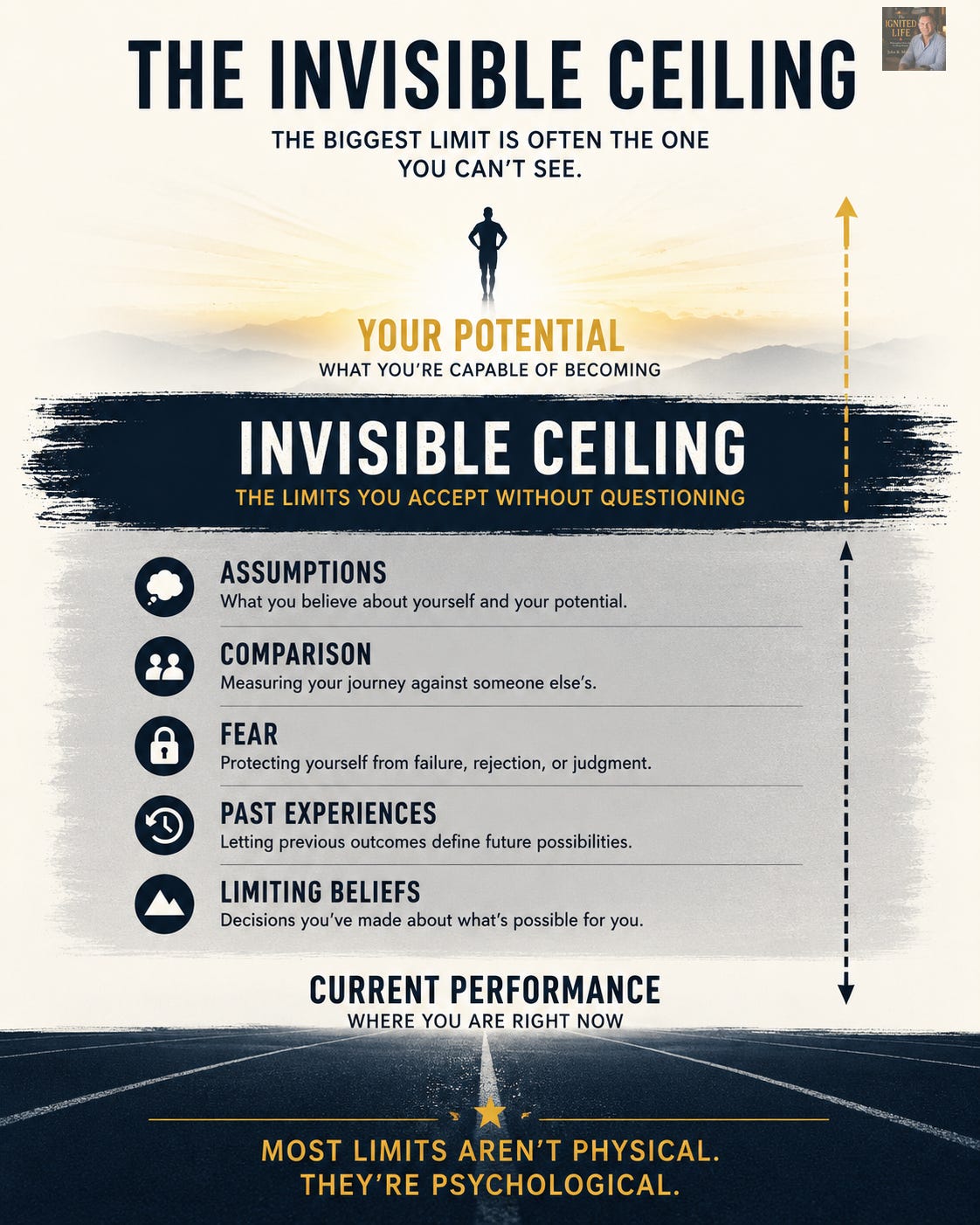
We spend much of our adult lives doing the exact same thing off the track. We carry invisible ceilings into our careers, our leadership, and our personal aspirations. We look at world-changing achievements—building an elite culture, writing a transformative book, or mastering a discipline—and treat them as territory reserved exclusively for an exceptional few.
We confuse where we currently stand with what we are capable of becoming. Those invisible ceilings aren't built by reality alone. They're constructed from assumptions, comparison, fear, past experiences, and the limiting beliefs we quietly accumulate over time.
The Trap of Natural Talent
We love the mythology of natural talent. It comforts us. If extraordinary results belong only to those born on the finish line, then our own average outcomes aren’t a reflection of our choices—they are simply our destiny.
When coach Sean Brosnan arrived at Newbury Park High School, he inherited a cross country program that hadn’t reached a state championship in twenty-five years. It was a team defined by decades of being “good enough.”
He didn’t inherit a squad of genetically gifted phenoms. His star athlete, Nico Young—who would go on to break national records, win championships, and reach the Olympic stage—entered the program as a five-foot-one freshman who barely filled out his uniform.
The breakthrough didn’t happen because Sean discovered hidden genetic lottery winners. It happened because he refused to accept the invisible ceilings the school, the parents, and the athletes had built around themselves.
“Belief changes performance... Once you believe in something, you’re on a whole other level mentally and physically.”
— Sean Brosnan
Talent is merely raw material. Without a culture that demands daily excellence, talent yields sporadic, fragile results. But when you place ordinary people into an environment where uncompromising standards and deep self-belief are the baseline, their understanding of what is possible fundamentally rewires.
Standards Over Expectations
We often confuse having big expectations with having high standards.
Expectations are external wishes. They focus heavily on the outcome, carrying a weight of anxiety and burden. Standards, on the other hand, are internal behaviors. They focus entirely on daily execution.
On his first day with the team, Sean stood in front of a room of skeptical parents and promised they would win a state championship in four years. Half the room thought he was out of his mind. But he didn’t sit around wishing for a trophy; he established daily, non-negotiable standards:
Purpose in every action: Every run had a specific goal—including “dog slow” recovery days that were treated as mathematically vital to national titles as intense speed intervals.
Making commitment cool: Hard work became the cultural norm. The athletes who skipped sleep, neglected hydration, or cut corners became the outliers.
Designing the environment: The team set up a literal “compound” at meets—placing the largest tent in the park to signal confidence before the starting gun ever fired.
When standards are clear and consistently upheld, discipline stops feeling like a punishment. It becomes contagious.
Evidence Precedes Confidence
We like to think that confidence comes first—that once we feel entirely secure, capable, and fearless, we will finally step into the arena.
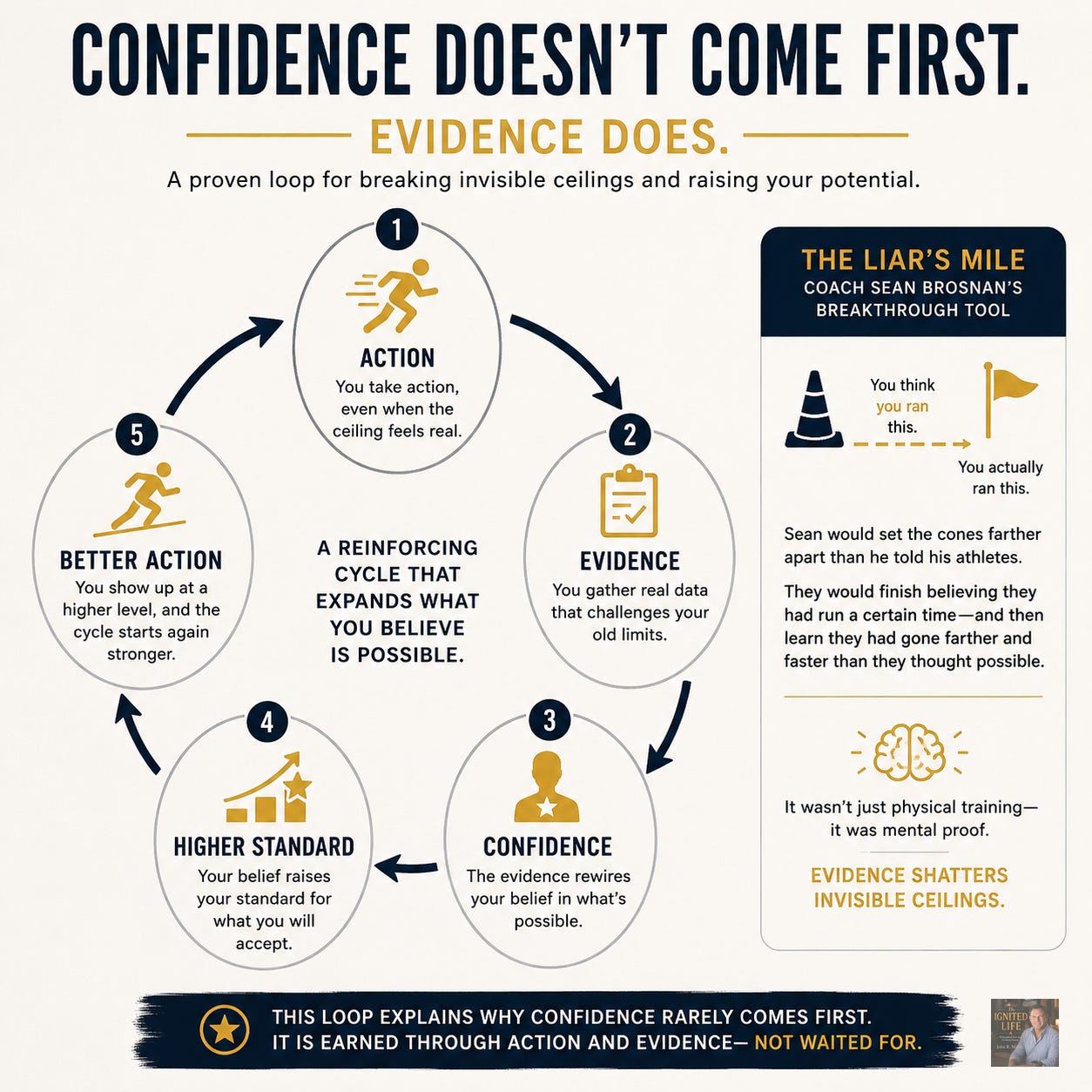
In reality, confidence rarely precedes action. Confidence follows evidence.
During key training blocks, Sean used a psychological technique he called the “Liar’s Mile.” He would wheel out workout cones on a grass field and intentionally measure the interval distances slightly longer than what he told his runners.
The athletes would finish the workout believing they had run a specific time, only to learn afterward that they had run significantly farther and faster than they thought their bodies were capable of going.
Why was that psychological nudge so effective? Because it shattered their mental glass ceilings with cold, undeniable proof.
When Roger Bannister broke the four-minute mile in 1954, medical experts believed it was a physical barrier that would cause the human heart to burst. Yet, within a year of Bannister proving it could be done, multiple runners accomplished the exact same feat. The human body hadn’t evolved overnight; the mental ceiling had simply been dismantled.
Most of us are running inside our own “four-minute miles.” We’ve drawn arbitrary boundaries around our career, our leadership, or our creative potential, mistaking a mental block for a physical limit.
The truth is that the limits we accept quickly become the limits we live.
The Power of Mattering
In distance running, team titles aren’t won by the first runner across the line; they are decided by the fifth runner. You can have the fastest individual in the country, but if your fifth runner finishes in 80th place, your team loses.
Sean built a national powerhouse by ensuring that every single athlete—from the state champion down to the junior varsity runner trying to make the squad—knew their daily effort was structurally essential to the mission.
“Every body, every person counts... Everyone has their role, and it’s just doing the best you can do in that role.”
— Sean Brosnan
This is the core of human flourishing. People don’t excel when they feel like passive attendees in an organization. They flourish when they know that their presence matters—that their daily discipline carries real, material consequences for the group.
When people realize their contribution is irreplaceable, compliance turns into deep, unwavering commitment.
Shattering Your Own Invisible Ceilings
As you move through this week, take a quiet inventory of the invisible ceilings you’ve built around your own life:
Where have you lowered the standard? What goal or calling have you labeled “unrealistic” simply because it demands more belief than you currently possess?
Are you relying on expectations or standards? What daily micro-habits can you establish today that make your long-term vision inevitable?
Are you honoring the invisible work? Are you treating your recovery, your intentional practice, and your daily discipline with the respect they deserve?
Extraordinary lives are rarely built by people with extraordinary natural gifts. They are built by ordinary people who make the conscious choice to step into an environment of uncompromising standards, dismantle their mental ceilings, and choose to live every single day like they matter.
Listen to my full conversation with Sean Brosnan in Episode 799 of Passion Struck.
Download the FREE Companion Digital Workbook
Every ❤️, restack, or comment helps this message reach someone who needs to break their own invisible ceiling. Thank you for being a vital part of The Ignited Life community.
© John R. Miles 2026. All rights reserved.