

Dismantle The Truman Trap
How to Redesign a Life You Don’t Need to Escape From


In the 1998 film The Truman Show, the god-like creator, Christof, is asked why Truman never questioned his fabricated reality. His answer is chillingly simple — and a diagnostic for the modern high-achiever:
“We accept the reality of the world with which we are presented. It’s as simple as that.”
How many times this week have you done exactly that? Accepted a version of yourself that is incredibly convenient for everyone else, yet leaves you feeling like a guest in your own existence?
If you constantly need to “get away” — through endless scrolling, weekend escapes, or subtle numbing — it’s because your life wasn’t built to nourish you. It was built to be useful to others.
Living intentionally means choosing your values before your circumstances choose them for you.
The Spotlight Moment: When the Script Fails
Psychologist Thomas Gilovich describes the "spotlight effect"—our tendency to overestimate how much others notice our flaws. We imagine the world is scrutinizing us, so we smooth over the cracks. Leon Festinger’s work on cognitive dissonance explains why: when reality conflicts with our accepted story, we work overtime to restore comfort. We rationalize. We drive on.
Truman did it. We do it every day.
But in The Truman Show, the transformation begins with a literal Spotlight Moment.
A spotlight falls from a clear blue sky and lands on the street in front of Truman. He looks up, and the sky looks normal. He looks at the people around him, and every single one of them acts as if nothing happened. So, he does, too.
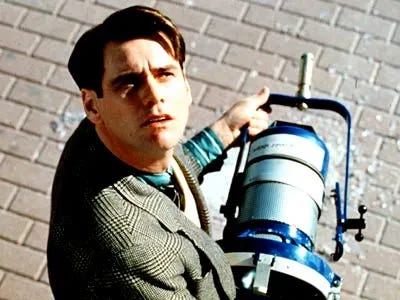
That is the moment of choice.
Not the exit—the first time he noticed something was wrong and talked himself out of it. We do this because being “useful” feels safe, while being truly known feels dangerous. We settle for “convenient” interactions because friction feels like a threat to our belonging. But “safe” is exhausting. You can never fully rest inside a performance.

The Performance Contract: When Belonging is a Transaction
A lot of what we call “belonging” is actually just a Performance Contract. We trade authenticity for acceptance, shrinking ourselves to fit the room. As Jean-Paul Sartre warned, this is “bad faith”—living as an object in other people’s gaze instead of as a free, authentic being.
Consider the life of author Truman Capote. In the 1960s, he was the ultimate social fixture—the witty mirror who made the New York elite feel fascinating. In exchange, he was invited onto yachts and into estates. But when he stopped being a mirror and started being a writer—publishing the ugly truths of his social circle in Answered Prayers—the invitations stopped.
His “friends” did not leave because he betrayed them. They left because he stopped being useful.
“If your people leave when you stop performing, they didn’t leave you. They left the show.” — John R. Miles
We often trade our aliveness for a sense of security that can be taken away the second we stop being a tool for someone else’s convenience.
The Promethean Choice: How to Redesign Your Life
When we finally notice the spotlight, most of us make the same mistake: we change the scenery but keep the old script. We quit the job, move to a new city, or rebrand — yet bring the same unexamined performance into the new room.
True life design demands something harder. It asks us to become Promethean — to intelligently reshape our world, as Prometheus stole fire and gave humanity the power to create rather than merely accept. Meaning is not discovered in some pre-existing blueprint. It is engineered, moment by moment, through conscious choice.
"Living intentionally means choosing your values before your circumstances do." — John R. Miles
This is where behavioral science meets philosophy. The Law of Reversibility, popularized by Bill Tracy, holds that if we act “as if” we are already living a resonant life, the feelings and habits will follow. Aristotle understood this centuries earlier: eudaimonia — deep flourishing — comes not from pleasure but from living in alignment with virtue and purpose.
The Three Quiet Shifts That Turn a Useful Life Into a Resonant One
Real redesign asks us to become the author rather than the actor. Here are the three shifts that actually change the story:
1. From Audience to Authorship
Performance is exhausting because it’s always on stage. Presence is quieter. It’s the difference between curating a life for the feed and living one that feels like home when the lights go out. The ancient Stoics called this turning inward — caring more about your own character than other people’s opinions. Modern psychology backs it: when we stop managing impressions, we reduce chronic stress and reclaim mental energy.
This shift is simple in theory, radical in practice. It means choosing honesty in small moments — saying what you actually think in a meeting, setting a boundary without overexplaining, or spending an evening doing something that brings you joy rather than what looks impressive.
2. From Fitting In to Resonance
So many of us chase a kind of belonging that is really just approval in disguise. We shape ourselves to be likable, low-drama, useful. We become the reliable one, the agreeable one, the person who makes the group feel comfortable.
But there’s a quieter, stronger alternative: finding your people instead of trying to fit into everyone’s. This is the difference between a crowd that tolerates you and a circle that actually recognizes you. It requires courage, because it means some doors will close. The ones that stay open, though, are built on something real.
You don’t have to be liked by everyone. You only need to be known by the right ones. Over time, this shift replaces exhaustion with ease. You stop performing and start belonging in a way that doesn’t require constant maintenance.
3. From Escape to Return
The goal of a well-designed life isn’t constant bliss or perfection. It’s a life you genuinely want to come back to — even after the hard days, the disappointments, and the ordinary Tuesdays.
Many of us treat life like something we need to escape from. We plan vacations, scroll for hours, or fantasize about “someday.” But what if the real work was building a daily existence that feels like a place worth returning to?
This shift is practical: create small return rituals. An evening walk where you leave your phone behind. A few quiet minutes reviewing what felt meaningful that day. A boundary that protects your energy instead of draining it. These aren’t grand gestures. They are quiet votes for a life that feels like yours.
When you design for return instead of escape, something powerful happens. The hard days still come, but they land in a life that can hold them. You stop running away and start building something worth staying for.
FAQ: Common Questions on Life Design
What is the difference between success and significance? Success is a measure of your output and utility to others. Significance is a measure of your mattering—the inherent worth you feel when your internal values match your external actions.
Why do I feel empty even though I am successful? This is often the success hollow. It occurs when you have won the “efficiency game” but lost the human one, living a script you never chose for an audience you don’t actually know.
How do I start living intentionally? Start with the design diagnostic: If nobody was watching—no opinions, no consequences—what would you do differently tomorrow? That immediate flash of a choice is the unperformed version of you trying to get your attention.

The Final Bow
At the end of The Truman Show, Truman reaches the edge of his world. The boat hits the painted wall. The creator’s voice urges him to stay in the safe illusion.
Truman thinks about it. And then, he takes a bow.
That bow is everything. It’s not an act of rage; it’s a man acknowledging the performance, thanking the audience for their time, and leaving. A quiet thank-you to the version of himself that kept him safe, followed by the decision to walk through the door anyway.
You are allowed to do the same.
Thank the version of you that got you this far — the performer, the peacekeeper, the useful one. Then step into the life you were actually meant for.
Are you ready to stop performing and start mattering?
Let’s keep this conversation grounded in what works.
Listen to the full exploration on Episode 762 of Passion Struck
Download the FREE Companion Reflection Guide here.
Thoughts? Let me know below this essay!
Every 🧡, restack, or comment you share here on Substack
is like a signal flare…..
It helps this message find the person who is still walking
their own “schoolyard” alone.
Thank you for being part of this ecosystem.
I love turning these essays into a two-way conversation
So please let me know your thoughts below.
© John R. Miles 2026. All rights reserved.