

Why We Feel More Misunderstood Than Ever
Greg McKeown on the communication trap quietly damaging our relationships, teams, and communities.


In 1990, a Stanford University doctoral student named Elizabeth Newton conducted a deceptively simple study that exposed the hidden architectural flaw in human communication. She paired participants into dyads consisting of a tapper and a listener. The tappers were instructed to tap out the rhythm of a well-known song on a table, while the listeners had to guess the melody based purely on those percussive strokes.
Before the tapping began, Newton asked the tappers to estimate how likely the listeners were to guess correctly. On average, the tappers confidently predicted a 50% success rate. In reality, the listeners accurately identified the song just 2.5% of the time—only 3 out of 120 trials.
What struck me wasn’t the failure rate itself. It was the wild overconfidence of the communicators. Because the tappers could hear the full orchestration, lyrics, and arrangement playing perfectly inside their own heads, they found it impossible to comprehend that all the listener heard was a series of disconnected, erratic thuds. They left the interaction entirely convinced they were clear, yet they were almost completely wrong.
This week in Passion Struck EP 778, I sat down with bestselling author, host of the What’s Essential podcast, and Cambridge doctoral researcher Greg McKeown to dissect this exact phenomenon. Greg has spent the last decade studying a singular question: What is the primary bottleneck preventing individuals and organizations from focusing on what truly matters?
His research points to a devastating systemic blind spot he calls confident misunderstanding—the dangerous illusion that we have accurately understood someone else, or that they have accurately understood us, when we are actually operating in total error.
The Shift from Distraction to Disorientation
For most of human history, the rhythms of communication were slow, localized, and context-rich. Conversations happened face-to-face, where immediate presence, tone, and physical proximity naturally filtered out gross misinterpretation.
Today, we are moving from an Information Age defined by distraction into an AI Age increasingly characterized by disorientation. We live in a hyper-connected environment where everyone is constantly posting, commenting, reacting, and communicating, yet genuine understanding often feels harder than ever to achieve.
Modern technologies solved many real problems of reach and convenience, but they also changed the conditions under which human relationships operate. Greg argues that we are rapidly approaching a dangerous noise threshold. Like an old radio dial where a small amount of interference transforms words into static, emotional overload is pushing many conversations beyond the point of comprehension.
The consequences are real and growing. Research shows that more than one in five people have stopped speaking to a close friend or family member because of unresolved misunderstandings and conflict. Without addressing this underlying friction, even the best talent, leadership strategies, and organizational systems struggle to achieve their potential.

The Mathematical Law of Clarity
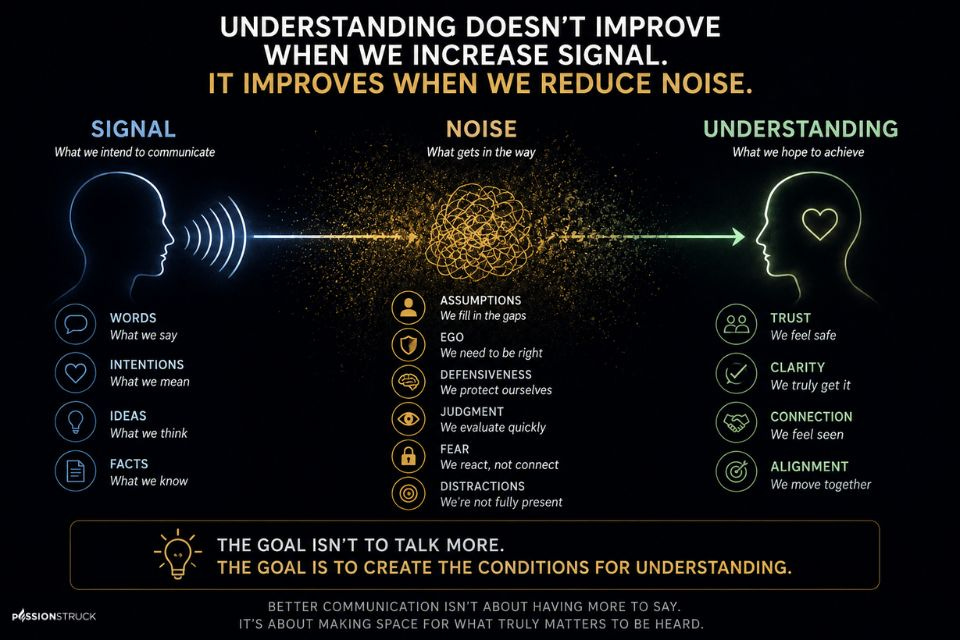
One of the most memorable ideas from my conversation with Greg was the mathematical law that governs human connection. Clarity follows a surprisingly simple formula:
Clarity = Signal ÷ Noise
Most of us instinctively respond to communication breakdowns by increasing our signal. We repeat ourselves. We argue harder. We add more facts, more explanations, and more urgency.
Yet information theory suggests that noise is often the determining factor in the equation.
A small reduction in emotional noise—our assumptions, defensiveness, judgments, and ego—can have a far greater impact on understanding than dramatically increasing the strength of our signal. The clearer the channel becomes, the easier it is for understanding to emerge naturally.
This insight shifts the focus of communication. Instead of asking, “How do I make my point more effectively?” we begin asking, “What noise is preventing understanding from occurring in the first place?”
Practical Signalists: Nadella and Maddox
To understand how this principle works in practice, Greg shared two powerful examples of leaders who achieved extraordinary outcomes not by speaking louder, but by reducing noise.
The Microsoft Cultural Turnaround
When Satya Nadella became CEO of Microsoft, he inherited a company known for intense internal competition and defensive communication. Team members often shut down opposing viewpoints rather than exploring them.
One of Nadella’s early moves was surprisingly simple: he introduced principles from Nonviolent Communication and modeled deep listening throughout the organization.
By reducing defensiveness and creating greater psychological safety, Nadella helped foster a culture where valuable insights surfaced more easily and people felt more comfortable sharing them. Over time, that shift helped lay the foundation for one of the most remarkable corporate turnarounds in modern business history.

The Saddam Hussein Intelligence Breakthrough
An even more dramatic example comes from military interrogator Eric Maddox, the man credited with locating Saddam Hussein.
Maddox rejected many traditional interrogation methods and adopted a radically different approach that he described as “erasing his mind.” Before entering an interrogation, he intentionally set aside assumptions, judgments, and preconceived narratives in order to fully understand the world from the other person’s perspective.
By listening without judgment and paying close attention to seemingly insignificant details, Maddox uncovered information that eventually led to one of the most significant intelligence breakthroughs of the Iraq War.
His success was not built on coercion. It was built on understanding.
The Four-Step Loop for Better Conversations
One of Greg’s most practical insights comes from the work of psychologist Carl Rogers.
Rogers believed that many conflicts persist because people try to be understood before demonstrating that they understand. His rule was simple: before making your point, first explain the other person’s perspective to their satisfaction.
Greg translates this principle into a four-step loop:
Listen with genuine curiosity.
Reflect back what you heard.
Share your perspective clearly.
Confirm what the other person understood.
Most people skip directly to step three. They begin advocating for their position before creating enough safety for understanding to occur. The result is predictable: more signal, more noise, and less clarity.
The discipline of slowing down and moving through each step intentionally creates the conditions for real connection and mutual understanding.
Key Takeaways
Establish Safety Before Signal Power
When conversations become tense, resist the urge to speak louder, repeat yourself, or overwhelm the other person with additional arguments. Focus first on reducing emotional noise and creating psychological safety.
Practice Reflective Listening
Never assume understanding. Reflect back what you heard and allow the other person to confirm or correct your interpretation before moving forward.
Erase Your Mind
Before entering an important conversation, set aside assumptions and preconceived narratives. Genuine understanding begins when curiosity replaces certainty.
Step Outside Your Own Thinking
When caught in cycles of anxiety, frustration, or overthinking, remember that perspective often emerges through dialogue. Understanding is frequently discovered in relationships rather than isolation.
Download the FREE Companion Guide and Digital Workbook
Final Reflection
The conditions that once facilitated deep understanding were built into everyday life. Today, they require deliberate effort.
That shift helps explain why so many people feel disconnected despite being surrounded by communication. The issue is rarely a lack of intelligence, talent, or strategy. More often, it is a growing accumulation of emotional noise that prevents us from accurately understanding one another.
Greg’s central insight is surprisingly simple: nothing important gets done without understanding. Families, teams, organizations, and communities all depend on our ability to accurately interpret one another’s intentions, experiences, and perspectives.
Slowing down long enough to listen, reflect, and reduce noise may seem insignificant in the moment. Yet these small acts create the conditions under which trust, belonging, collaboration, and human flourishing become possible.
The modern world will continue to generate more information, more opinions, and more noise. Our need to be understood—and to understand others—remains unchanged.
Understanding the relationship between the two may be one of the most important skills we can develop if we hope to keep our connections alive and stay Passion Struck.
Listen to the Full Episode Below:
Download the FREE Companion Guide and Digital Workbook
Thoughts? Let me know below this essay!
Every 🧡, restack, or comment you share here on Substack
is like a signal flare…..
It helps this message find the person who is still walking
their own “schoolyard” alone.
Thank you for being part of this ecosystem.
I love turning these essays into a two-way conversation
So please let me know your thoughts below.
© John R. Miles 2026. All rights reserved.
Wow, my husband and I just had an intentional coffee date this afternoon to connect and this was our conversation - how we are seeing in both of our work environments that the noise is increasing exponentially. I find myself increasingly frustrated as a person trying to put meaningful content into a world that is snowballing into a new normal where everyone is talking and nobody is actually listening (and now so much of the "talking" is AI-created). I have always prided myself on being a good listener and I feel that we have moved way too far away from technology as a tool. Now it is just a vehicle for our noise. It is a drug that feeds our egos, validates our judgments, allows us to live in a mindless drift, and keeps us focused on external validation and the fear that we are not enough unless someone hears us and understands us - and so we are inclined to increase the signal.
This was a Brillant article, what I found amazing is you were explaining, "The Art of Communication."
A lot of times, we think we’re being clear just because it makes sense in our own head. But the other person may be hearing something totally different. That’s where communication breaks down. To me, real communication is not just talking more or explaining harder. It’s slowing down, listening better, and making sure both people actually understand each other. That takes patience, humility, and awareness.
That’s what stood out to me most. You did a very good job showing that good communication is not just about sending a message. It’s about making sure the message is truly received.