

What If We Have Mistaken Survival for Living?
A reflection on presence, inner guidance, and the quiet wisdom Suzanne Giesemann stirred awake in me.


My conversation with Suzanne Giesemann has stayed with me for an entirely different reason than I expected.
When people encounter Suzanne’s work for the first time, the focus often lands on mediumship, intuition, or the possibility that consciousness extends beyond physical life. Those topics are undeniably compelling. Yet, after sitting with our discussion for several days, I realized that what struck me most had very little to do with the afterlife and everything to do with the limitations of the lives many of us are living right now.
Suzanne spent decades operating inside one of the world’s most demanding institutions. She served as a Navy commander, worked directly for the Chairman of the Joint Chiefs of Staff, and built a career defined by discipline, competence, and service. She understood hierarchy, evidence, and responsibility at the highest levels. The systems she inhabited rewarded clarity, precision, and the ability to function under extraordinary pressure.
I recognized something deeply familiar in that story.
Although my path unfolded differently, I spent years inside organizations that prized many of the same qualities. The military taught me to suppress uncertainty in favor of action. Corporate leadership reinforced the idea that every meaningful problem could be solved through analysis, strategy, and execution. Those lessons served me well. They allowed me to build a career, lead global teams, and create opportunities I never imagined growing up.
But eventually I encountered questions that competence alone could not answer.
No framework explained why achievement felt increasingly disconnected from significance. No strategic plan clarified why the external markers of success failed to produce an equivalent sense of internal peace. The methods that worked so effectively in managing organizations proved far less useful when confronting grief, identity, meaning, or belonging.
The deeper questions demanded a different kind of intelligence.
The Limits of External Navigation
One of the ideas Suzanne shared that continues to resonate with me is her description of what she calls our human belief system—what she playfully shortens to human BS. The phrase is memorable, but the underlying observation is profound. We become conditioned to experience ourselves as isolated individuals whose worth depends on performance, productivity, and external validation. We accept separation as reality and spend enormous amounts of energy trying to secure ourselves within it.
Modern life rewards that orientation.
We measure everything.
We optimize everything.
We seek answers through search engines, analytics dashboards, performance reviews, and increasingly sophisticated technologies. We have unprecedented access to information while simultaneously experiencing profound uncertainty about ourselves.
The assumption beneath all of it is that more data will eventually resolve our deeper questions.
Yet some of the most important moments in life refuse to cooperate with that logic.
You know a relationship has reached its natural conclusion long before you can articulate why. You sense that a career path that once felt meaningful no longer aligns with who you are becoming. You experience a quiet conviction about a decision despite lacking evidence that would satisfy anyone else. These moments arise from somewhere that operates differently from rational analysis, even though they are no less real.
Suzanne’s work invites a reconsideration of those experiences. She asks whether human beings possess ways of knowing that modern culture has systematically undervalued.
Whether one approaches that question spiritually, psychologically, or philosophically, it deserves serious consideration.
Because many of us have become exceptionally skilled at navigating the external world while remaining surprisingly disconnected from our interior one.

The Burden of Self-Reliance
Growing up, I learned early that resilience meant handling things yourself.
You worked harder.
You complained less.
You kept moving.
The military strengthened those instincts. If something hurt, you pushed through it. If circumstances became difficult, you adapted. Emotional endurance was not merely encouraged; it was expected.
Suzanne described a similar experience. After witnessing the devastation of September 11 and later enduring the sudden loss of her stepdaughter, she realized that she possessed tremendous discipline but very few tools for processing grief itself. Her response, like so many high performers, was to continue functioning until life demanded a different approach.
I think many people live inside that pattern without recognizing it.
Self-reliance is a remarkable strength until it becomes an identity. The moment we believe that we must solve every problem alone, we cut ourselves off from forms of guidance, support, and reflection that might fundamentally change our experience of being human.
This is one reason I found Suzanne’s emphasis on stillness so compelling.
Her practice of the “SIP of the Divine” begins with a deceptively simple invitation: sit in peace. Observe what arises. Become curious about the thoughts moving through your awareness rather than assuming that you are identical to them.
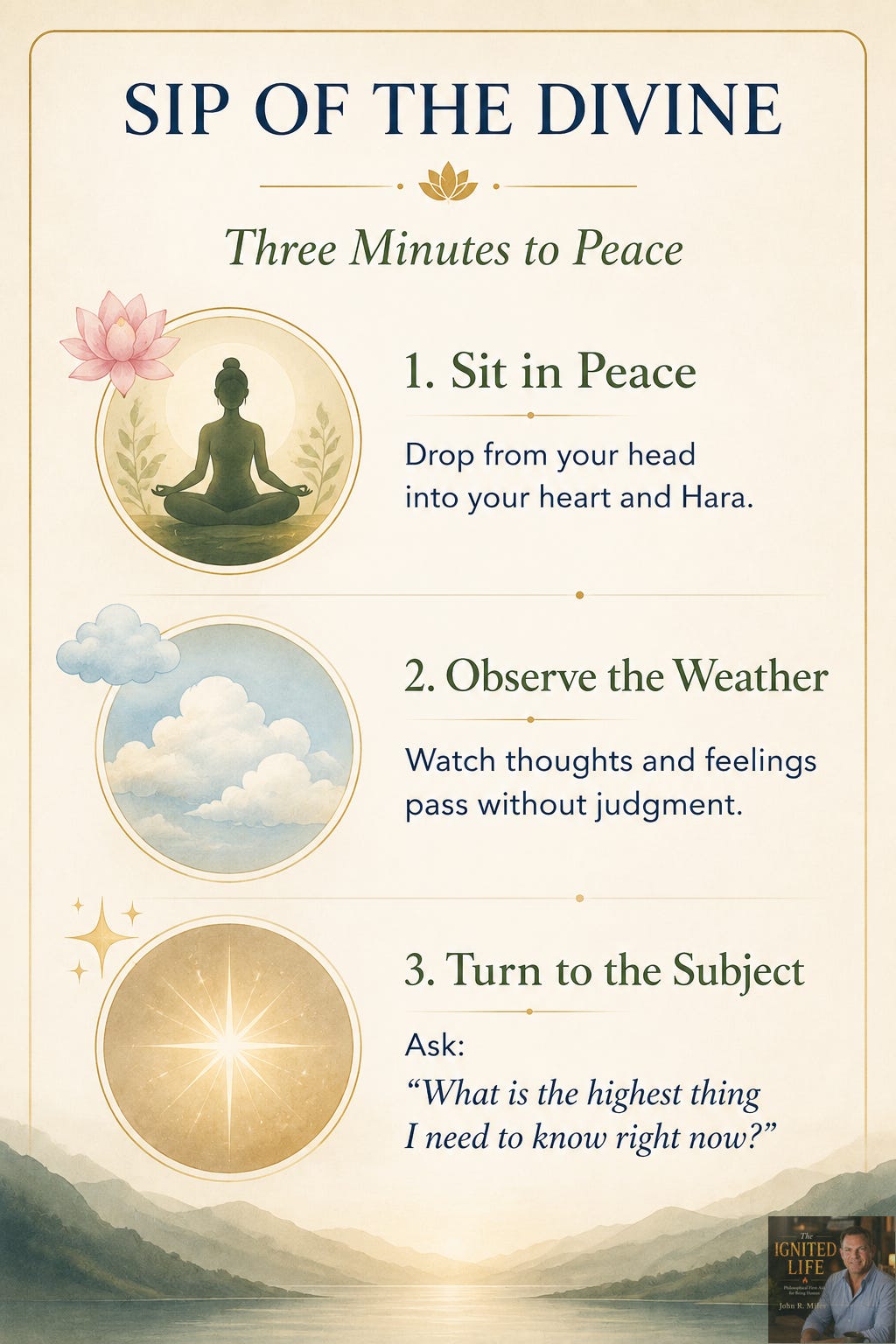
That distinction matters.
The ability to notice our thoughts rather than automatically obey them creates the possibility of choice. It interrupts autopilot. It allows us to recognize that many of the stories governing our lives were inherited, adaptive, and perhaps no longer necessary.
The question shifts from What should I do next? to What assumptions have been directing me all along?
Leadership Beyond Hierarchy
Another aspect of our conversation that has continued to unfold in my thinking concerns leadership.
Suzanne observed that leadership in the military was fundamentally organized around separation—officers and enlisted personnel, chains of command, clearly defined roles and responsibilities. Her understanding of leadership today feels rooted in something far different: interconnectedness and wholeness.
That perspective aligns with ideas I have increasingly embraced in my own work.
For years, I viewed leadership primarily through the lens of execution. Great leaders articulated a vision, drove accountability, and delivered results. Those capabilities remain essential. But experience has convinced me that lasting leadership requires something more nourishing.
I often describe this as gardener leadership.
A gardener cannot force growth. The work involves creating the conditions under which growth becomes possible. You prepare the soil. You provide nourishment. You remove obstacles. You recognize that development follows rhythms that cannot be accelerated through pressure alone.
Human beings operate much the same way.
People flourish when they feel seen, trusted, and connected to something larger than themselves. They grow when given space to experiment, fail, and discover capacities they did not know they possessed. Leadership, at its best, is less about directing people toward predetermined outcomes and more about helping them remember possibilities they have forgotten.
The language of remembering appeared repeatedly throughout my conversation with Suzanne.
Forgiveness as Remembering
Perhaps the most powerful idea she shared was her understanding of forgiveness.
Her daily prayer is simple:
Forgive me for ever thinking I was anything less than love.
What moved me about that statement was its orientation.
The focus is not on condemnation or self-punishment. It rests on the recognition that harmful actions often emerge when we lose contact with our deeper nature. We forget our connection to others. We forget our inherent worth. We forget that fear and scarcity are temporary conditions rather than permanent identities.
I find that framework remarkably useful even outside explicitly spiritual contexts.
Many of the behaviors we regret most originated as attempts to protect ourselves. Perfectionism, overachievement, emotional withdrawal, and people-pleasing often begin as intelligent adaptations to earlier environments. They helped us earn approval, avoid rejection, or create a sense of safety.
The challenge is that strategies designed for one chapter of life frequently persist long after their usefulness has expired.
Forgiveness allows us to acknowledge those patterns without remaining imprisoned by them. It permits gratitude for what once protected us while granting permission to live differently now.
The Questions I’m Carrying Forward
The older I become, the less interested I am in dividing human experience into rigid categories of rational and spiritual, measurable and mysterious.
Life consistently refuses those distinctions.
The most meaningful decisions rarely emerge from analysis alone. Love cannot be quantified. Grief does not follow project plans. Purpose arrives through experimentation, reflection, and moments of insight that often appear uninvited.
The conversation with Suzanne reinforced something I have been slowly learning for years: flourishing requires both competence and contemplation.
We need the ability to build, execute, and contribute meaningfully to the world around us. We also need practices that reconnect us to the parts of ourselves that productivity alone cannot reach.
Without that balance, success risks becoming an endless exercise in external navigation while our inner life remains largely unexplored.
Joining the conversation:
What questions in your life cannot be solved through achievement alone?
Where have you mistaken self-reliance for genuine strength?
What practice helps you listen to forms of wisdom that exist beyond analysis and productivity?
Listen to the full episode featuring Suzanne Giesemann.
Every 🧡, restack, or comment helps this message reach someone who may be discovering that the answers they seek cannot be found solely by moving faster, working harder, or accomplishing more.
© John R. Miles 2026. All rights reserved.