

The Speech Impediment of the Soul
Breaking the performance trap, healing childhood trauma, and reclaiming a worth that doesn’t have to be earned


In my thirties, I sat in the boardrooms of a Fortune 50 company.
I was a former Naval Officer. I had led teams through combat deployments and served as the youngest executive in the company’s history. To anyone looking in, I was the definition of "having it all together."
But inside? I was hiding.
I was a highly decorated, very well-paid ghost.
Every promotion, every successful deployment, every box checked was another attempt to shout over the silence:
‘I matter. Please notice me.’
Let me tell you: Over-achieving is the most socially acceptable way to stay invisible.
The pattern looks like this:
You build a 'massive, impressive life' as a form of emotional camouflage (the relentless career climb, the perfectly curated home, the wall of degrees and certifications). It’s like polishing a trophy so bright that it blinds people to the person actually holding it.
There is a widening chasm between the Public Persona (the XO, the combat veteran, the senior executive) and the Private Reality (the person who feels invisible).
Over-achievement draws applause. Because society rewards the behavior, the pattern is reinforced daily. It’s hard to "heal" a foundation when everyone is busy praising the skyscraper you built on top of it.
It was a high-stakes masquerade ball. The mask was made of gold, and the party never ended.
But the reason I was hiding went back decades.
It started in a basement. With a shattered window.
I was five years old, playing a reckless game of tag. One shove. A split-second of weightlessness. Then the world exploded into shards of glass as I went headfirst through a basement window.
The traumatic brain injury that followed didn’t just leave me with physical pain. It left me with a “speech impediment of the soul.”
Inside my head, my thoughts were vibrant and clear. But when I tried to speak, they emerged garbled and halting.
I became the kid with the black eye patch and a devastating processing lag.
Every day, I had to stand up in front of my class and do the “walk of shame”—crossing a wide-open schoolyard alone to head to a small room for speech therapy.
In that schoolyard, I learned a lie that would dictate the next thirty years: You only count if you can perform.
I became convinced that my presence was a burden, so I made a trade.
I traded my voice for safety.
And eventually, I traded my existence for achievement.
I thought if I won enough boardrooms or led enough missions, the silence would finally go away.
You build a massive, impressive life so that no one—including yourself—looks too closely at the foundation.
That’s when I realized the ‘speech impediment of the soul’ wasn’t gone—it had just learned to wear a suit and tie.
Maybe you do this too?
Maybe your brain has its own heavily bookmarked Validation Folder.
The promotion you chased because you didn’t feel “enough” without it.
The relationship where you’re the constant “fixer” because you’re afraid to just be.
We treat our worth like a debt that has to be paid back every single day.
Here’s why….

There is a psychological phenomenon called the Arrival Fallacy
It’s the illusion that once we reach a certain goal, we will finally be happy and “complete.”
For high-achievers, it’s a trap. We think, “If I get this title, I’ll finally matter.” But when we arrive, the goalposts move.
The “mattering” file in our brain stays open because we are trying to solve an internal problem with an external solution.
My brain was running outdated software.
It was still trying to “fix” the five-year-old in the eye patch by adding more lines to a resume.
But no amount of combat ribbons could heal the boy in the schoolyard.
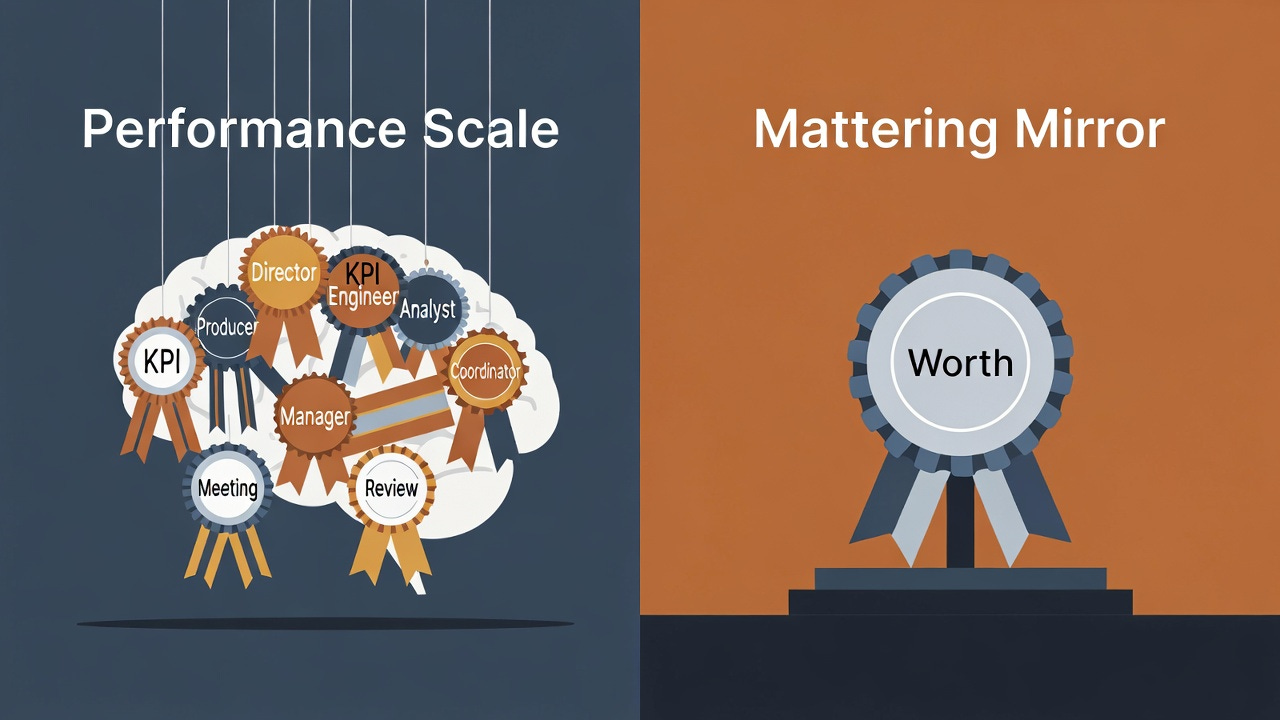
This is where The Silent Weight of the "Humanity Gap" comes in
There is another reason your brain keeps the “Validation Folder” open.
It’s called the Peak-End Rule.
Psychologists found that we don’t remember our lives like a movie; we remember them as a series of snapshots—specifically, the most intense moment (the peak) and how things ended (Peak-End Rule).
For decades, my “peak” was that basement window.
My brain decided that the shattered glass was the headline of my story, and every boardroom win since then was just a footnote.
It didn’t matter that I was leading combat deployments; my internal software was still stuck on the “walk of shame” across the schoolyard.
We become so attached to our “Success Armor” that we forget there is a person underneath it.
We start to believe that if we take off the ribbons or the titles, there’s nothing left to see.
I see this pattern in my coaching clients and podcast listeners all the time.
There’s Mark, who finally landed the C-suite role he spent twenty years chasing. But instead of feeling the peace he expected, he’s working eighty-hour weeks, terrified that if he slows down, his board will realize he doesn’t actually belong there. His brain has completely forgotten the decades of expertise he’s built; it only remembers the fear of being “found out.”
There’s Lisa, who successfully sold her company for millions. But instead of enjoying the freedom, she’s obsessing over a minor deal she “lost” five years ago. She’s convinced that one small setback defines her more than the massive win she’s currently standing on.
Different masks, same face underneath.
They are both trying to use a new achievement to fix an old feeling of invisibility. They are both still walking that wide-open schoolyard in their minds, hoping that if they run fast enough, they’ll finally reach safety.
So how do we recalibrate a brain that is still running on a 30-year-old survival script?
Here are two helpful tools.
1. The Mirror Audit
When you feel the urge to over-perform, stop and ask: “Am I polishing the mirror or looking at the person?”
We spend all our time polishing the mirror of achievement—making sure the titles, the revenue, and the “perfect” life look flawless for the world. Interrupt that.
Look at the human behind the mirror.
Celebrate your curiosity, your resilience, or your presence today—the things that have nothing to do with your “output.”
2. The Luma Shield
This is the tool I created for the next generation, but we can use it, too.
This is why I wrote my new children’s book, You Matter, Luma.
In the story, Luma has to learn that her “spark” isn’t a reward for being the best; it’s a birthright. When you feel the Performance Trap closing in, envision your own “Luma Shield.”
Remind yourself that your worth was settled the moment you were born. The loop is closed.
The order is paid. You don’t have to keep the file open anymore.
We all have these markers in our lives. The things that make the “unresolved files” finally feel worth it.
The podcast guest who told you your show saved their life. An episode that only happened because you spent decades learning how to use your voice again.
The moment of stillness you finally found in your backyard, realizing you don’t need a joint command to be “in charge” of your own peace.
My children’s book, You Matter, Luma. If I hadn’t spent thirty years trying to outrun that kid with the eye patch, I never would have discovered the “preventative medicine” that thousands of families need today.
If I hadn’t been broken, I wouldn’t have known how to help others stay whole.
Your reset button is whatever makes your brain finally go quiet about the “performance” you missed out on… because the path you actually took led to a significance you wouldn’t trade for any boardroom title or combat ribbon.
A New Command
Before we move on, I want you to take a breath and realize something:
You have spent so much energy trying to “fix” a version of yourself that was never actually broken—only injured.
We think that if we reach the next peak, the “eye patch” will finally disappear.
But your worth isn’t waiting for you at the next finish line.
It’s been sitting right there in the silence with you all along.
You don’t need to lead another mission to earn your seat at the table.
You are already the commanding officer of your own significance.
Understanding the arrival fallacy and the Peak-End Rule hasn’t deleted the memory of that schoolyard walk. Those files are still in the system.
But there has been a fundamental shift in where the authority sits.
My brain still occasionally brings up that five-year-old version of me like an overly persistent junior officer presenting a report I’ve already signed off on. In the past, I would let that report dictate the entire mission. I’d scramble to achieve more, win more, and do more just to quiet the noise.
Now? I recognize the report for what it is: outdated intelligence.
I don’t try to “fix” the noise or argue with the memory. I simply acknowledge it and stay on course. It’s not evidence that I’m failing or that I’m still “broken.” It’s just the brain’s legacy software running in the background while I operate from a completely different manual.
The “recalibration” isn’t about making the old thoughts go away.
It’s about stripping them of their power to command your life.
Your turn.
Where does the authority rest in your life today?
What is the “outdated report” your brain keeps trying to hand you, and what would happen if you simply stopped signing off on it?
Share below in the comments area.
I’d love to hear how you are decommissioning your own outdated missions.
And remember:
We all have versions of ourselves that stayed in the "safe" lane…..
The ones who never got hurt, never struggled, and never had to fight for their voice.
But the life you are actually in…
The one built from the shards of glass, the hard-won victories, and the quiet moments of finally being seen for who you are, not just what you can do…
That is the only version of you that was ever meant to exist.
The trade is over. You’ve already arrived.
Listen to the full episode below.
Download the FREE Companion Digital Workbook here.

Ever wish you could go back and tell that younger version of yourself that they didn’t have to perform?
Or wish you could quiet that restless feeling?
The one that keeps your brain looping on everything you haven’t yet achieved?
This is exactly why I wrote You Matter, Luma.
It is more than a children’s book—it is a tool for parents, educators, and high-achievers alike to close the “performance loop” for good. It’s about building a future where our significance isn’t a debt we have to pay, but a truth we get to live.
By pre-ordering today, you aren’t just buying a book; you’re helping us plant this “preventative medicine” in homes and libraries across the country.
[HELP US REACH OUR 300 PRE-ORDER GOAL HERE!]
Thoughts? Let me know below this essay!
Every 🧡, restack, or comment you share here on Substack
is like a signal flare…..
It helps this message find the person who is still walking
their own “schoolyard” alone.
Thank you for being part of this ecosystem.
I love turning these essays into a two-way conversation
So please let me know your thoughts below.
We often carry these weights without knowing where they came from, and your breakdown of childhood trauma versus adult behavior is incredibly clarifying. A must-read for anyone trying to find their voice again.
John, this is so beautiful. What a reflection! There is major personal freedom that comes from this awareness. If you haven't explored the Enneagram, I would encourage you to do so.