

When Did You Stop Being That Person?
Why Adulthood Asks Us to Remember More Than It Asks Us to Improve


A few weeks ago, I found myself doing something I suspect many of us do without realizing its significance. I was looking through old photographs. Most of them passed by quickly, little snapshots of places, people, and moments that now feel strangely compressed by time.
But one photograph stopped me.
There was nothing remarkable about it. No milestone. No achievement. No dramatic event. Yet as I looked at it, I had the unsettling feeling that I was staring at someone I knew intimately and hadn't spoken to in years.
The longer I sat with that feeling, the clearer it became: When did I stop being that person?
Somewhere in the process of building a life, I may have drifted away from myself without ever noticing the distance.
It's an uncomfortable question because it carries another possibility, one many of us spend years avoiding: that the greatest danger in adulthood is not failure. It is becoming extraordinarily competent at being someone we no longer recognize.
The Competence Trap
Our competence is often the very thing that rewrites us.
When we enter an environment, a corporate culture, a family structure, or a professional hierarchy, we instinctively optimize for what that situation rewards. We learn what builds trust, what manages tension, and what moves things forward. We practice being responsible, efficient, and dependable because the situation demands it, and the world cheers for the performance.
Over time, what began as an adaptation quietly hardens into an identity. We become what we repeatedly practice.
I’ve been thinking a lot about this specific trap through the lens of Hook, a film I loved as a young adult, but now understand very differently.
When we first meet Peter Banning, he isn’t in an obvious crisis. He is highly functional. He has built a successful career, supports his family, and occupies the exact kind of life the world applauds. His days are structured by deadlines, his attention is completely fragmented by billable hours, and he is permanently tethered to his gold Rolex. The watch alarms, dictates his focus, and physically separates him from his children. He is a man who has become entirely organized around urgency and utility.
Peter Banning is compelling because his disappearance feels so familiar. He lost himself in a situation that constantly reinforced one identity while quietly starving another.
And we see this everywhere.
The executive who cannot sit through dinner without checking email. The parent who keeps an entire household functioning but cannot remember the last time they experienced unstructured delight. The physician who knows how to care for everyone except herself.
Competence becomes identity because competence is what the environment rewards.
The Geography of Forgetting
We often speak about identity as though it lives entirely inside us, an unchanging core we carry from room to room.
But identity is geographical.
The version of yourself that emerges around childhood friends is not the same version that walks into a quarterly board meeting. One environment rewards tenderness. Another rewards decisiveness. A third rewards self-sufficiency. None of these selves is false. Yet over time, some become practiced while others grow quiet.
Families reward one set of behaviors. Organizations reward another. Friendships sustain certain qualities while neglecting others. The environments we inhabit begin selecting which parts of us survive and which go dormant.
The environments that help us succeed are not always the environments that help us remember ourselves. Success is the reward for adapting to a situation. Flourishing requires asking whether that situation still deserves your loyalty.
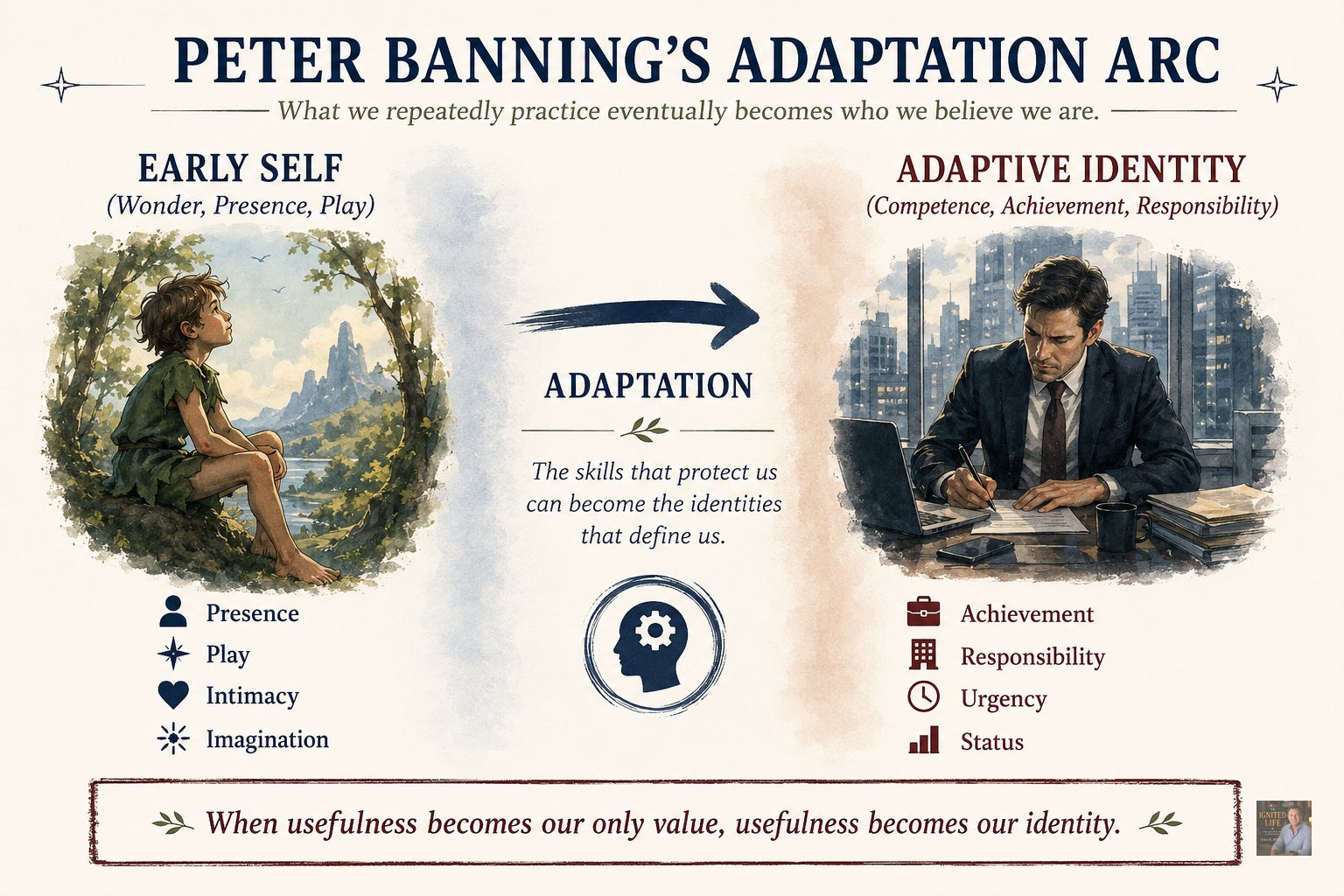
When our situations require only our usefulness, that usefulness becomes our entire identity.
Over years of reinforcing the ways of being our professional environments reward, play, wonder, and presence cease to make sense to our internal systems. The external structures remain intact, but the inner life begins to thin.
We continue executing. We continue producing. We continue succeeding.
And slowly, we disappear from our own story.
The Relational Mirror
The unsettling aspect of the competence trap is that we cannot think our way out of our own armor. Our self-narrative is too warped by the scripts we’ve been practicing. We cannot simply sit in a sterile boardroom, review our past, and magically regain our essence.
We need an interruption.
In Hook, Peter is failing miserably to find his way back to himself. He is angry, constrained by his suit, demanding corporate logic in a world that no longer recognizes it.
Then one of the youngest Lost Boys, Pockets, approaches him.
The child grabs Peter’s face, pulls at his features, peers directly into his eyes, and quietly says:
“Oh, there you are, Peter.”
The boy recognizes something Peter himself cannot access.
That scene has stayed with me because it reflects a profound truth about human development: we do not come to know ourselves in isolation.
A friend notices the deep fatigue beneath our competence. A mentor sees possibilities where we see only heavy responsibility. Someone who loves us says, "You haven't been yourself lately."
The painful part is that we often disagree.
We have become so identified with the adaptations that sustained us that we mistake them for our essence.
Yet these relationships matter precisely because they interrupt the expectations of our current environments. They act as mirrors, reflecting back qualities we buried beneath years of necessity.
Character and context are deeply intertwined. Who we become depends, in part, on who calls us forth.
The Ecology of Selfhood
What Peter remembers in Neverland is not simply who he was. He remembers the conditions under which certain parts of himself once made sense.
As children, most of us live in environments where curiosity carries value of its own. Play is not a break from life; it is life. Attention moves more slowly. Time feels expansive. The qualities that help us belong are often wonder, imagination, and presence.
Adulthood reorganizes those incentives. We enter institutions that reward reliability, urgency, and measurable contribution. We learn to anticipate needs, solve problems, and become useful to the people who depend on us. None of this is wrong. In many ways, it is what maturity requires.
But every environment selects for something.
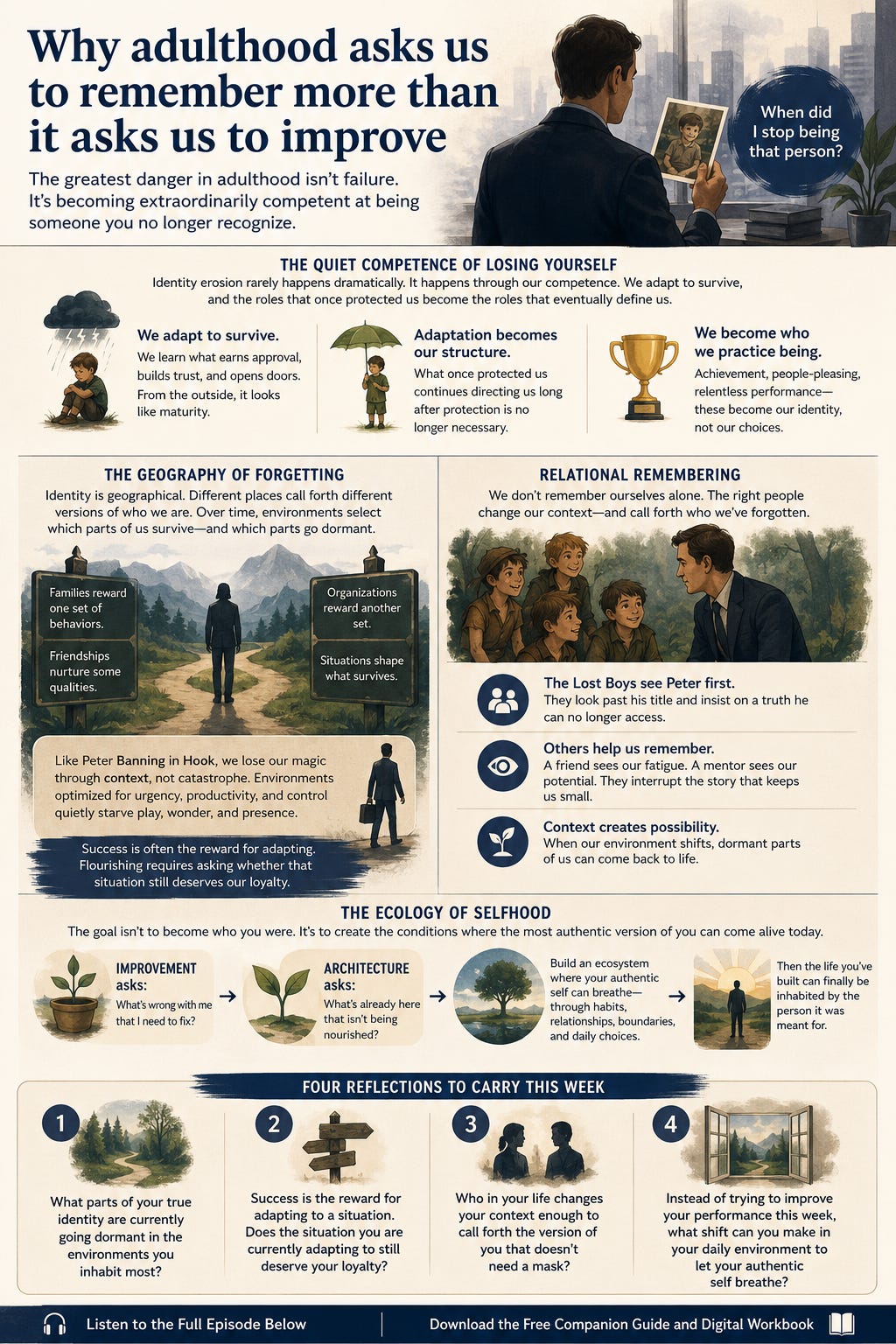
The habits that make us effective in one season of life can quietly crowd out capacities that once felt essential. Not because they disappear, but because we stop exercising them. A musician who spends years managing a company may still love music, yet find that the impulse to sit down and play no longer arrives naturally. A parent who expertly coordinates the needs of an entire household may realize that delight has become something planned rather than something encountered.
The environments that help us succeed are not always the ones that help us remain fully alive to ourselves.
That, I think, is what changes when Peter returns home.
He does not reject adulthood, nor does he remain in Neverland. He goes back to the same family, the same obligations, and the same ordinary realities he left behind. The difference is subtler than transformation. He no longer treats responsibility as the only legitimate way of being in the world.
He remembers that love requires presence as much as provision, and that usefulness is only one dimension of a life.
The task, then, is not to become the person you once were.
The child in the photograph belonged to a different moment, with different freedoms and different constraints. Memory can illuminate the path forward, but it cannot become a destination.
Perhaps the more important question is this: What conditions allow the best parts of you to remain in conversation with one another?
Not only the part that accomplishes, but the part that notices. Not only the part that provides, but the part that delights. Not only the part that carries responsibility, but the part that still knows how to wonder.
Adulthood asks us to hold those dimensions together rather than sacrificing one in service of the other.
The Work of Remembering
The work of remembering is an act of internal architecture.
We start to notice the environments we move through each day and the behaviors they reward. We recognize that some versions of ourselves emerged not from conscious choice but from repetition and necessity. We became dependable because dependability was needed. We became productive because productivity created security. We learned to anticipate, organize, and perform because those capacities served us well.
There is dignity in those adaptations.
The danger comes when we forget that they are adaptations at all.
For some people, remembering may mean protecting time that has no productive purpose. For others, it may mean returning to relationships in which older, less-defended versions of themselves still emerge naturally. Sometimes it means paying attention to the activities that make time feel different—slower, wider, less transactional.
The work is rarely about tearing down a life and beginning again. It is about noticing what the life we have built asks us to practice every day, and deciding whether those practices are shaping us in ways we can wholeheartedly claim.

Four reflections to carry this week:
What parts of your true identity are currently going dormant in the environments you inhabit most?
Success is the reward for adapting to a situation. Does the situation you are currently adapting to still deserve your loyalty?
Who in your life changes your context enough to call forth the version of you that doesn’t need a mask?
Instead of trying to improve your performance this week, what shift can you make in your daily environment to let your authentic self breathe?
Listen to the Full Episode Below
Download the Free Companion Guide and Digital Workbook
Every 🧡, restack, or comment helps this message reach someone who may be successful on the outside and quietly wondering why they still feel far from themselves.
© John R. Miles 2026. All rights reserved.