

Why Your 2026 Should Be Smaller, Not Bigger
Our brains were built for a village of 150, not a world of 8 billion. It’s time for the "Dunbar Reset."


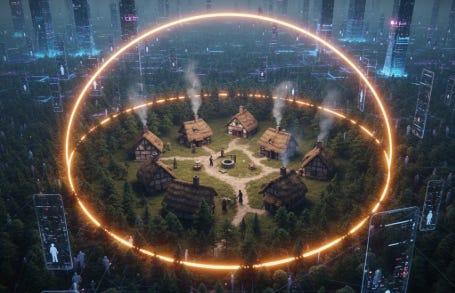
Imagine stepping into a small medieval English village on a crisp autumn morning. Smoke rises gently from thatched roofs. The blacksmith greets the baker by name as they pass the village well. Children laugh as they chase chickens across the green. Every face is familiar. Every story is shared. The entire community numbers exactly 148 people, a size that feels complete without ever feeling crowded.
Thousands of miles and centuries away, an Amish community in Ohio gathers after Sunday service. Families linger over shared meals, conversations flowing easily because everyone truly knows one another. When the group approaches 150 members, they do not celebrate expansion. They prepare to divide, preserving the intimacy that defines their way of life.
Deep in the Amazon rainforest, a Yanomami band moves through the forest with quiet confidence. Hunters return with the day’s catch. Elders tell stories around the fire. Relationships are layered and clear, binding the group together at roughly 150 individuals.
These moments, separated by time and geography, point to the same invisible boundary in the human mind.
The Discovery of Dunbar’s Number
In the early 1990s, British anthropologist Robin Dunbar observed something interesting while studying primates. The size of a species’ social group correlated almost perfectly with the size of its neocortex, the brain region responsible for complex cognition and social behavior.
Plot the data for monkeys, apes, and finally humans, and a clear pattern emerged. For us, the cognitive ceiling sits at roughly 150 stable relationships, the number where we can know who each person is, how they relate to everyone else, and maintain genuine trust.
Dunbar didn’t invent this limit. He uncovered it. And it’s everywhere once you look: ancient clans, military units (Roman centuries hovered around 150), even the Christmas card lists of ordinary British families clustering around 150.
Modern Evidence from Six Billion Calls
Dunbar’s prediction has held up remarkably well. In 2007, before smartphones and social media dominated interaction, researchers analyzed six billion mobile calls from 35 million people in Europe. Filtering for reciprocal social calls, they found the average person maintained meaningful contact with about 130 others, strikingly close to 150.
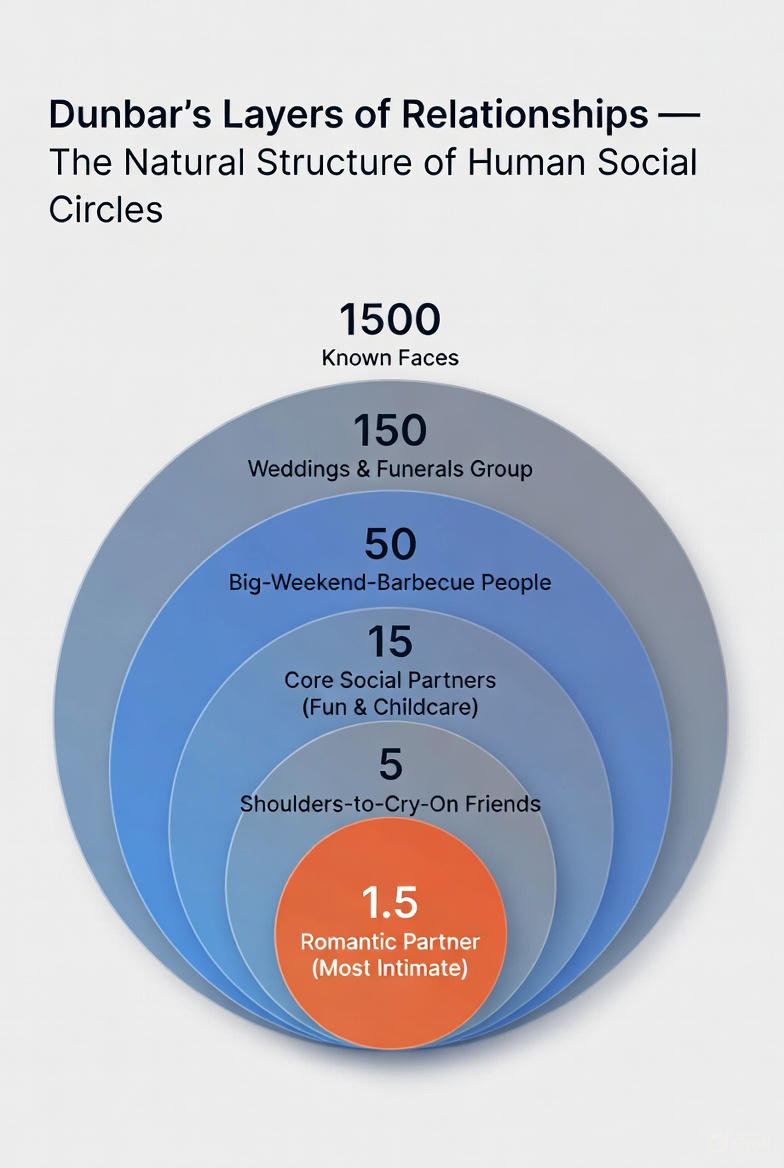
More revealing: clustering by call frequency revealed clear layers of emotional closeness averaging 4, 11, 30, and 129 people, aligning almost exactly with Dunbar’s proposed structure of 5 intimate ties, 15 close friends, 50 good friends, and 150 total meaningful relationships.
This wasn’t theoretical. It emerged from real human behavior at scale.
Even the most connected individuals rarely exceeded these bounds in sustained, reciprocal contact. The data suggests our brains enforce the limit not through conscious choice, but through natural patterns of attention and energy.
In our era of infinite digital reach, these findings become even more poignant. We can “follow” thousands, but we still communicate deeply with roughly the same village-sized circle our ancestors did.
The Hidden Cost of Living Beyond Our Limits
Our brains are not designed for billions. They’re intended for villages. In a group of 150, conflicts are resolved face-to-face. Cooperation feels natural. Empathy flows easily because everyone matters for survival.
Scale that to eight billion, and something breaks. The brain, unable to track genuine relationships at that size, defaults to shortcuts: stereotypes, tribes, us-versus-them thinking. Strangers become threats. Distant suffering becomes overwhelming or numb.
This isn’t a moral failing. It’s a mismatch. We’re asking Stone Age hardware to run a global operating system.
The symptoms are familiar: chronic low-level anxiety from endless notifications, compassion fatigue from 24-hour news, polarization from algorithmic outrage, burnout from trying to matter to too many people at once.
Biologist Paul Ehrlich has long described humans as “small-group animals” suddenly living in gigantic societies. This evolutionary legacy makes large-scale cooperation difficult, thereby fueling polarization, burnout, and our reluctance to confront shared threats such as biodiversity loss.
Ehrlich points out that our tribal instincts prioritize fitting in over truth-telling, making honest discussions about overpopulation and consumption rare. The strain is evident in rising anxiety from constant connectivity and in compassion fatigue from global crises.
We feel isolated in crowds because, neurologically, we are.
The Quiet Power of Shrinking Back
Here’s the insight that changes everything: Thriving isn’t about expanding your circle. It’s about honoring its natural size.
The most compelling real-world proof comes from W. L. Gore & Associates, the company behind Gore-Tex. Founder Bill Gore discovered through trial and error that when a plant exceeded approximately 150 to 200 employees, outcomes deteriorated.
Below that threshold, people spoke of decisions as “we.” Above it, they began saying “they,” signaling a loss of personal agency and the rise of faceless bureaucracy. Everyone knew everyone’s name, role, and face. Informal communication flowed freely. The lifeblood of innovation in Gore’s flat “lattice” structure, where there are no bosses, only leaders who earn followership through respect.
Once the group grew larger, social grooming, the natural peer pressure of a small tribe, no longer sufficed. Rules, handbooks, and middle management became necessary. Creativity suffered.
Gore’s solution was radical: get big by staying small. When a facility approached its capacity limit, the company split it, sometimes by building a new plant next door, to preserve intimacy, trust, and self-management.
Decades later, this “Rule of 150” remains core to Gore’s culture. It has helped them consistently rank on Fortune’s “100 Best Companies to Work For” list while fostering breakthrough innovation.
When companies like Gore-Tex keep teams under 150 people, innovation and morale soar. When communities stay small, trust deepens. When individuals focus on their true 150, life feels richer, not smaller.
Shrinking your world isn’t retreat. It’s alignment. Energy once scattered across superficial ties returns to depth, deeper conversations, deeper impact, and more profound peace.
History’s most creative eras often happened at this scale: Renaissance workshops, early scientific societies, startup garages. Intimacy breeds boldness. Breadth breeds distraction.
Making 2026 the Year of the Dunbar Number 150
In 2026, the most powerful choice we can make may be the simplest: return to a human scale.
Begin by mapping your true circles. Identify the five people closest to your heart, the fifteen you trust deeply, the fifty you genuinely enjoy, and the full 150 you meaningfully know. Then gently release the energy spent on distant outrage, performative relationships, and the illusion of global belonging.
What remains is space. Space for presence with those who truly see you. Space for conversations that matter. Space for impact that lasts because it starts close to home.
The Profound Promise of a Smaller World
Dunbar’s number offers more than an interesting fact. It offers permission. Permission to stop measuring success by reach and begin measuring it by resonance. Permission to choose depth over breadth. Permission to build a life that feels sustainable because it matches the architecture of our minds.
In a year that will tempt us toward bigger goals and louder voices, the quietest revolution may be this:
coming home to the size of community our brains have always understood as home.
Not to withdraw from the world, but to engage it from a place of authentic strength.
A smaller world is not a lesser one. It is the one for which we were built. What will you release this year to make space for your true 150?
Listen to the full exploration in Passion Struck Episode 711.
Download the free Tribe Mapping Workbook, practical prompts to identify your 150 and build belonging:
Pre-order You Matter, Luma (launching February 24), a children’s story about being truly seen in your circle.
To a smaller, deeper, more human 2026.
Smiling as I read your reply. I didn’t want to offend vegetarian readers, so I left the smell vague. But in my head it was roasted pig, like at a London market. Funny thing is, this little poem came to me before I saw your comment, and it kinda answers:
writers write
dancers dance
friends connect
find your community
I discovered dance by accident and have found deep connections withib small, safe containers. Looks like I'm starting to find a writers community here, also unexpectedly;)
Loved the opening scene — I could practically smell the food cooking in the open air. Such a great concept, backed by science and history. So true.